Complex Figures / Composite Shapes
By the end of this lesson, you’ll be able to:
- Break composite shapes into simpler geometric figures.
- Compute the area of combined figures.
- Find areas involving cut-outs or missing regions.
- Compute the perimeter of composite shapes.
- Identify hidden rectangles and right triangles.
- Use previous geometry skills to find missing measurements.
Key Ideas
A composite shape is a figure made from two or more basic shapes, such as:
- rectangles
- triangles
- squares
- circles or semicircles
Complex-looking figures can often be made much easier by breaking them into familiar pieces.
A useful strategy is:
- Break apart the figure into simpler shapes.
- Find any missing measurements you need.
- Compute the area or perimeter of each relevant part.
- Add or subtract depending on how the figure is constructed.
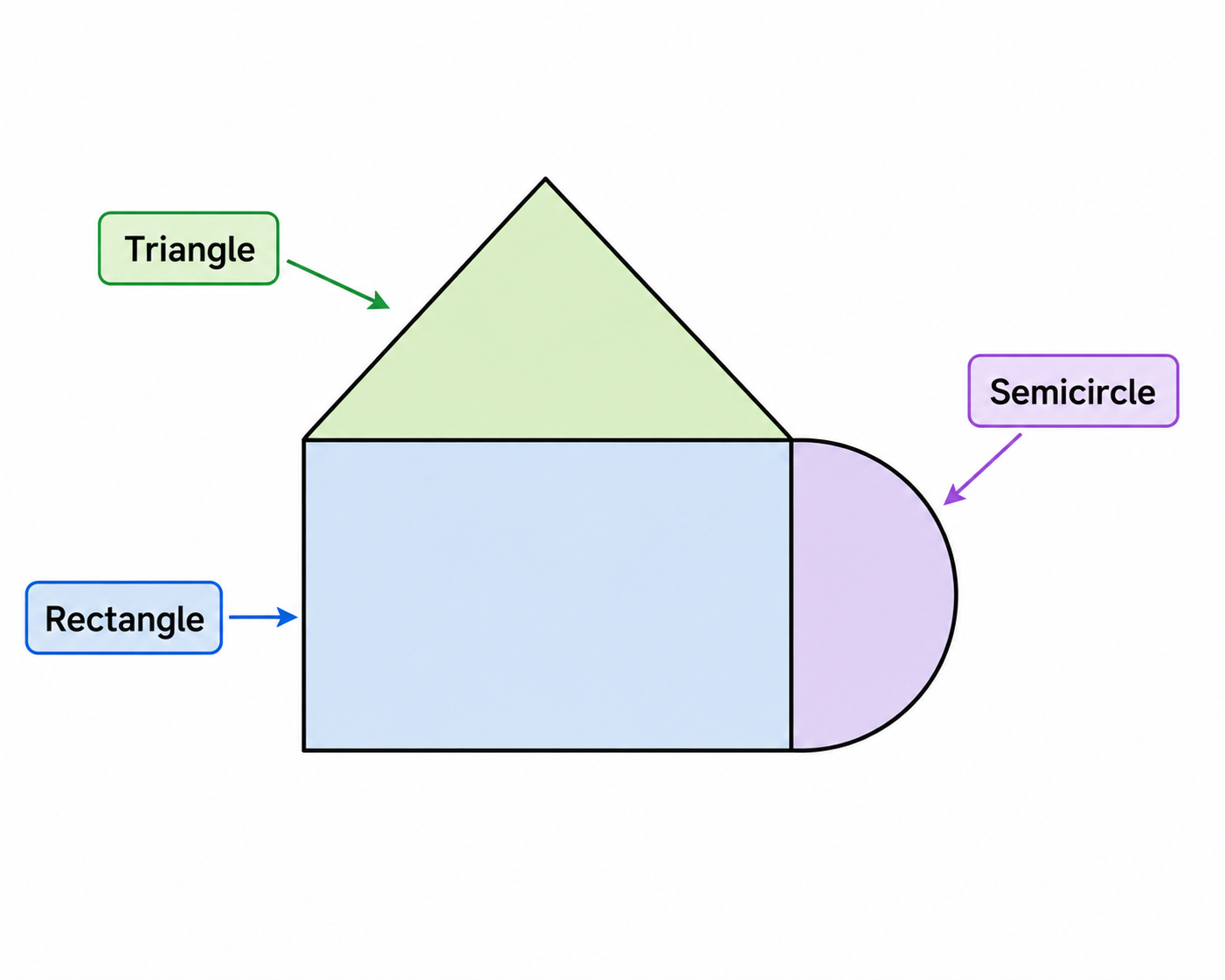
Area measures the space inside a figure, so you may need to add or subtract the areas of several pieces.
Perimeter measures the distance around the outside of a figure, so only the outer boundary counts.
Common Problem Types
1. Splitting a Shape Into Simpler Parts
Many composite figures can be divided into rectangles, triangles, or other familiar shapes.
For example, an L-shaped figure can often be divided into two rectangles.
Find the area of each rectangle separately:
\[ A_1=l_1w_1 \]
\[ A_2=l_2w_2 \]
Then add:
\[ A_{\text{total}}=A_1+A_2 \]
There may be more than one correct way to divide the same figure.
2. Area With a Cut-Out
Sometimes it is easier to imagine the figure as one large shape with a smaller piece removed.
In that case:
\[ A_{\text{composite}} = A_{\text{large shape}} - A_{\text{cut-out}} \]
For example, if a large rectangle has area \(80\) square units and a rectangular piece with area \(20\) square units is removed:
\[ A=80-20 \]
\[ A=60 \]
So the remaining area is:
\[ \boxed{60\text{ square units}} \]
3. Combining Different Shapes
A composite figure may contain different types of shapes.
Suppose a figure consists of a rectangle and a triangle.
Find each area separately:
\[ A_{\text{rectangle}}=lw \]
and:
\[ A_{\text{triangle}}=\frac12 bh \]
Then add them:
\[ A_{\text{total}} = A_{\text{rectangle}} + A_{\text{triangle}} \]
The same idea works with circles, semicircles, and other familiar shapes.
4. Finding Missing Measurements
Not every length needed to solve a composite-shape problem will always be labeled.
Sometimes you can find a missing length by:
- subtracting known lengths from a total length
- using properties of rectangles
- using the Pythagorean Theorem
- using similar triangles
For example, a diagonal across a rectangle with side lengths 6 and 8 creates a right triangle.
The diagonal \(d\) is the hypotenuse:
\[ 6^2+8^2=d^2 \]
\[ 36+64=d^2 \]
\[ 100=d^2 \]
\[ d=10 \]
5. Perimeter of a Composite Shape
For perimeter, trace only the outside boundary of the figure.
Do not include lines that divide the figure into smaller shapes.
For example, suppose two rectangles share a side. That shared side lies inside the combined figure, so it is not part of the perimeter.
Add only the exposed outer edges:
\[ P=s_1+s_2+s_3+\cdots \]
A useful technique is to start at one corner and trace around the entire figure until you return to your starting point.
6. Real-World Composite Shapes
Composite geometry often appears in real-world problems involving:
- floorplans
- gardens
- patios
- walls
- packaging
- irregular plots of land
The same strategy applies: break the complicated figure into familiar pieces before calculating.
Strategies
- Decide first whether the problem asks for area or perimeter.
- Draw dividing lines to create rectangles, triangles, or other familiar shapes.
- Label all known measurements before calculating.
- Look for missing lengths that can be found by subtraction.
- Remember that opposite sides of a rectangle have equal lengths.
- Use the Pythagorean Theorem when a diagonal creates a right triangle.
- For area, add pieces or subtract cut-outs.
- For perimeter, trace only the outer boundary.
- Do not count an interior dividing line as part of the perimeter.
- Keep track of units: area uses square units, while perimeter uses ordinary units.
Worked Examples
Example 1 — Adding Areas
A composite figure consists of a \(10\times6\) rectangle and a right triangle with base 8 and height 6.
Find the total area.
First find the rectangle’s area:
\[ A_{\text{rectangle}}=lw \]
\[ A_{\text{rectangle}}=(10)(6)=60 \]
Now find the triangle’s area:
\[ A_{\text{triangle}}=\frac12 bh \]
\[ A_{\text{triangle}}=\frac12(8)(6) \]
\[ A_{\text{triangle}}=24 \]
Add the two areas:
\[ A_{\text{total}}=60+24 \]
\[ A_{\text{total}}=84 \]
Therefore:
\[ \boxed{84\text{ square units}} \]
Example 2 — Subtracting a Cut-Out
A large rectangle has an area of 72 square units. A rectangular section with an area of 18 square units is removed.
Find the area of the remaining figure.
Because part of the larger shape has been removed, subtract:
\[ A_{\text{remaining}} = A_{\text{large}} - A_{\text{cut-out}} \]
Substitute:
\[ A_{\text{remaining}}=72-18 \]
\[ A_{\text{remaining}}=54 \]
Therefore:
\[ \boxed{54\text{ square units}} \]
Example 3 — Finding a Missing Length
A rectangle has side lengths 6 and 8. A diagonal is drawn across the rectangle. Find the length of the diagonal.
The sides and diagonal form a right triangle.
The diagonal is the hypotenuse, so use the Pythagorean Theorem:
\[ a^2+b^2=c^2 \]
Substitute:
\[ 6^2+8^2=c^2 \]
\[ 36+64=c^2 \]
\[ 100=c^2 \]
Take the square root:
\[ c=10 \]
Therefore:
\[ \boxed{10} \]
Example 4 — Composite Perimeter
A \(10\times6\) rectangle has a \(4\times2\) rectangular section cut out of one corner.
Find the perimeter of the remaining L-shaped figure.
For perimeter, trace around the outer boundary of the new figure.
The cut-out removes portions of two original sides, but it also creates two new boundary edges.
The boundary lengths are:
\[ 10,\quad 4,\quad 4,\quad 2,\quad 6,\quad 6 \]
Add them:
\[ P=10+4+4+2+6+6 \]
\[ P=32 \]
Therefore:
\[ \boxed{P=32\text{ units}} \]
Notice that the original rectangle also had perimeter:
\[ 2(10)+2(6)=32 \]
In this particular corner cut-out, the perimeter happens to stay the same because the removed boundary lengths are replaced by equal-length new boundary segments.
- Adding areas when a region should be subtracted.
- Forgetting to subtract a cut-out.
- Counting interior dividing lines as part of the perimeter.
- Leaving out new boundary edges created by a cut-out.
- Using the wrong base or height for a triangle.
- Forgetting that a triangle’s height must be perpendicular to its base.
- Ignoring right triangles created by diagonals.
- Mixing perimeter units with square units used for area.
Practice Problems
A composite figure consists of a \(12\times5\) rectangle and a triangle with base 12 and perpendicular height 4. Find the total area.
A diagonal is drawn across a \(9\times12\) rectangle. Find the length of the diagonal.
A large rectangle has an area of 50 square units. A smaller region with an area of 12 square units is cut out. Find the remaining area.
A \(10\times8\) rectangle has a \(3\times2\) rectangular section removed from one corner. Find the perimeter of the remaining L-shaped figure.
1. First find the area of the rectangle:
\[ A_{\text{rectangle}}=lw \]
\[ A_{\text{rectangle}}=(12)(5)=60 \]
Now find the area of the triangle:
\[ A_{\text{triangle}}=\frac12 bh \]
\[ A_{\text{triangle}}=\frac12(12)(4) \]
\[ A_{\text{triangle}}=24 \]
Add the two areas:
\[ A_{\text{total}}=60+24 \]
\[ \boxed{A_{\text{total}}=84\text{ square units}} \]
2. The rectangle’s diagonal creates a right triangle with legs 9 and 12.
Use the Pythagorean Theorem:
\[ 9^2+12^2=d^2 \]
\[ 81+144=d^2 \]
\[ 225=d^2 \]
Take the square root:
\[ d=15 \]
Therefore:
\[ \boxed{15} \]
3. The smaller region is a cut-out, so subtract its area from the area of the larger rectangle:
\[ A_{\text{remaining}} = A_{\text{large}} - A_{\text{cut-out}} \]
\[ A_{\text{remaining}}=50-12 \]
\[ \boxed{A_{\text{remaining}}=38\text{ square units}} \]
4. Start with the perimeter of the original \(10\times8\) rectangle:
\[ P=2(10)+2(8) \]
\[ P=36 \]
The \(3\times2\) corner cut-out removes 3 units and 2 units from the original outside boundary.
But it also creates new boundary edges of exactly 3 units and 2 units.
So the total perimeter does not change:
\[ P=36 \]
Therefore:
\[ \boxed{36\text{ units}} \]
Summary
- Break composite figures into familiar shapes.
- For combined areas, find the area of each piece and add.
- For cut-outs, find the larger area and subtract the missing region.
- Use previous geometry skills to find missing measurements.
- For perimeter, count only the outer boundary.
- Interior dividing lines do not count toward perimeter.
- Area is measured in square units; perimeter is measured in units.
- Area: think inside the figure.
- Perimeter: trace around the figure.
- Break complicated shapes into rectangles and triangles whenever possible.
- For cut-outs: big area − missing area.
- Look for hidden right triangles and familiar Pythagorean triples.
- Before calculating perimeter, trace the boundary with your finger or pencil.