Writing Linear Equations From Graphs
By the end of this lesson, you’ll be able to:
- Extract slope and y-intercept directly from a graph.
- Determine slope from two clear points on a graph.
- Write the linear equation of a graphed line in slope-intercept form.
Key Ideas
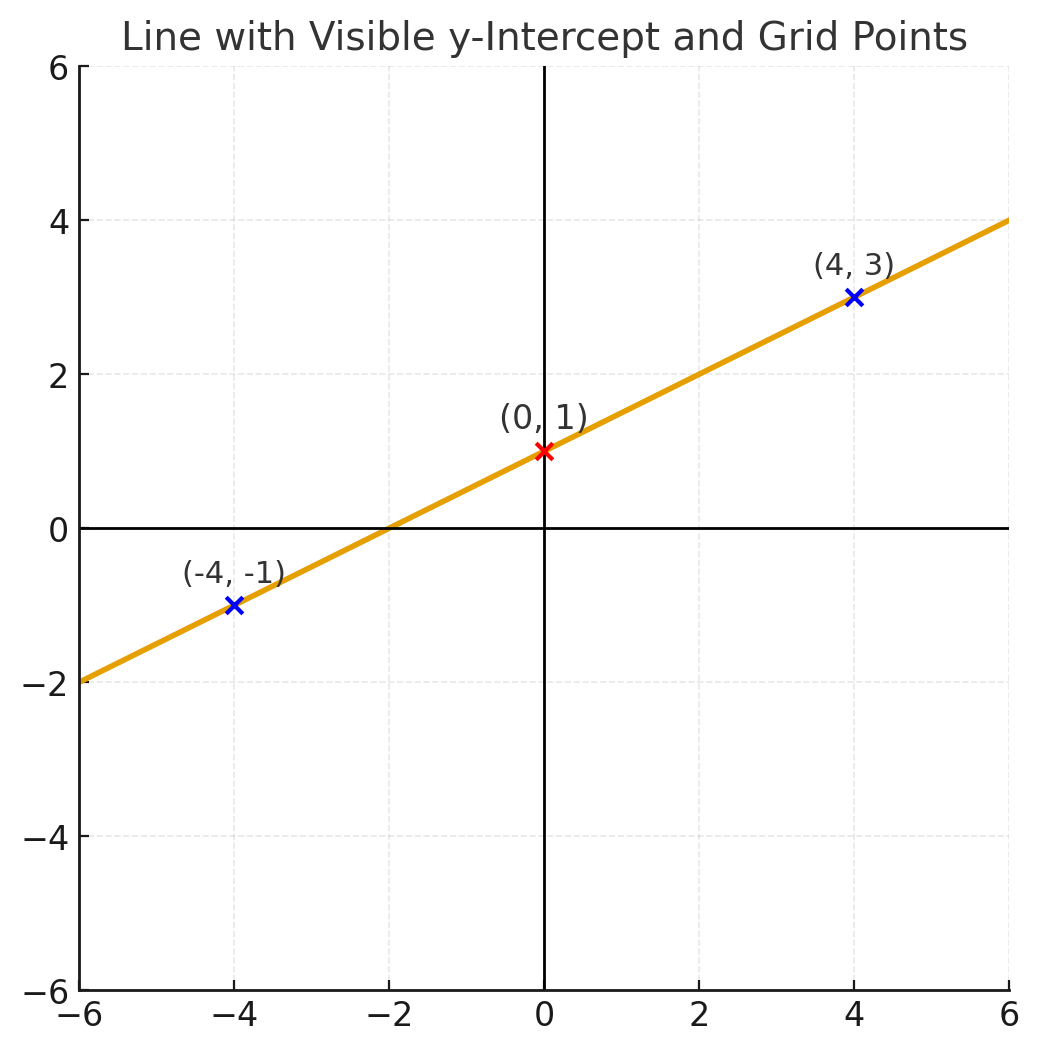
There are two main strategies for writing the equation of a line from a graph.
1. Use slope and y-intercept
If the graph clearly shows:
- where the line crosses the y-axis → this gives \(b\)
- any two points you can use to count rise/run → this gives \(m\)
Then substitute into:
\[ y = mx + b \]
2. Use two points on the line
If the intercept is unclear, choose any two visible points and compute slope:
\[ m = \frac{y_2 - y_1}{x_2 - x_1} \]
Then plug into point-slope or slope-intercept form to find \(b\).
Common Problem Types
1. Equation from slope and intercept
You can read \(b\) directly from the graph.
Then use rise/run between two grid points to get \(m\).
2. Equation from two points on the graph
Pick any two clean points, compute slope, then use \(y = mx + b\).
3. Equation when line slopes downward
Negative slopes are common—make sure you count down for rise when appropriate.
Strategies
- Start by identifying exact lattice points (points with integer coordinates).
- If the line rises as it moves right → slope is positive; if it falls → negative.
- Use a second point far from the intercept to avoid small counting mistakes.
- Always verify your equation by plugging one point back in.
Worked Examples
Example 1 — Using slope & intercept
A graph shows a line crossing the y-axis at \(-2\) and passing through \((3, 4)\).
Step 1: Identify intercept
\[
b = -2
\]
Step 2: Compute slope
\[ m = \frac{4 - (-2)}{3 - 0} = \frac{6}{3} = 2 \]
Step 3: Write equation
\[ y = 2x - 2 \]
Example 2 — Using two points
A graph shows points \((1, 1)\) and \((5, 9)\).
Step 1: Compute slope
\[ m = \frac{9 - 1}{5 - 1} = \frac{8}{4} = 2 \]
Step 2: Find intercept
Plug \((1,1)\) into \(y = mx + b\):
\[ 1 = 2(1) + b \Rightarrow b = -1 \]
Step 3: Equation
\[ y = 2x - 1 \]
- Reading the y-intercept off the x-axis.
- Counting slope as run/rise rather than rise/run.
- Using two points but mixing the order of subtraction.
- Forgetting that a downward slope is negative.
Practice Problems
For each situation, write the linear equation.
- A line has slope \(-1\) and y-intercept \(3\).
- A line passes through \((0, -2)\) and \((3, 4)\).
- A line passes through \((2, -3)\) and \((6, 5)\).
- A line on a graph crosses the y-axis at \(5\) and goes through \((4, 1)\).
- A line rises 2 for every 3 units right and passes through \((1, 4)\).
1.
\[
y = -x + 3
\]
2.
Slope:
\[
m = \frac{4 - (-2)}{3 - 0} = 2
\]
Equation:
\[
y = 2x - 2
\]
3.
\[
m = \frac{5 - (-3)}{6 - 2} = \frac{8}{4} = 2
\Rightarrow y = 2x - 7
\]
4.
Slope:
\[
m = \frac{1 - 5}{4 - 0} = -1
\]
Equation:
\[
y = -x + 5
\]
5.
Slope = \(\frac{2}{3}\)
Use point \((1,4)\):
\[
4 = \frac{2}{3}(1) + b \Rightarrow b = \frac{10}{3}
\]
Equation:
\[
y = \frac{2}{3}x + \frac{10}{3}
\]
Summary
- Use slope and intercept when the graph makes them obvious.
- If not, use any two points and compute slope.
- Substitute into \(y = mx + b\) and check with a point.
- Count slope using large, easy-to-read steps on the graph grid.
- If intercept is messy, switch to the two-point method.
- Always write slope as a fraction when graphing.