Tangent Lines
By the end of this lesson, you’ll be able to:
- Identify tangent and secant lines in circle diagrams.
- Use the radius–tangent perpendicularity rule.
- Use the Pythagorean Theorem with tangent lines.
- Apply the tangent–tangent theorem.
- Apply the tangent–secant theorem to find missing lengths.
Key Ideas
Tangent Line
A tangent line touches a circle at exactly one point.
That point is called the point of tangency.
Secant Line
A secant line passes through a circle and intersects it at two points.
The distinction matters because tangent and secant segments follow different geometric relationships.
Radius–Tangent Perpendicularity
A radius drawn to the point of tangency is always perpendicular to the tangent line.
\[ \boxed{\text{radius}\perp\text{tangent}} \]
Therefore, the angle formed by the radius and tangent at the point of tangency is:
\[ 90^\circ \]
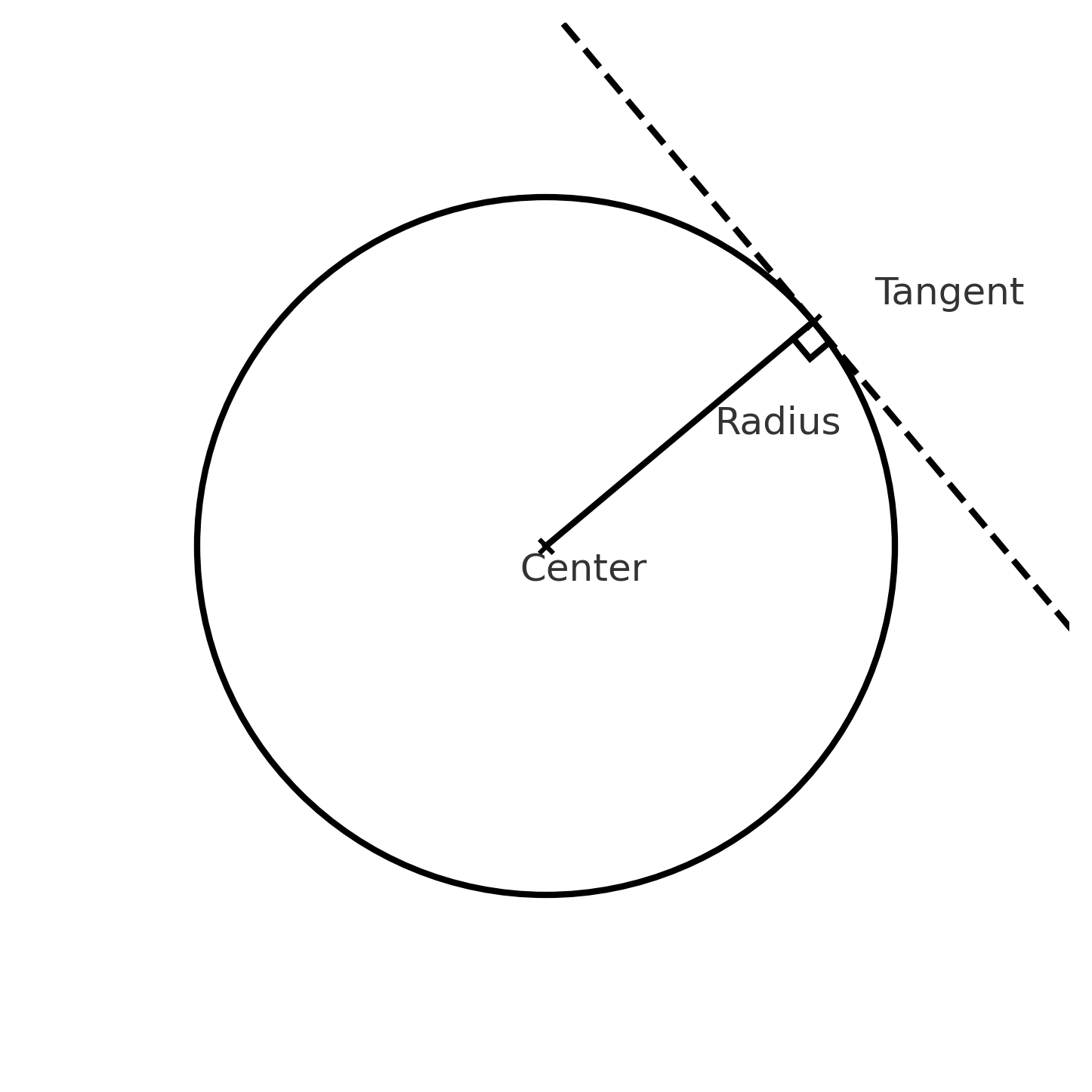
This often creates a right triangle, allowing you to use the Pythagorean Theorem.
Tangent–Tangent Theorem
If two tangent segments are drawn from the same external point to a circle, their lengths are equal.
If \(PA\) and \(PB\) are tangent segments from the same external point \(P\), then:
\[ \boxed{PA=PB} \]
Tangent–Secant Theorem
Suppose a tangent and a secant are drawn from the same point outside a circle.
Then:
\[ \boxed{ (\text{tangent})^2 = (\text{external secant})(\text{whole secant}) } \]
In symbols:
\[ t^2=e(e+i) \]
where:
- \(t\) = tangent length
- \(e\) = external portion of the secant
- \(i\) = portion of the secant inside the circle
- \(e+i\) = entire secant length
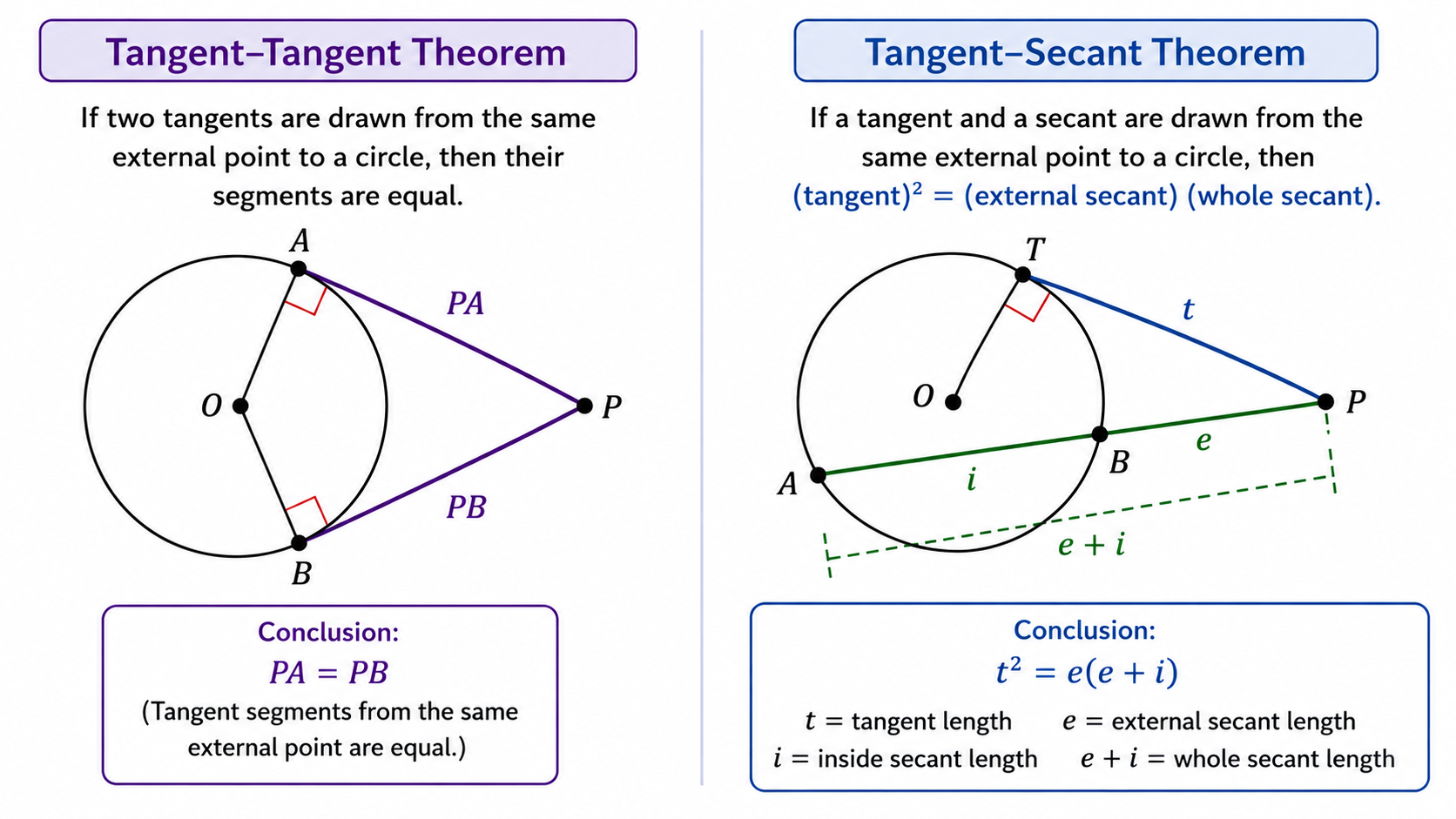
In the tangent–secant formula, do not multiply the external part by only the inside part.
Use:
\[ (\text{external})(\text{whole}) \]
where:
\[ \text{whole}=\text{external}+\text{inside} \]
Common Problem Types
1. Using Radius–Tangent Perpendicularity
When you see a radius drawn to a point of tangency, immediately recognize a right angle:
\[ 90^\circ \]
This often creates a right triangle involving:
- the radius,
- the tangent segment, and
- the distance from the center to the external point.
2. Finding a Tangent Length
Suppose:
- the radius is 5,
- the distance from the center to an external point is 13,
- the tangent length is \(x\).
Because the radius and tangent are perpendicular, they form the legs of a right triangle.
The center-to-external-point segment is the hypotenuse.
Use the Pythagorean Theorem:
\[ 5^2+x^2=13^2 \]
\[ 25+x^2=169 \]
Subtract 25:
\[ x^2=144 \]
Take the square root:
\[ x=12 \]
Therefore:
\[ \boxed{x=12} \]
3. Two Tangents From the Same External Point
Suppose two tangent segments are drawn from the same external point.
If their lengths are:
\[ x+3 \]
and:
\[ 11 \]
then the tangent–tangent theorem tells us:
\[ x+3=11 \]
Subtract 3:
\[ x=8 \]
4. Tangent–Secant Problems
If a tangent and secant come from the same external point, use:
\[ (\text{tangent})^2 = (\text{external secant})(\text{whole secant}) \]
Suppose the tangent has length \(x\), the external part of the secant is 4, and the part inside the circle is 5.
First find the whole secant:
\[ 4+5=9 \]
Then:
\[ x^2=(4)(9) \]
\[ x^2=36 \]
\[ x=6 \]
Therefore:
\[ \boxed{x=6} \]
Strategies
- First determine whether each line is a tangent or a secant.
- If a radius meets a tangent at the point of tangency, mark a \(90^\circ\) angle.
- Look for a right triangle and use:
\[ a^2+b^2=c^2 \]
- Remember that the center-to-external-point distance is the hypotenuse of the right triangle formed by a radius and tangent.
- If two tangents come from the same external point, set their lengths equal.
- For tangent–secant problems, remember:
\[ (\text{tangent})^2 = (\text{external})(\text{whole}) \]
- Always calculate the whole secant before substituting if only the external and inside portions are labeled.
Worked Examples
Example 1 — Tangent Length Using the Pythagorean Theorem
A tangent touches a circle at point \(T\).
The radius is 10, and the distance from the center of the circle to the external point is 26.
Find the tangent length.
The radius is perpendicular to the tangent, so the two segments form a right angle.
Let the tangent length be \(x\).
The right triangle has:
- leg = 10
- leg = \(x\)
- hypotenuse = 26
Use the Pythagorean Theorem:
\[ 10^2+x^2=26^2 \]
\[ 100+x^2=676 \]
Subtract 100:
\[ x^2=576 \]
Take the square root:
\[ x=24 \]
Therefore:
\[ \boxed{24} \]
Example 2 — Two Tangents From One Point
Two tangent segments are drawn from the same external point.
One tangent has length 11, and the other has length \(x\).
Tangent segments from the same external point are equal:
\[ x=11 \]
Therefore:
\[ \boxed{x=11} \]
Example 3 — Solving an Equation With Two Tangents
Two tangent segments are drawn from the same external point.
Their lengths are:
\[ 3x-2 \]
and:
\[ 19 \]
Because the tangent segments are equal:
\[ 3x-2=19 \]
Add 2:
\[ 3x=21 \]
Divide by 3:
\[ x=7 \]
Therefore:
\[ \boxed{x=7} \]
Example 4 — Tangent–Secant Relationship
A tangent and a secant are drawn from the same external point.
The tangent has length \(x\).
The external part of the secant has length 8, and the part inside the circle has length 10.
First find the whole secant:
\[ 8+10=18 \]
Use the tangent–secant theorem:
\[ x^2=(8)(18) \]
\[ x^2=144 \]
Take the square root:
\[ x=12 \]
Therefore:
\[ \boxed{x=12} \]
- Forgetting that a radius and tangent form a \(90^\circ\) angle at the point of tangency.
- Treating a secant as though it were a tangent.
- Using the diameter instead of the radius in a Pythagorean setup.
- Forgetting that two tangent segments must come from the same external point before setting them equal.
- Using the inside portion instead of the whole secant in the tangent–secant theorem.
- Forgetting to square the tangent length in the tangent–secant theorem.
- Forgetting to take the square root after solving for the tangent length squared.
Practice Problems
A circle has radius 5. A tangent is drawn from an external point that is 13 units from the center. Find the tangent length.
Two tangent segments are drawn from the same external point. Their lengths are 9 and \(x\). Find \(x\).
A circle has radius 7 and a tangent segment of length 24. Find the distance from the center of the circle to the external point.
Two tangent segments from the same external point have lengths \(2x+3\) and 15. Find \(x\).
A tangent and secant are drawn from the same external point. The external part of the secant is 4 units, and the part inside the circle is 5 units. Find the tangent length.
1. The radius is perpendicular to the tangent, so a right triangle is formed.
The radius and tangent are the legs, and the center-to-external-point distance is the hypotenuse.
Use the Pythagorean Theorem:
\[ 5^2+x^2=13^2 \]
\[ 25+x^2=169 \]
Subtract 25:
\[ x^2=144 \]
Take the square root:
\[ x=12 \]
Therefore:
\[ \boxed{12} \]
2. Tangent segments from the same external point have equal lengths.
Therefore:
\[ x=9 \]
So:
\[ \boxed{x=9} \]
3. The radius and tangent form the legs of a right triangle.
Let \(d\) be the distance from the center to the external point.
Use the Pythagorean Theorem:
\[ 7^2+24^2=d^2 \]
\[ 49+576=d^2 \]
\[ 625=d^2 \]
Take the square root:
\[ d=25 \]
Therefore:
\[ \boxed{25} \]
4. The two tangent segments come from the same external point, so their lengths are equal:
\[ 2x+3=15 \]
Subtract 3:
\[ 2x=12 \]
Divide by 2:
\[ x=6 \]
Therefore:
\[ \boxed{x=6} \]
5. Use the tangent–secant theorem:
\[ (\text{tangent})^2 = (\text{external})(\text{whole}) \]
The external part is 4 and the inside part is 5.
First find the whole secant:
\[ 4+5=9 \]
Let the tangent length be \(x\):
\[ x^2=(4)(9) \]
\[ x^2=36 \]
Take the square root:
\[ x=6 \]
Therefore:
\[ \boxed{x=6} \]
Summary
- A tangent touches a circle at exactly one point.
- A secant intersects a circle at two points.
- A radius drawn to a point of tangency is perpendicular to the tangent:
\[ \text{radius}\perp\text{tangent} \]
- This perpendicular relationship often creates a right triangle.
- Two tangents from the same external point have equal lengths:
\[ PA=PB \]
- For a tangent and secant from the same external point:
\[ (\text{tangent})^2 = (\text{external secant})(\text{whole secant}) \]
- See a tangent + radius? → mark a right angle.
- Right triangle? → consider the Pythagorean Theorem.
- Two tangents from the same point? → set them equal.
- Tangent + secant? → think:
\[ \boxed{t^2=(\text{external})(\text{whole})} \]
- For a secant:
\[ \text{whole} = \text{external} + \text{inside} \]