Central & Inscribed Angles
By the end of this lesson, you’ll be able to:
- Relate central angles, inscribed angles, and intercepted arcs.
- Find arc measures using central and inscribed angle relationships.
- Compare central and inscribed angles that intercept the same arc.
- Use the semicircle rule in circle diagrams.
- Apply angle relationships to solve for missing measures.
Key Ideas
Angles in circles are closely related to the arcs they intercept.
An intercepted arc is the portion of the circle that lies between the two points where the sides of an angle meet the circle.
In this lesson, an arc’s measure is given in degrees.
For example:
\[ m(\widehat{AB})=80^\circ \]
This is different from arc length, which measures an actual distance along the circle.
Central Angle
A central angle has its vertex at the center of the circle.
The measure of a central angle equals the measure of its intercepted arc:
\[ \boxed{ m(\angle_{\text{central}}) = m(\text{intercepted arc}) } \]
For example, if a central angle measures:
\[ 120^\circ \]
then its intercepted arc also measures:
\[ 120^\circ \]
Inscribed Angle
An inscribed angle has its vertex on the circle.
Its measure is half the measure of its intercepted arc:
\[ \boxed{ m(\angle_{\text{inscribed}}) = \frac12 m(\text{intercepted arc}) } \]
For example, if the intercepted arc measures:
\[ 80^\circ \]
then the inscribed angle measures:
\[ \frac12(80^\circ)=40^\circ \]
Central vs. Inscribed Angles
If a central angle and an inscribed angle intercept the same arc, the central angle is twice the inscribed angle:
\[ \boxed{ m(\angle_{\text{central}}) = 2m(\angle_{\text{inscribed}}) } \]
Equivalently:
\[ \boxed{ m(\angle_{\text{inscribed}}) = \frac12 m(\angle_{\text{central}}) } \]
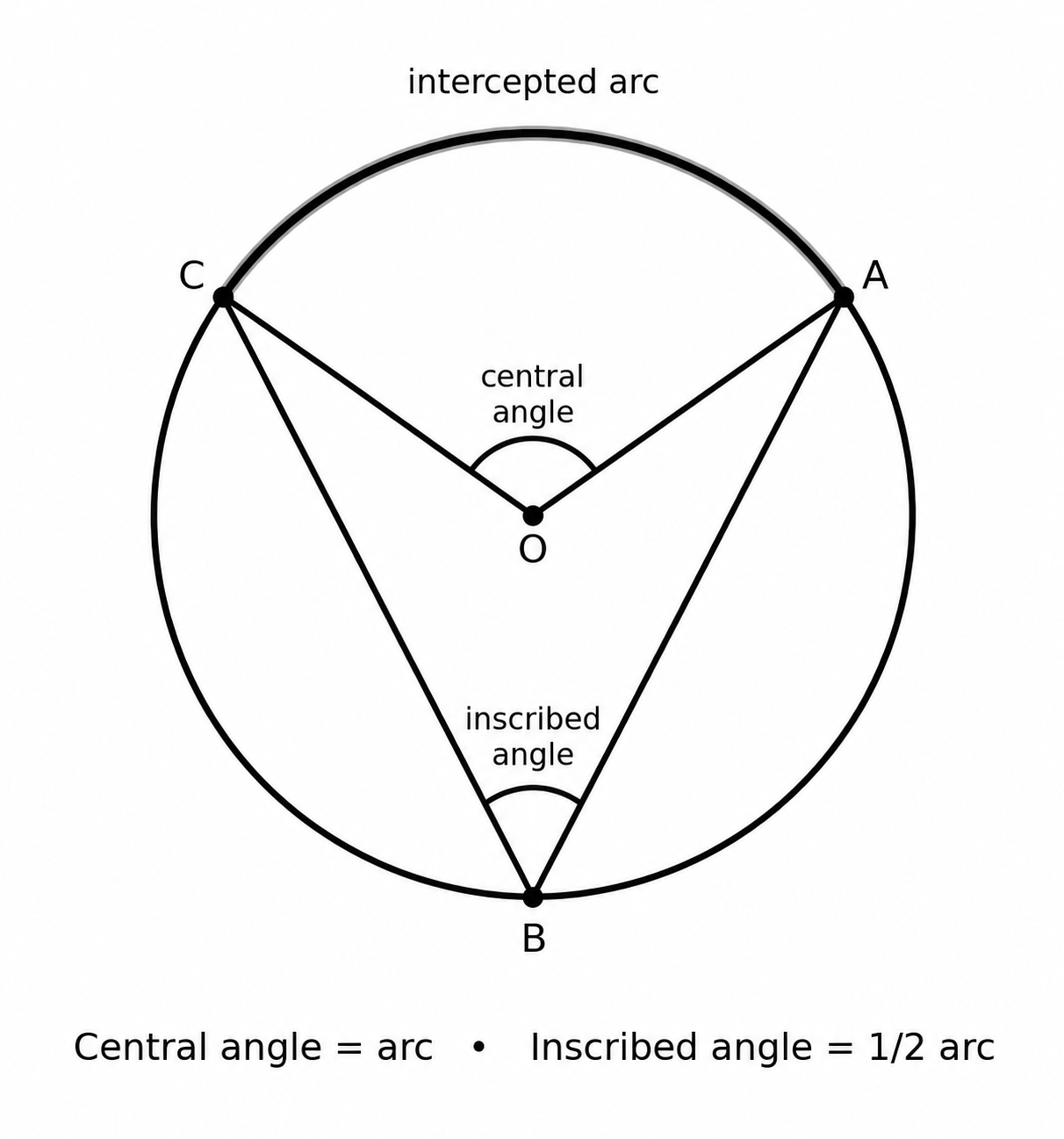
The important condition is that both angles must intercept the same arc.
Special Case — Angle Inscribed in a Semicircle
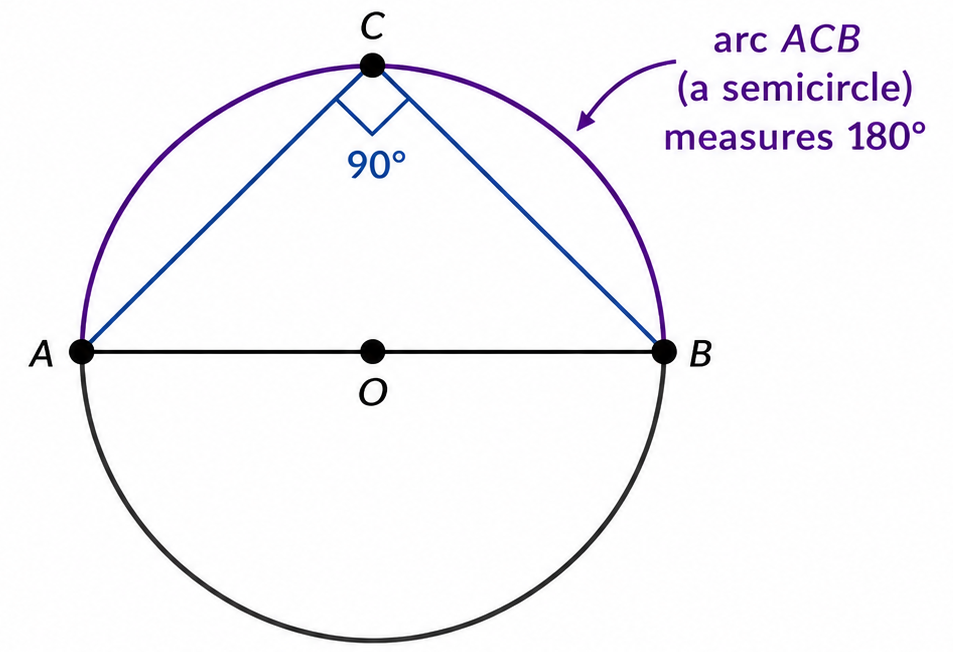
A semicircle has an arc measure of:
\[ 180^\circ \]
An inscribed angle that intercepts that semicircle therefore measures:
\[ \frac12(180^\circ)=90^\circ \]
So:
\[ \boxed{ \text{An angle inscribed in a semicircle is a right angle.} } \]
This often appears when one side of the circle diagram is a diameter.
Common Problem Types
1. Finding a Central Angle From an Arc
A central angle has the same measure as its intercepted arc.
If:
\[ m(\widehat{AB})=120^\circ \]
then:
\[ m(\angle AOB)=120^\circ \]
So:
\[ \boxed{120^\circ} \]
2. Finding an Inscribed Angle From an Arc
An inscribed angle is half the measure of its intercepted arc.
If the intercepted arc measures:
\[ 80^\circ \]
then:
\[ m(\angle)=\frac12(80^\circ) \]
\[ m(\angle)=40^\circ \]
Therefore:
\[ \boxed{40^\circ} \]
3. Finding an Arc From an Inscribed Angle
If the inscribed angle is known, reverse the half-rule.
The intercepted arc is twice the inscribed angle:
\[ m(\text{arc}) = 2m(\angle_{\text{inscribed}}) \]
For example, if:
\[ m(\angle_{\text{inscribed}})=35^\circ \]
then:
\[ m(\text{arc})=2(35^\circ) \]
\[ m(\text{arc})=70^\circ \]
4. Comparing Central and Inscribed Angles
If a central angle and an inscribed angle intercept the same arc:
\[ m(\angle_{\text{central}}) = 2m(\angle_{\text{inscribed}}) \]
For example, if the central angle is:
\[ 100^\circ \]
then the inscribed angle is:
\[ \frac12(100^\circ)=50^\circ \]
5. Using the Semicircle Rule
If an inscribed angle intercepts a diameter, then it intercepts a semicircle.
The intercepted arc measures:
\[ 180^\circ \]
Therefore:
\[ m(\angle) = \frac12(180^\circ) = 90^\circ \]
So the angle is a right angle.
6. Solving for an Unknown
Circle-angle relationships may appear inside an equation.
Suppose an inscribed angle measures:
\[ 3x+5 \]
and its intercepted arc measures:
\[ 100^\circ \]
Use the inscribed-angle rule:
\[ 3x+5=\frac12(100) \]
\[ 3x+5=50 \]
Subtract 5:
\[ 3x=45 \]
Divide by 3:
\[ x=15 \]
Therefore:
\[ \boxed{x=15} \]
Strategies
- First identify where the vertex is located.
- At the center → central angle.
- On the circle → inscribed angle.
- Trace the intercepted arc carefully.
- For a central angle, use:
\[ m(\angle)=m(\text{arc}) \]
- For an inscribed angle, use:
\[ m(\angle)=\frac12m(\text{arc}) \]
- To find an arc from an inscribed angle, double the angle.
- If a central and inscribed angle intercept the same arc, the central angle is twice the inscribed angle.
- Look for a diameter. An inscribed angle that intercepts a diameter is \(90^\circ\).
- Make sure you are using arc measure, not arc length.
Worked Examples
Example 1 — Inscribed Angle From Arc
An inscribed angle intercepts an arc measuring \(80^\circ\).
Find the measure of the inscribed angle.
The vertex is on the circle, so use the inscribed-angle rule:
\[ m(\angle_{\text{inscribed}}) = \frac12m(\text{arc}) \]
Substitute:
\[ m(\angle) = \frac12(80^\circ) \]
\[ m(\angle)=40^\circ \]
Therefore:
\[ \boxed{40^\circ} \]
Example 2 — Arc From an Inscribed Angle
An inscribed angle measures \(35^\circ\).
Find the measure of its intercepted arc.
An inscribed angle is half its intercepted arc, so the arc is twice the angle:
\[ m(\text{arc}) = 2m(\angle_{\text{inscribed}}) \]
Substitute:
\[ m(\text{arc}) = 2(35^\circ) \]
\[ m(\text{arc})=70^\circ \]
Therefore:
\[ \boxed{70^\circ} \]
Example 3 — Central and Inscribed Angles
A central angle and an inscribed angle intercept the same arc.
The central angle measures:
\[ 110^\circ \]
Find the inscribed angle.
The inscribed angle is half the central angle:
\[ m(\angle_{\text{inscribed}}) = \frac12(110^\circ) \]
\[ m(\angle_{\text{inscribed}}) = 55^\circ \]
Therefore:
\[ \boxed{55^\circ} \]
Example 4 — Semicircle
An inscribed angle intercepts a diameter of a circle.
Find the angle measure.
A diameter divides the circle into a semicircle, so the intercepted arc measures:
\[ 180^\circ \]
An inscribed angle is half its intercepted arc:
\[ m(\angle) = \frac12(180^\circ) \]
\[ m(\angle)=90^\circ \]
Therefore:
\[ \boxed{90^\circ} \]
- Using the half-rule for a central angle.
- Saying an inscribed angle is half the arc length instead of half the arc measure.
- Mixing up which arc an angle intercepts.
- Comparing a central and inscribed angle that do not intercept the same arc.
- Forgetting to double an inscribed angle when finding its intercepted arc.
- Forgetting the semicircle rule when a diameter is present.
Practice Problems
A central angle measures \(110^\circ\). What is the measure of its intercepted arc?
An inscribed angle measures \(25^\circ\). What is the measure of its intercepted arc?
An angle is inscribed in a semicircle. What is the measure of the angle?
A central angle and an inscribed angle intercept the same arc. If the central angle is \(96^\circ\), what is the inscribed angle?
A central angle and an inscribed angle intercept the same arc. If the inscribed angle is \(42^\circ\), what is the central angle?
An inscribed angle measures \(2x+10\) degrees and intercepts an arc measuring \(100^\circ\). Find \(x\).
1. A central angle has the same measure as its intercepted arc.
Therefore:
\[ \boxed{110^\circ} \]
2. The intercepted arc is twice the inscribed angle.
\[ m(\text{arc}) = 2(25^\circ) \]
\[ m(\text{arc}) = 50^\circ \]
Therefore:
\[ \boxed{50^\circ} \]
3. An angle inscribed in a semicircle intercepts an arc of:
\[ 180^\circ \]
An inscribed angle is half its intercepted arc:
\[ \frac12(180^\circ)=90^\circ \]
Therefore:
\[ \boxed{90^\circ} \]
4. The central angle and inscribed angle intercept the same arc.
The inscribed angle is half the central angle:
\[ \frac12(96^\circ)=48^\circ \]
Therefore:
\[ \boxed{48^\circ} \]
5. The central angle is twice the inscribed angle:
\[ 2(42^\circ)=84^\circ \]
Therefore:
\[ \boxed{84^\circ} \]
6. The intercepted arc measures:
\[ 100^\circ \]
So the inscribed angle must be half of that:
\[ \frac12(100^\circ)=50^\circ \]
The angle is given as:
\[ 2x+10 \]
Set the expressions equal:
\[ 2x+10=50 \]
Subtract 10:
\[ 2x=40 \]
Divide by 2:
\[ x=20 \]
Therefore:
\[ \boxed{x=20} \]
Summary
- A central angle has its vertex at the center of the circle.
\[ m(\angle_{\text{central}}) = m(\text{intercepted arc}) \]
- An inscribed angle has its vertex on the circle.
\[ m(\angle_{\text{inscribed}}) = \frac12m(\text{intercepted arc}) \]
- If a central and inscribed angle intercept the same arc:
\[ m(\angle_{\text{central}}) = 2m(\angle_{\text{inscribed}}) \]
- An angle inscribed in a semicircle is:
\[ 90^\circ \]
- Vertex at the center → central angle → same as arc.
- Vertex on the circle → inscribed angle → half the arc.
- Given an inscribed angle and need the arc? → double it.
- Central + inscribed intercept the same arc? → central is twice the inscribed angle.
- Diameter intercepted by an inscribed angle? → think \(90^\circ\).
- These rules use arc measure in degrees, not arc length.