Proportional Relationships
By the end of this lesson, you’ll be able to:
- Identify direct proportional relationships of the form \(y = kx\).
- Identify inverse proportional relationships of the form \(y = \frac{k}{x}\).
- Distinguish proportional relationships from non-proportional linear relationships.
- Interpret proportionality from equations, tables, and graphs.
- Find and use the constant of proportionality \(k\).
Key Ideas
A proportional relationship describes two quantities that change together in a predictable way.
There are two common types:
- Direct proportionality: \(y = kx\)
- Inverse proportionality: \(y = \frac{k}{x}\)
These differ in how the variables change and what their graphs look like.
1. Direct Proportional Relationships
In a direct proportional relationship, one quantity is always a constant multiple of the other:
\[ y = kx \]
where:
- \(k\) is the constant of proportionality
- The ratio \(\frac{y}{x}\) is constant
- The graph is a straight line through the origin \((0,0)\)
Examples of Direct Proportions
- Cost = (price per unit) × (quantity)
- Distance = (speed) × (time)
- Recipe scaling
- Unit conversions
Example:
If something costs $2.50 per pound,
\[ \text{Cost} = 2.5x \]
and
\[ k = 2.5. \]
Identifying Direct Proportionality
A relationship is directly proportional if:
- The equation is in the form \(y = kx\)
- The graph is a straight line and passes through the origin
- A table shows a constant ratio \(\frac{y}{x}\)
A relationship is not proportional if:
- It has a nonzero y-intercept
- The ratio \(\frac{y}{x}\) changes
Example of a relationship that is not proportional:
\[ y = 2x + 3 \]
- Does not pass through the origin
- Ratio \(\frac{y}{x}\) is not constant
- Therefore it is linear, but not proportional
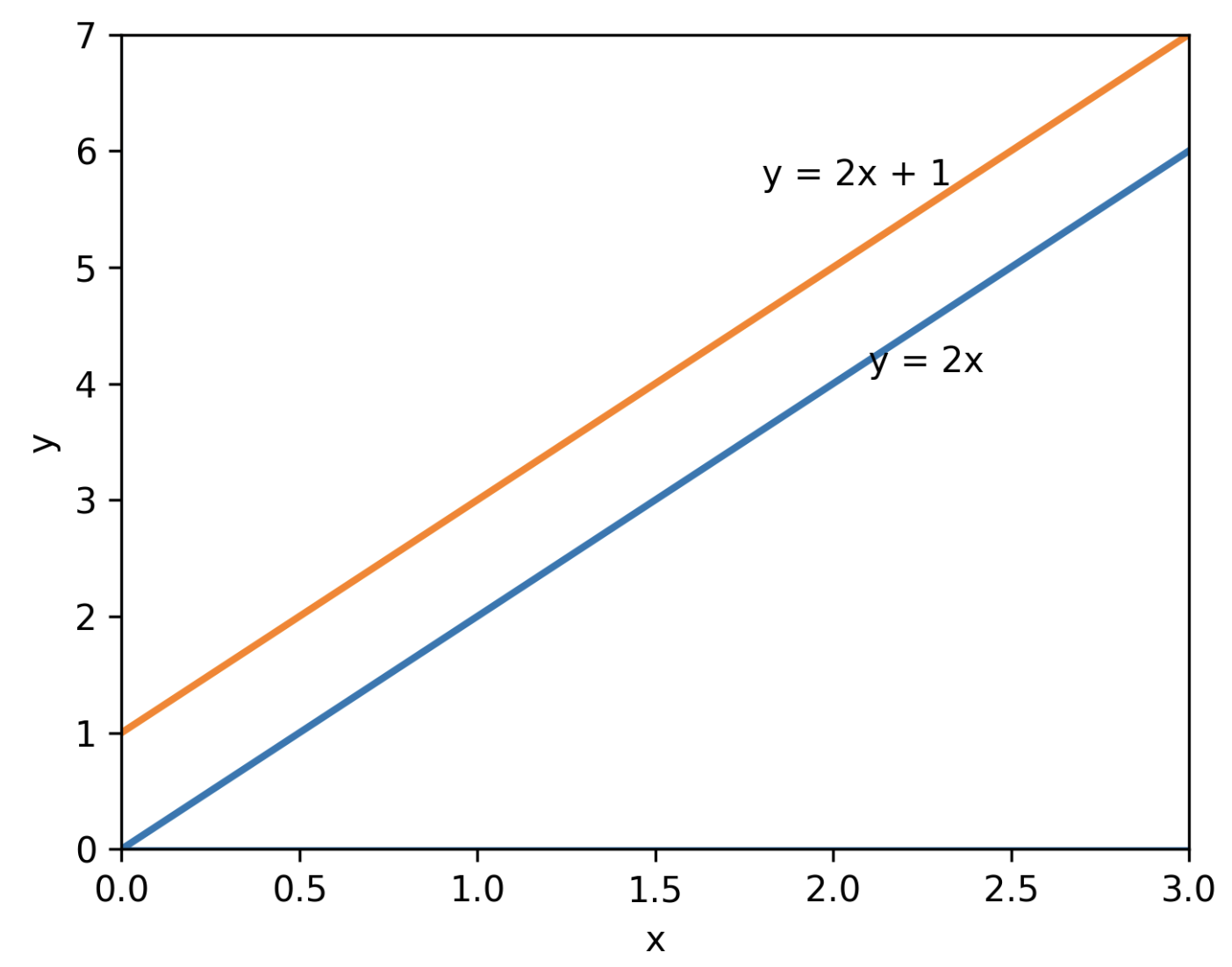
Notice that both graphs are straight lines.
- The graph of \(y = 2x\) passes through the origin, so it is directly proportional.
- The graph of \(y = 2x + 1\) has a nonzero y-intercept, so it is linear but not proportional.
If a line does not pass through \((0,0)\), it is not directly proportional.
In a direct proportion, the variables increase or decrease together. In an inverse proportion, one variable increases while the other decreases.
2. Inverse Proportional Relationships
In an inverse proportional relationship, one quantity increases while the other decreases:
\[ y = \frac{k}{x} \]
Characteristics:
- As \(x\) increases, \(y\) decreases
- The product \(xy\) is constant
- The graph is a hyperbola, not a line
- The graph never crosses the axes
Examples of Inverse Proportions
- Pressure and volume
- Work-rate problems (more workers → fewer hours)
- Concentration and dilution
- Intensity and distance
Example:
If
\[ xy = 12, \]
then:
- If \(x = 3\), then \(y = 4\)
- If \(x = 6\), then \(y = 2\)
Both produce the same product:
\[ xy = 12. \]
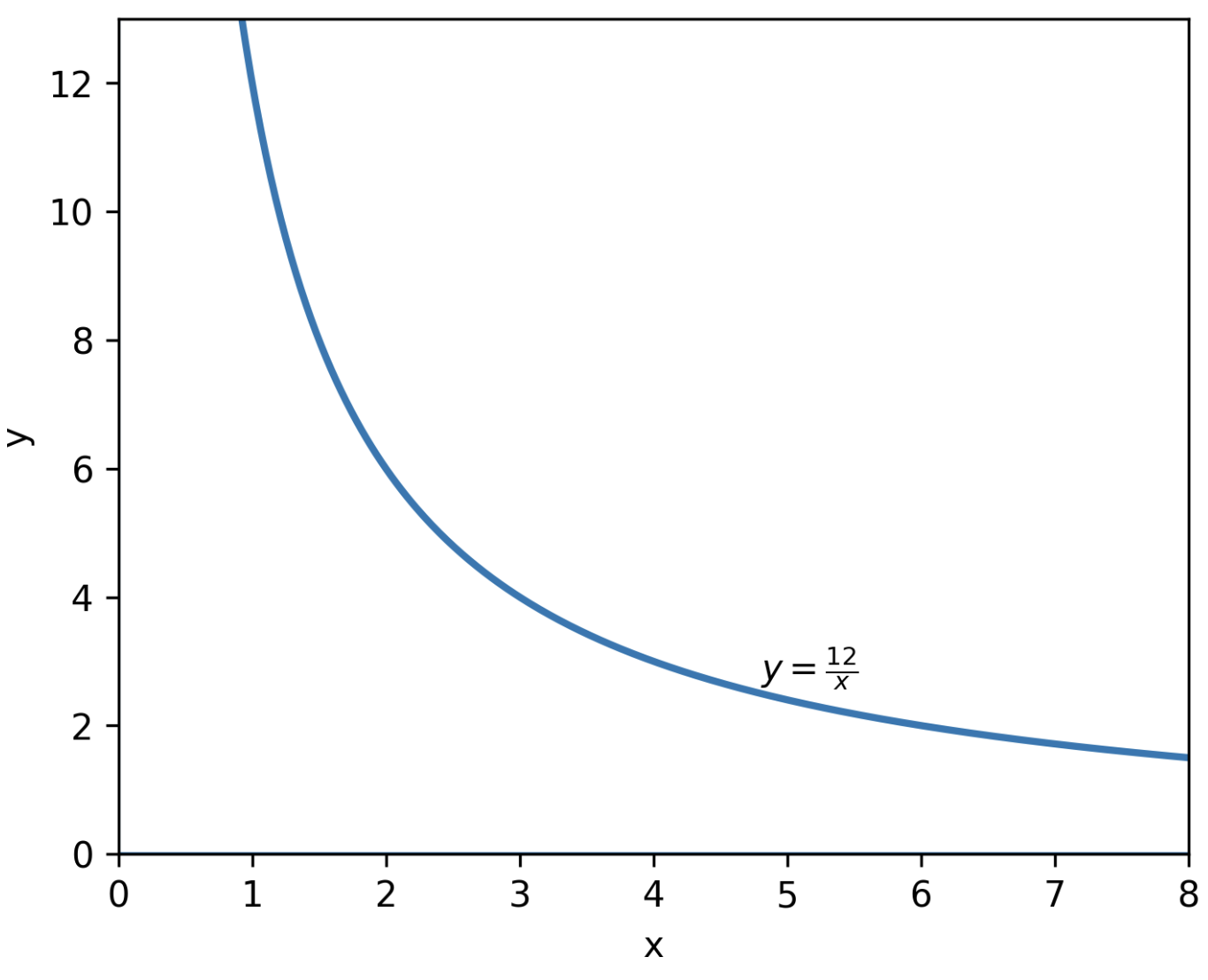
Unlike a direct proportion, an inverse proportion does not form a straight line.
As \(x\) increases, \(y\) decreases so that the product
\[ xy = k \]
remains constant.
For example, on the graph of
\[ y=\frac{12}{x}, \]
the points \((2,6)\), \((3,4)\), and \((6,2)\) all satisfy
\[ xy = 12. \]
Visual Comparison
| Relationship | Graph Shape | Key Feature |
|---|---|---|
| Direct proportional | Straight line | Passes through origin |
| Non-proportional linear | Straight line | Has a nonzero y-intercept |
| Inverse proportional | Curved hyperbola | Product \(xy\) is constant |
When looking at graphs:
- Origin + straight line → direct proportion
- Straight line + intercept → linear but not proportional
- Curved graph → inverse proportion
When deciding whether a relationship is proportional:
- Table → check whether \(\frac{y}{x}\) is constant.
- Graph → check whether the line passes through \((0,0)\).
- Equation → check whether it can be written as \(y = kx\).
If any of these fail, the relationship is not directly proportional.
Common Problem Types
1. Identifying Proportionality From a Table
Example:
| x | y |
|---|---|
| 2 | 10 |
| 4 | 20 |
| 6 | 30 |
Compute the ratio:
\[ \frac{y}{x} \]
- \(10/2 = 5\)
- \(20/4 = 5\)
- \(30/6 = 5\)
Since the ratio is always 5, the relationship is directly proportional.
The equation is:
\[ y = 5x \]
and the constant of proportionality is:
\[ k = 5. \]
2. Identifying From a Graph
- Line through origin → direct proportion
- Line not through origin → linear but not proportional
- Curved hyperbola → inverse proportion
3. Writing an Equation (Direct)
Example:
A car travels at 60 miles per hour.
\[ d = 60t \]
The constant of proportionality is
\[ k = 60. \]
4. Writing an Equation (Inverse)
Example:
A job takes 24 worker-hours.
\[ xy = 24 \]
or equivalently,
\[ y = \frac{24}{x}. \]
5. Finding the Constant of Proportionality
- Direct: \(k = \frac{y}{x}\)
- Inverse: \(k = xy\)
Strategies
- Look for keywords:
- “per,” “each,” “every” → often direct proportional
- “inversely proportional,” “product is constant” → inverse
- Check table patterns:
- constant ratio → direct
- constant product → inverse
- Graph clues:
- line through origin → direct
- line not through origin → linear but non-proportional
- curve such as \(y=\frac{k}{x}\) → inverse
Worked Examples
Example 1 — Direct Proportion
Is
\[ y = 7x \]
proportional?
Yes. It is in the form
\[ y = kx \]
with
\[ k = 7. \]
Example 2 — Not Proportional
Is the table proportional?
| x | y |
|---|---|
| 5 | 15 |
| 10 | 40 |
Compute the ratios:
- \(15/5 = 3\)
- \(40/10 = 4\)
The ratios are not constant.
Answer: Not proportional.
Example 3 — Inverse Proportion
A quantity varies inversely with \(x\). When \(x = 4\) and \(y = 8\), find the equation.
Compute the constant:
\[ k = xy = 4 \cdot 8 = 32 \]
Substitute into
\[ y = \frac{k}{x} \]
to obtain
\[ y = \frac{32}{x}. \]
- Assuming every linear equation is proportional.
- Forgetting that a direct proportion must pass through the origin.
- Checking differences instead of ratios for direct proportionality.
- Checking ratios instead of products for inverse proportionality.
- Mixing up \(y=kx\) and \(y=\frac{k}{x}\).
Practice Problems
- Is \(y = 12x\) directly proportional?
- A relationship has \(xy = 18\). When \(x = 3\), what is \(y\)?
- A table contains the points \((2,6)\), \((4,13)\), and \((6,18)\). Is it proportional?
- Write an equation for: “A plant grows 2.3 cm per day.”
- A graph passes through \((0,0)\) and \((3,12)\). Write the proportional equation.
- A quantity varies inversely with \(x\). If \(x=5\) and \(y=9\), write the equation.
1.
Yes.
\[ y = 12x \]
is in the form \(y = kx\).
2.
\[ y = \frac{18}{3} = 6 \]
3.
\[ \frac{6}{2}=3 \]
\[ \frac{13}{4}=3.25 \]
The ratios are not constant.
Answer: Not proportional.
4.
\[ h = 2.3d \]
5.
\[ k = \frac{12}{3}=4 \]
Therefore,
\[ y = 4x. \]
6.
\[ k = xy = 5 \cdot 9 = 45 \]
Therefore,
\[ y = \frac{45}{x}. \]
Summary
- Direct proportion: \(y = kx\), constant ratio, line through the origin.
- Non-proportional linear: \(y = mx + b\) where \(b \neq 0\).
- Inverse proportion: \(y = \frac{k}{x}\), constant product, hyperbola.
- Direct and inverse proportionality appear frequently in rate, scaling, and work problems.
- Constant ratio → direct proportion.
- Constant product → inverse proportion.
- A direct proportion must pass through the origin.
- If a line has a y-intercept, it is not directly proportional.