3D Shapes Overview
By the end of this lesson, you’ll be able to:
- Identify common three-dimensional figures and their key features.
- Distinguish between faces, edges, vertices, bases, and curved surfaces.
- Identify prisms and pyramids by the shape of their bases.
- Relate 2D nets to the 3D solids they form.
- Recognize common cross-sections of 3D figures.
- Identify the measurements commonly used in surface area and volume formulas.
Key Ideas
A three-dimensional (3D) figure has length, width, and height.
Unlike a two-dimensional figure, a 3D figure occupies space.
Two important measurements of 3D figures are:
- Surface area — the total area covering the outside of a solid
- Volume — the amount of space inside a solid
Common 3D Solids
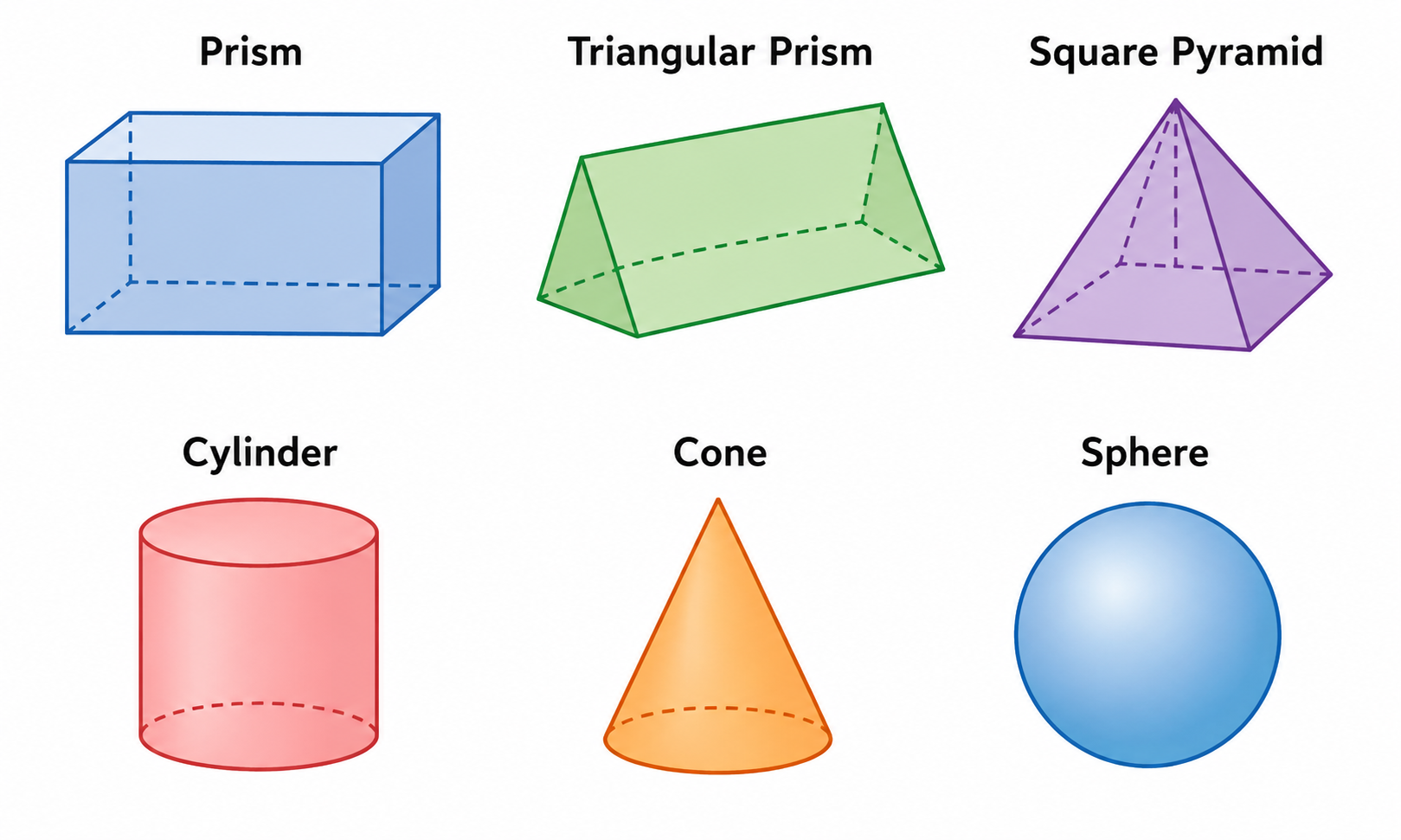
| Shape | Key Features | Notes |
|---|---|---|
| Prism | Two parallel, congruent bases | Named by the shape of its bases |
| Pyramid | One base; triangular faces meet at one vertex | Named by the shape of its base |
| Cylinder | Two parallel, congruent circular bases | Has a curved surface |
| Cone | One circular base; curved surface meets at an apex | Has one pointed end |
| Sphere | Completely curved surface | No flat faces, edges, or vertices |
Faces, Edges, and Vertices
For solids made from flat polygonal surfaces:
- Face — a flat surface
- Edge — a line segment where two faces meet
- Vertex — a point where edges meet
For example, a rectangular prism has:
\[ 6\text{ faces} \]
\[ 12\text{ edges} \]
\[ 8\text{ vertices} \]
Cylinders, cones, and spheres include curved surfaces, so their features do not fit the face-edge-vertex description as neatly as prisms and pyramids.
For example, a sphere has no flat faces, edges, or vertices.
Bases
The base is especially important because it often determines both the name of the solid and the formula used.
For a prism, the two bases are:
- parallel
- congruent
A prism with triangular bases is a:
\[ \boxed{\text{triangular prism}} \]
A prism with rectangular bases is a:
\[ \boxed{\text{rectangular prism}} \]
A pyramid has only one base.
A pyramid with a square base is a:
\[ \boxed{\text{square pyramid}} \]
A quick way to distinguish them:
- Prism → two matching parallel bases
- Pyramid → one base and faces that meet at an apex
Nets
A net is a two-dimensional arrangement of surfaces that can be folded to form a three-dimensional solid.
For example:
- 6 squares can form a cube.
- 2 triangles and 3 rectangles can form a triangular prism.
- 1 square and 4 triangles can form a square pyramid.
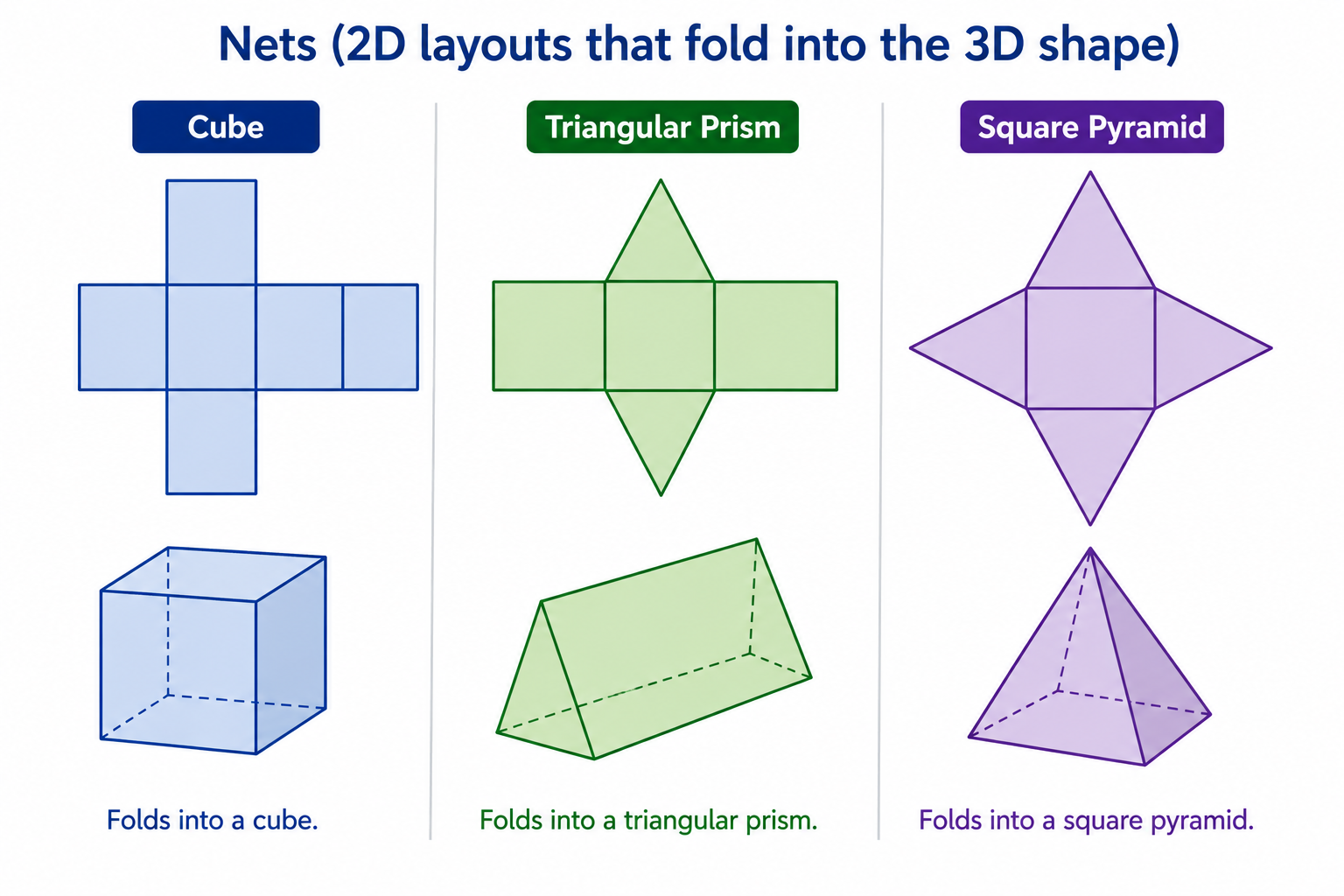
Nets are especially useful when thinking about surface area because the entire outside surface of the solid is unfolded into flat pieces.
Cross-Sections
A cross-section is the two-dimensional shape created when a three-dimensional solid is sliced by a plane.
The shape of the cross-section depends on both:
- the solid
- the direction of the cut
For example:
- A horizontal slice through a cylinder can produce a circle.
- A vertical slice through a right cylinder parallel to its axis can produce a rectangle.
- A slice through a sphere produces a circle.
- Different slices through a pyramid can produce triangles or other polygons.
So always pay attention to how the solid is being cut.
Measurements Used in 3D Geometry
Several measurements appear repeatedly in surface-area and volume problems.
Base Area
The area of a base is often represented by:
\[ B \]
For example, if the base is a rectangle:
\[ B=lw \]
If the base is a circle:
\[ B=\pi r^2 \]
Height
The height \(h\) of a solid is the perpendicular distance between its bases or from its base to its apex.
This is important because a slanted edge is not necessarily the height.
Radius
For cylinders, cones, and spheres, the radius \(r\) is often needed.
Remember:
\[ d=2r \]
Common Problem Types
1. Identifying a 3D Shape
Look at the number and shape of the bases.
For example, a solid with two parallel congruent triangular bases is a:
\[ \boxed{\text{triangular prism}} \]
A solid with one square base and triangular sides meeting at a point is a:
\[ \boxed{\text{square pyramid}} \]
2. Identifying Shapes From Nets
Imagine folding the flat pieces together.
For example, a net consisting of:
- 2 congruent triangles
- 3 rectangles
forms a:
\[ \boxed{\text{triangular prism}} \]
3. Counting Faces, Edges, and Vertices
Count systematically rather than relying only on the drawing.
A rectangular prism has:
- 6 faces
- 12 edges
- 8 vertices
For a square pyramid:
- 1 square base
- 4 triangular faces
- 5 vertices
- 8 edges
4. Determining the Base Shape
The base often determines the name of the solid.
For example:
- triangular bases → triangular prism
- pentagonal bases → pentagonal prism
- square base → square pyramid
Remember that prisms have two congruent bases, while pyramids have one base.
5. Identifying Cross-Sections
Determine:
- what solid is being sliced
- the direction of the slice
For example, a right circular cylinder sliced parallel to its circular bases produces a:
\[ \boxed{\text{circle}} \]
A slice parallel to its axis can produce a:
\[ \boxed{\text{rectangle}} \]
6. Matching Shapes to Formulas
Before using a formula, identify the solid.
For example:
- Rectangular prism → use prism formulas
- Cylinder → use formulas involving \(\pi r^2\)
- Pyramid → use pyramid formulas
- Cone → use cone formulas
- Sphere → use sphere formulas
You do not need to memorize all of these formulas from this overview alone. The important first step is recognizing which type of solid you have.
Strategies
- Identify the base or bases first.
- Two congruent parallel bases usually indicate a prism.
- One base with faces meeting at an apex indicates a pyramid.
- For nets, imagine folding the pieces together.
- Count faces, edges, and vertices systematically.
- For cross-sections, pay attention to the direction of the cut.
- Distinguish between a perpendicular height and a slanted edge.
- Identify the solid before choosing a surface-area or volume formula.
- Label important dimensions such as \(r\), \(h\), \(l\), and \(w\) on the diagram.
Worked Examples
Example 1 — Identify a Solid From Its Net
A net consists of two congruent triangles and three rectangles.
The two triangles will become the parallel bases.
The three rectangles connect those bases.
Therefore, the solid is a:
\[ \boxed{\text{triangular prism}} \]
Example 2 — Count Edges of a Square Pyramid
How many edges does a square pyramid have?
The square base has:
\[ 4\text{ edges} \]
There is also one edge connecting each corner of the square to the apex.
That gives:
\[ 4\text{ more edges} \]
So the total is:
\[ 4+4=8 \]
Therefore:
\[ \boxed{8\text{ edges}} \]
Example 3 — Identify a Cross-Section
A right circular cylinder is sliced by a plane parallel to its circular bases.
What is the shape of the cross-section?
Because the cut is parallel to the circular bases, the cross-section has the same basic shape as a base.
Therefore:
\[ \boxed{\text{circle}} \]
Example 4 — Identify the Base and Height
A triangular prism has triangular ends and a length of 10 units between those ends.
The congruent triangles are the:
\[ \boxed{\text{bases}} \]
The perpendicular distance between them is:
\[ \boxed{10\text{ units}} \]
This distance acts as the prism’s height when using a formula such as:
\[ V=Bh \]
where \(B\) represents the area of one triangular base.
- Mixing up prisms and pyramids.
- Naming a prism or pyramid using the wrong face instead of its base.
- Forgetting that prisms have two congruent parallel bases.
- Treating curved surfaces exactly like flat polygonal faces.
- Counting the same edge or vertex more than once.
- Assuming every cross-section of the same solid has the same shape.
- Confusing base area with surface area.
- Using a slanted edge as the height when the formula requires a perpendicular height.
- Choosing a formula before identifying the type of solid.
Practice Problems
What 3D shape has 6 rectangular faces?
A net has one square and four triangles. What shape is formed?
How many vertices does a triangular pyramid have?
A right circular cylinder is cut by a plane parallel to its axis. What common cross-section is formed?
A solid has two congruent pentagonal bases connected by rectangular faces. What is the solid?
A square pyramid has one square base and four triangular faces. How many total faces does it have?
1. A solid with 6 rectangular faces is a:
\[ \boxed{\text{rectangular prism}} \]
A cube is a special rectangular prism in which all six faces are squares.
2. The square forms the base.
The four triangles fold upward and meet at one apex.
Therefore, the net forms a:
\[ \boxed{\text{square pyramid}} \]
3. A triangular pyramid has:
- 3 vertices on its triangular base
- 1 additional vertex at the apex
Therefore:
\[ 3+1=4 \]
So it has:
\[ \boxed{4\text{ vertices}} \]
4. A plane parallel to the axis of a right circular cylinder passes vertically through the cylinder.
The resulting cross-section is a:
\[ \boxed{\text{rectangle}} \]
5. The solid has two congruent, parallel bases.
Therefore, it is a prism.
Because those bases are pentagons, it is a:
\[ \boxed{\text{pentagonal prism}} \]
6. A square pyramid has:
\[ 1\text{ square base} \]
and:
\[ 4\text{ triangular faces} \]
Therefore, the total number of faces is:
\[ 1+4=5 \]
So the pyramid has:
\[ \boxed{5\text{ faces}} \]
Summary
- Three-dimensional figures have surface area and volume.
- A face is a flat surface.
- An edge is where two flat faces meet.
- A vertex is a point where edges meet.
- Prisms have two congruent parallel bases.
- Pyramids have one base and triangular faces that meet at an apex.
- Cylinders, cones, and spheres have curved surfaces.
- A net is a 2D arrangement that can fold into a 3D solid.
- A cross-section is the 2D shape formed by slicing a 3D solid.
- Base area \(B\), perpendicular height \(h\), and radius \(r\) are common measurements used in later formulas.
- Two matching bases → think prism.
- One base + apex → think pyramid.
- Name prisms and pyramids by their base shape.
- Nets → imagine folding.
- Cross-sections → pay attention to the direction of the cut.
- Volume → think space inside.
- Surface area → think outside covering.
- Identify the solid before choosing a formula.