Parallel & Perpendicular Lines
By the end of this lesson, you’ll be able to:
- Determine whether two lines are parallel, perpendicular, or neither.
- Write equations of lines that are parallel or perpendicular to a given line.
- Use slope relationships confidently when building new equations.
Key Ideas
Understanding slope relationships is the key to quickly identifying how two lines behave.
Parallel Lines
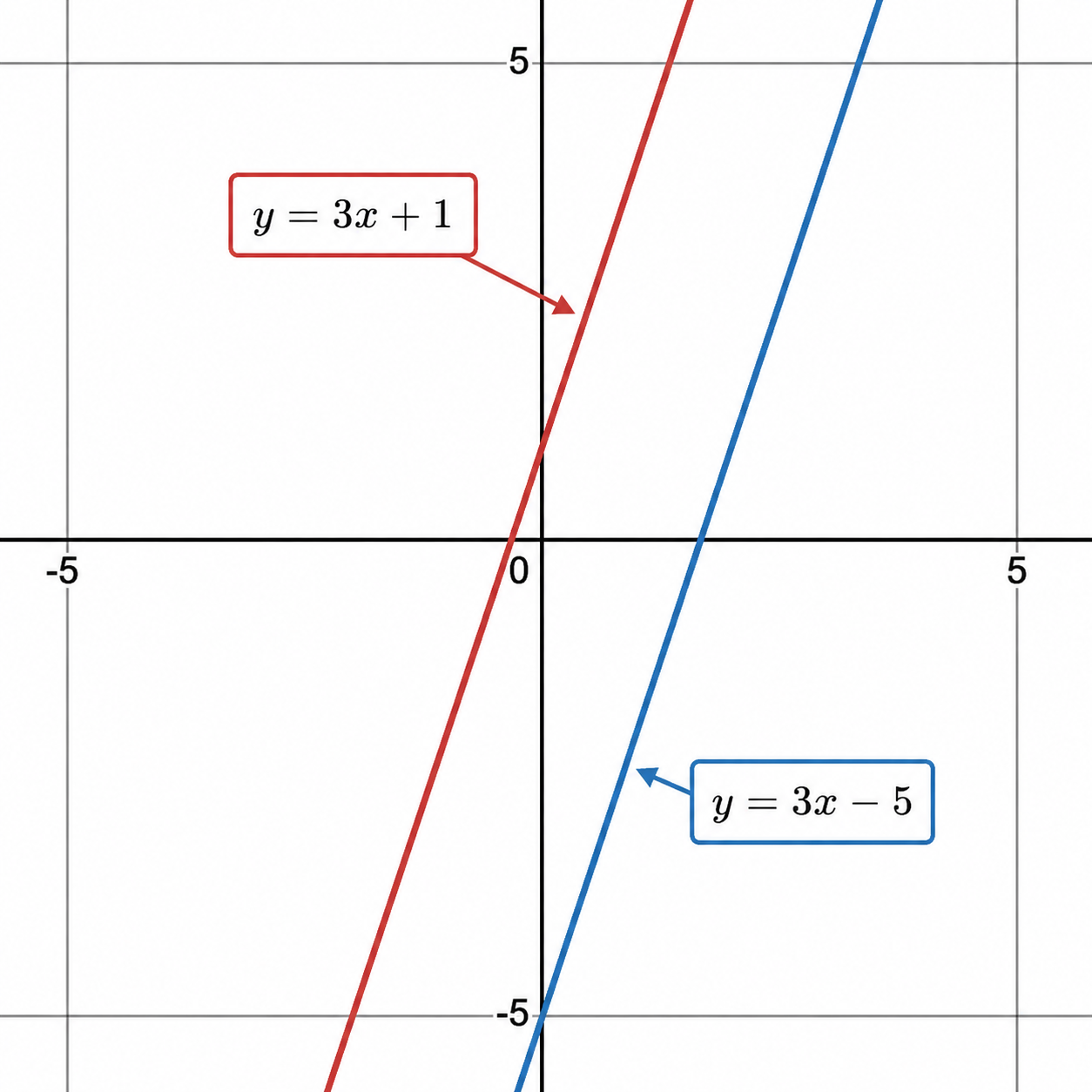
- Have the same slope
- Have different y-intercepts
- Never intersect
Example: \(y = 3x + 1\) and \(y = 3x - 5\) are parallel because both have \(m = 3\).
If two lines have the same slope and the same y-intercept, they are actually the same line, not parallel lines.
Example:
\[ y=2x+3 \]
and
\[ 2y=4x+6 \]
represent the exact same line.
Perpendicular Lines
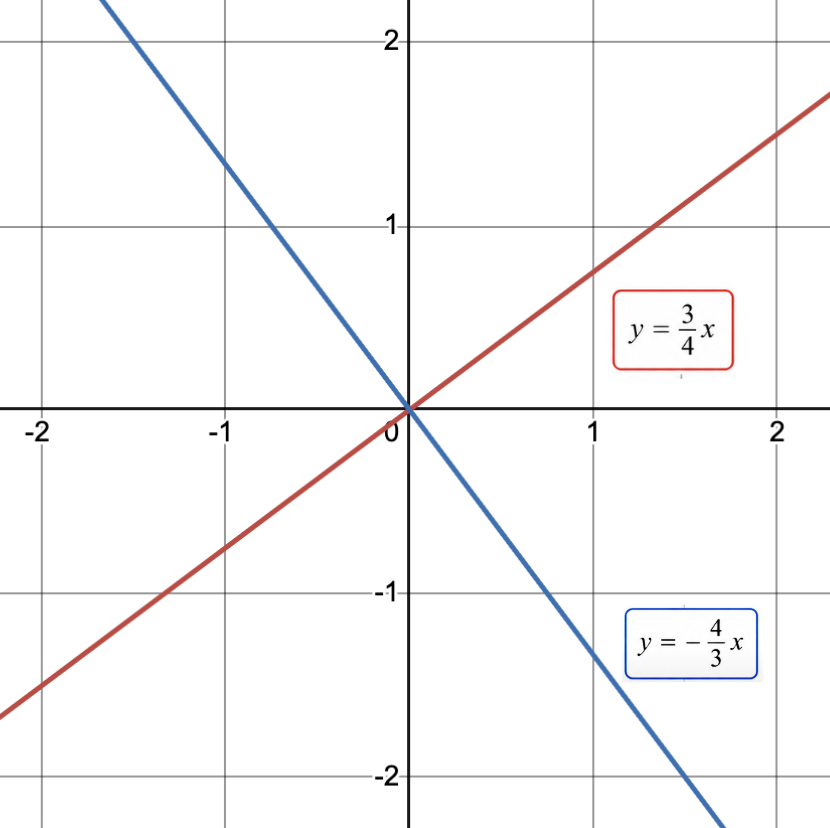
- Slopes are opposite reciprocals:
\[ m_2 = -\frac{1}{m_1} \]
Example:
If one slope is \(2\), the perpendicular slope is \(-\frac{1}{2}\).
Vertical and Horizontal
- Vertical line: \(x = c\)
- Horizontal line: \(y = k\)
These two are always perpendicular.
Common Problem Types
1. Determine if lines are parallel, perpendicular, or neither
Compare slopes:
- same slope → parallel
- negative reciprocals → perpendicular
- anything else → neither
2. Write a line parallel to a given line
Use the same slope, different intercept, and pass it through a given point.
3. Write a perpendicular line through a point
Use the opposite reciprocal slope, substitute the point, and create the new equation.
4. Rewrite from Standard Form if needed
Convert \(Ax + By = C\) to slope-intercept to identify the slope quickly.
Strategies
- Always extract slope first—even if the equation is not in slope-intercept form.
- When writing a new line, use point-slope form to avoid early algebra mistakes.
- Keep perpendicular slopes straight:
- Flip the fraction
- Change the sign
- Flip the fraction
- Check your final equation by confirming it passes through the given point.
Worked Examples
Example 1 — Parallel through a point
Line:
\[
y = 4x + 2
\]
Find a parallel line through \((1, -3)\).
Parallel slope = 4.
Use point-slope:
\[ y + 3 = 4(x - 1) \]
(You may convert if desired.)
Example 2 — Perpendicular through a point
Line:
\[
y = -3x + 5
\]
Given slope = \(-3\).
Perpendicular slope:
\[ m = \frac{1}{3} \]
Through point \((2,1)\):
\[ y - 1 = \frac{1}{3}(x - 2) \]
- Flipping a slope for perpendicular lines but forgetting to change the sign.
- Thinking perpendicular slopes multiply to +1 instead of -1.
- Mixing up vertical and horizontal lines.
- Using the intercept from the original line instead of substituting the new point.
Practice Problems
- Write the equation of a line parallel to \(y = 5x - 1\) through \((2, 4)\).
- Write the equation of a line perpendicular to
\(y = -\frac{1}{2}x + 3\) through \((0, -1)\).
- Determine whether the lines are parallel, perpendicular, or neither:
- \(y = 2x + 3\)
- \(4x - 2y = 10\)
- \(y = 2x + 3\)
- Find the equation of a line perpendicular to \(x = 3\) through \((2, 5)\).
- Write a parallel line to \(3x + y = 7\) through \((0, -2)\).
1.
Parallel slope = 5
\[
y - 4 = 5(x - 2)
\]
Convert:
\[
y = 5x - 6
\]
2.
Slope given = \(-\frac{1}{2}\)
Perpendicular slope = \(2\)
\[
y + 1 = 2(x - 0) \Rightarrow y = 2x - 1
\]
3.
Rewrite second:
\[
-2y = -4x + 10 \Rightarrow y = 2x - 5
\]
Same slope → parallel.
4.
\(x = 3\) is vertical.
Perpendicular line = horizontal → \(y = 5\).
5.
Rewrite original for slope:
\[
y = -3x + 7
\]
Parallel slope = \(-3\)
Through \((0,-2)\):
\[
y + 2 = -3(x - 0) \Rightarrow y = -3x - 2
\]
Summary
- Parallel lines have the same slope but different intercepts.
- Perpendicular lines have opposite reciprocal slopes.
- Lines with the same slope and the same intercept are the same line.
- Vertical and horizontal lines are always perpendicular.
- “Parallel = same slope; Perpendicular = flip and negate.”
- If the equation isn’t in \(y = mx + b\) form, rewrite it first.
- When unsure, pick one point and check that it satisfies your final equation.