Points, Lines, Rays, and Angles
TipLearning Objectives
- Identify points, lines, segments, and rays.
- Classify angles (acute, right, obtuse, straight).
- Use angle notation correctly.
- Understand how geometric objects relate on a coordinate plane.
Key Ideas
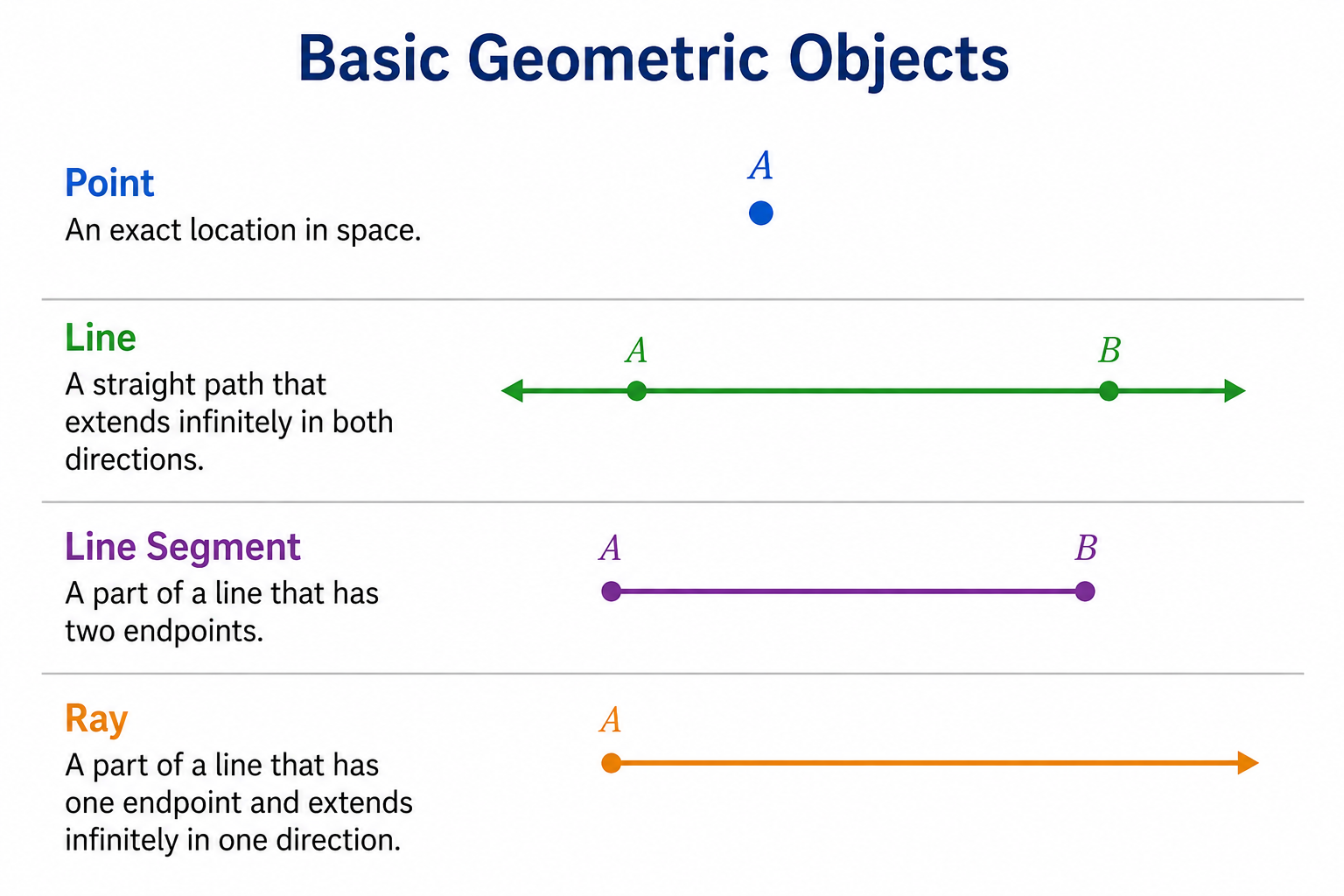
- A point has no size—just a location.
- A line extends infinitely in both directions.
- A line segment has two endpoints.
- A ray starts at one point and extends infinitely in one direction.
- Angles are formed by two rays with a common endpoint.
Angle Types
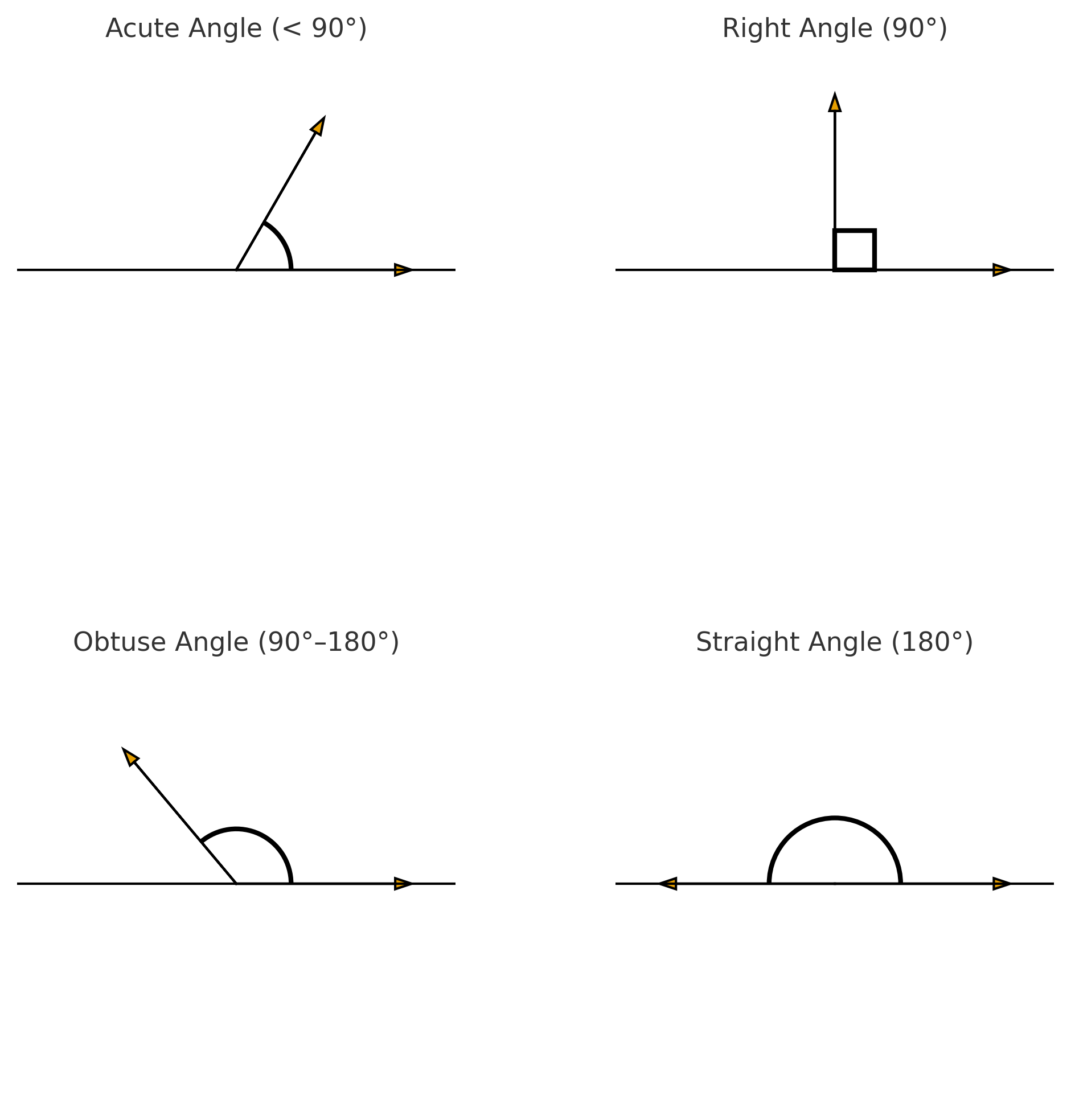
- Acute: measure < 90°
- Right: exactly 90°
- Obtuse: between 90° and 180°
- Straight: exactly 180°
Common Problem Types
Identifying Objects from a Diagram
Example: A figure shows AB with arrows on both ends → AB is a line.
Recognizing Angle Types
Example: Angle measures 47° → acute.
Using Correct Notation
- Angle ∠ABC: vertex is B
- Segment AB has endpoints A and B
- Ray \(\overrightarrow{AB}\) starts at A and goes through B
Relating Points and Lines on a Grid
Example: Points A(2,3) and B(2,7) lie on a vertical line.
Strategies
- Look at endpoints → decide line, segment, or ray.
- Check angle measure before classifying.
- Always identify the vertex for naming angles.
- On coordinate grids:
- same x-value → vertical
- same y-value → horizontal
- same x-value → vertical
Worked Examples
Example 1
Is \(\overline{AB}\) a line, segment, or ray?
Solution: Two endpoints, no arrows → segment.
Example 2
Classify a 135° angle.
Solution: 135° is obtuse.
WarningCommon Mistakes
- Mixing up rays and segments (ray has one arrow).
- Naming angles with the vertex in the wrong position.
- Calling a 90° angle “acute” or “obtuse.”
- Forgetting that a line has no endpoints.
Practice Problems
- Identify the figure: \(\overrightarrow{CD}\).
- Classify an angle measuring 89°.
- Determine if A(1,2) and B(1,9) lie on a vertical or horizontal line.
- Name the angle with vertex at point B using points A, B, and C.
TipStep-by-Step Solutions
- A ray (starts at C, goes through D).
- Acute (less than 90°).
- Vertical (same x-value).
- ∠ABC (vertex in the middle).
Summary
- Segments have two endpoints; rays have one; lines have none.
- Angles require two rays sharing an endpoint.
- Angle type depends on degree measure.
TipQuick Tips
- Vertex in the middle when naming angles.
- Ray has exactly one arrow.
- Use degree measure to classify angles quickly.