Solving Multi-Step Equations
By the end of this lesson, you’ll be able to:
- Solve linear equations that require multiple steps.
- Use the distributive property and combine like terms before isolating the variable.
- Recognize when to simplify each side first.
Key Ideas
Multi-step equations often involve:
- parentheses (distribution)
- combining like terms
- constants or variables on both sides
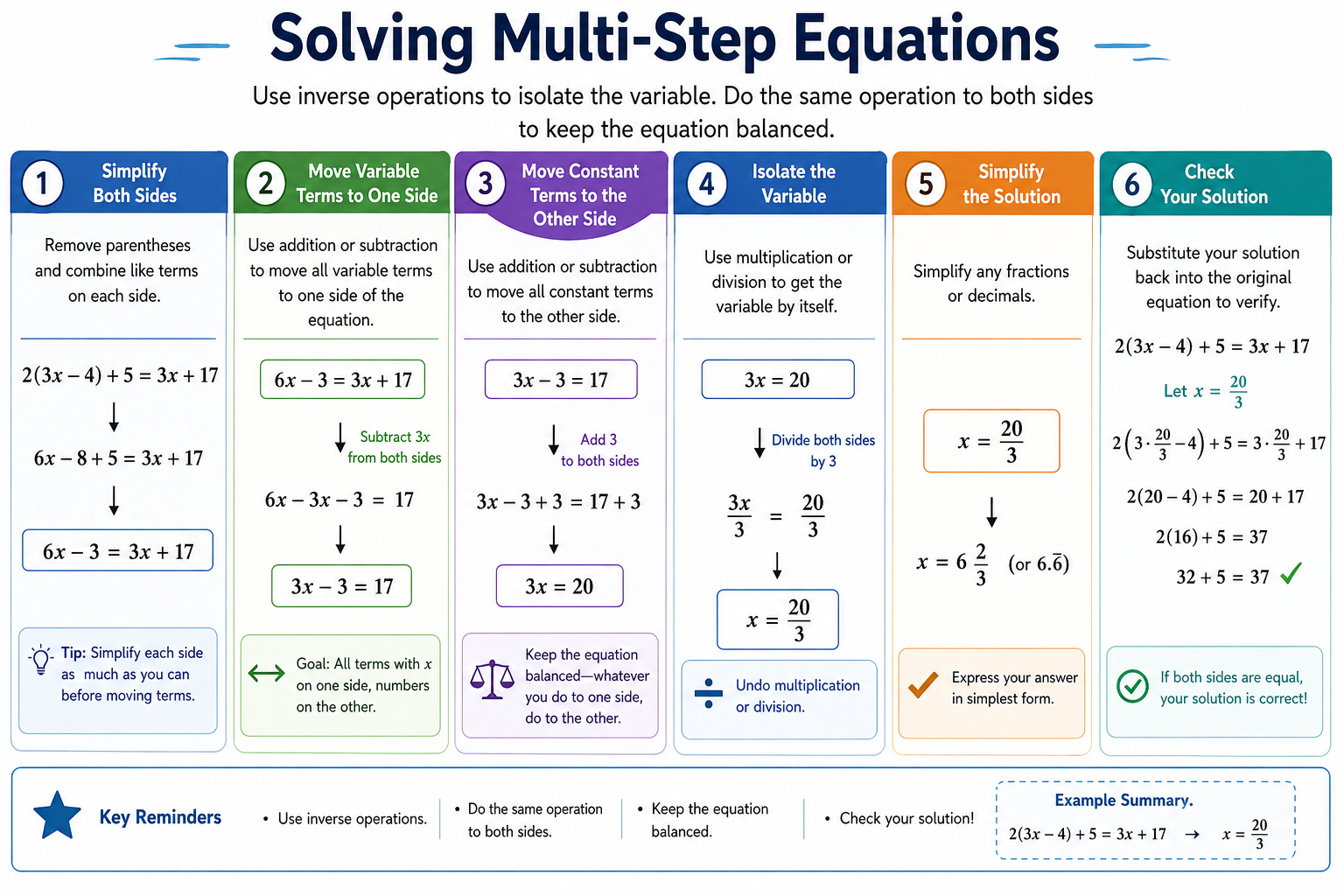
General plan:
- Simplify each side (distribute, combine like terms).
- Move variable terms to one side and constants to the other.
- Isolate the variable using one-step or two-step methods.
- Check your solution by substitution.
Common Problem Types
1. Distribute, Then Solve
Solve:
\[
2(x + 3) = 14
\]
Distribute: \(2x + 6 = 14\)
Subtract 6: \(2x = 8\)
Divide: \(x = 4\)
2. Combine Like Terms
Solve:
\[
3x + 2x - 5 = 10
\]
Combine: \(5x - 5 = 10\)
Add 5: \(5x = 15\)
Divide: \(x = 3\)
3. Parentheses on One Side
Solve:
\[
4(x - 2) + 3 = 15
\]
Distribute: \(4x - 8 + 3 = 15\)
Combine: \(4x - 5 = 15\)
Add 5: \(4x = 20\)
Divide: \(x = 5\)
Strategies
- Simplify first, then move terms.
- Write work in separate, clear steps.
- Keep track of variable terms vs. constants.
- Rewrite the equation neatly after large steps to avoid errors.
Worked Examples
Example 1
Solve:
\[
5(x + 1) - 2 = 3x + 6
\]
Step-by-step Solution:
- Distribute → \(5x + 5 - 2 = 3x + 6\)
- Combine → \(5x + 3 = 3x + 6\)
- Subtract \(3x\) → \(2x + 3 = 6\)
- Subtract 3 → \(2x = 3\)
- Divide → \(x = \tfrac{3}{2}\)
Answer: \(\tfrac{3}{2}\)
Example 2
Solve:
\[
7 - 3(x - 2) = 1
\]
Step-by-step Solution:
- Distribute → \(7 - 3x + 6 = 1\)
- Combine → \(13 - 3x = 1\)
- Subtract 13 → \(-3x = -12\)
- Divide by \(-3\) → \(x = 4\)
Answer: \(4\)
- Forgetting to distribute a negative sign: \(-(x - 3)\) becomes \(-x + 3\).
- Combining unlike terms (e.g., \(x\) with \(x^2\)).
- Skipping steps and losing track of signs.
- Moving terms before simplifying each side.
Practice Problems
- \(3(x + 4) = 21\)
- \(2x + 5x - 4 = 17\)
- \(6(x - 1) - 2 = 10\)
- \(10 - 2(x + 3) = 0\)
- \(4(x + 2) + 3x = 3\)
1. \(3(x + 4) = 21\)
Distribute → \(3x + 12 = 21\)
Subtract 12 → \(3x = 9\)
Divide → \(x = 3\)
2. \(2x + 5x - 4 = 17\)
Combine → \(7x - 4 = 17\)
Add 4 → \(7x = 21\)
Divide → \(x = 3\)
3. \(6(x - 1) - 2 = 10\)
Distribute → \(6x - 6 - 2 = 10\)
Combine → \(6x - 8 = 10\)
Add 8 → \(6x = 18\)
Divide → \(x = 3\)
4. \(10 - 2(x + 3) = 0\)
Distribute → \(10 - 2x - 6 = 0\)
Combine → \(4 - 2x = 0\)
Subtract 4 → \(-2x = -4\)
Divide → \(x = 2\)
5. \(4(x + 2) + 3x = 3\)
Distribute → \(4x + 8 + 3x = 3\)
Combine → \(7x + 8 = 3\)
Subtract 8 → \(7x = -5\)
Divide → \(x = -\tfrac{5}{7}\)
Summary
- Simplify each side before moving terms.
- Use distribution and combining like terms to clean up the equation.
- Move variables to one side and constants to the other.
- Check your solution to confirm correctness.
- Always simplify both sides before moving anything across the equals sign.
- Remember: distributing negatives is the #1 source of errors—be careful.
- Combine like terms early to reduce clutter.
- Neatly rewriting the equation after major steps keeps mistakes away.