Inverse Functions
By the end of this lesson, you’ll be able to:
- Understand what an inverse function represents.
- Explain how a function and its inverse “undo” each other.
- Determine when a function does or does not have an inverse.
Key Ideas
An inverse function reverses the action of the original function.
If \(f\) has an inverse, then:
\[ f\bigl(f^{-1}(x)\bigr)=x \qquad\text{and}\qquad f^{-1}(f(x))=x. \]
In other words, a function and its inverse undo each other.
For example, if
\[ f(3)=7, \]
then
\[ f^{-1}(7)=3. \]
This works because an inverse swaps the inputs and outputs of a function.
The same idea is used to find an inverse algebraically.
Suppose
\[ y=x+5. \]
To find the inverse:
- Write the function as \(y=\dots\)
- Switch the roles of \(x\) and \(y\):
\[ x=y+5 \]
- Solve for the new \(y\):
\[ y=x-5. \]
Therefore,
\[ f^{-1}(x)=x-5. \]
Why does switching work?
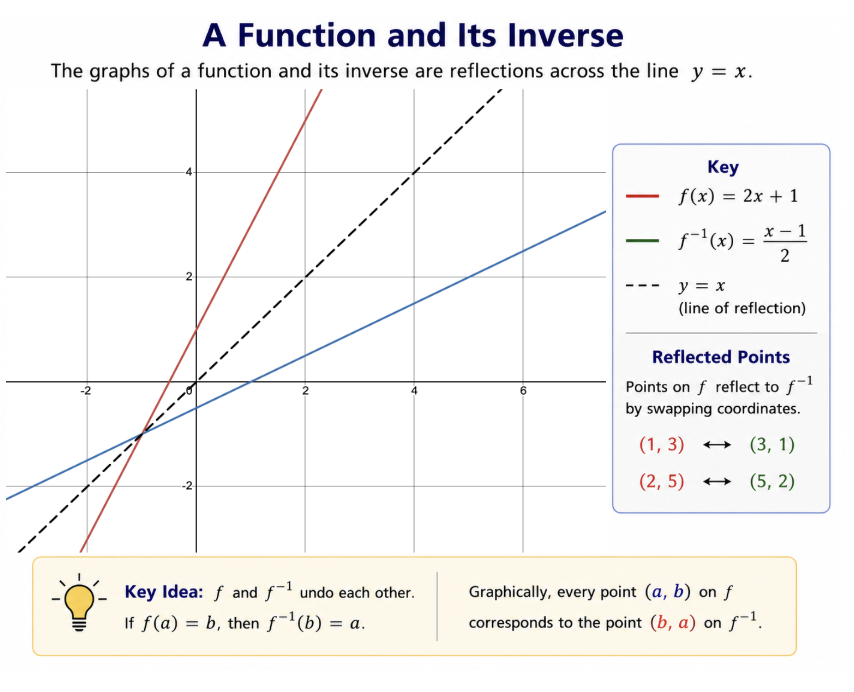
Because every point \((x,y)\) on the original function becomes \((y,x)\) on the inverse. The inputs become outputs, and the outputs become inputs.
Visually, the graph of \(f^{-1}\) is the reflection of the graph of \(f\) across the line
\[ y=x. \]
Not every function has an inverse.
A function has an inverse only if it is one-to-one, meaning each output comes from exactly one input.
A quick way to check this is the horizontal line test.
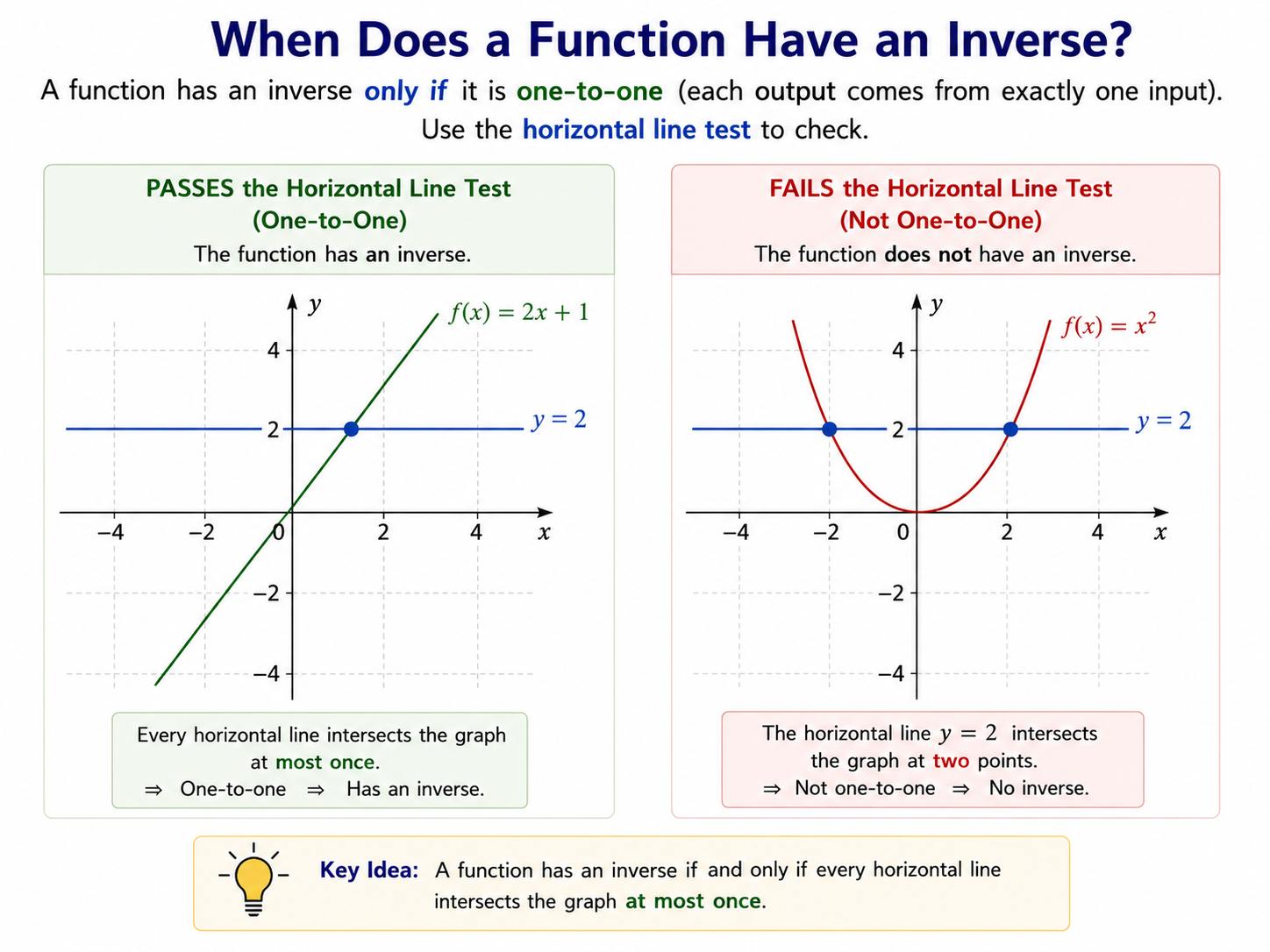
If every horizontal line intersects the graph at most once, the function is one-to-one and has an inverse.
Common Problem Types
1. Evaluating Inverses From Given Information
Using the fact that inverses switch inputs and outputs.
2. Determining If a Function Has an Inverse
Use the horizontal line test to determine whether the function is one-to-one.
3. Identifying Inverse Behavior on Graphs
Recognize that inverse functions are reflections across the line \(y = x\).
4. Finding an Inverse Algebraically
Write the function as \(y\), switch \(x\) and \(y\), then solve for the new \(y\).
Strategies
- When you see \(f(a) = b\), immediately know that \(f^{-1}(b) = a\).
- Use the horizontal line test to confirm one-to-one behavior.
- Remember that inverse functions swap inputs and outputs.
- Always distinguish between inverse functions and reciprocals—they are not the same.
- Think of inverses as undoing each step of the original function.
- To find an inverse algebraically: write the equation using \(y\), switch \(x\) and \(y\), then solve for \(y\).
Worked Examples
Example 1 — Evaluating an Inverse
If:
\[ f(3) = 7, \]
then inverses reverse the mapping:
\[ f^{-1}(7) = 3. \]
Example 2 — Finding an Inverse Algebraically
Find the inverse of
\[ f(x)=2x-3. \]
Write the function using \(y\):
\[ y=2x-3 \]
Switch \(x\) and \(y\):
\[ x=2y-3 \]
Solve for \(y\):
\[ x+3=2y \]
\[ y=\frac{x+3}{2} \]
Therefore,
\[ f^{-1}(x)=\frac{x+3}{2}. \]
Example 3 — Does a Function Have an Inverse?
A function has an inverse only if it passes the horizontal line test.
If a horizontal line touches the graph more than once, the function is not one-to-one and does not have an inverse function.
For example, \(f(x) = x^2\) does not have an inverse on all real numbers because many horizontal lines touch the parabola twice.
- Assuming every function has an inverse.
- Forgetting that inverses swap inputs and outputs.
- Confusing the reciprocal \(\dfrac{1}{f(x)}\) with the inverse function \(f^{-1}(x)\).
Practice Problems
- If \(f(2) = 9\), what is \(f^{-1}(9)\)?
- Does \(x^2\) have an inverse on all real numbers?
- What line is used when reflecting a function to get its inverse?
- If a function passes the horizontal line test, what does that tell you?
- If \(f(x) = x + 5\), find \(f^{-1}(x)\).
1.
\(f(2) = 9 \Rightarrow f^{-1}(9) = 2\)
2.
No. The function \(x^2\) fails the horizontal line test on all real numbers.
3.
The line is:
\[ y = x \]
4.
It tells you the function is one-to-one and has an inverse function.
5.
Let:
\[ y = x + 5 \]
Switch \(x\) and \(y\):
\[ x = y + 5 \]
Solve for \(y\):
\[ y = x - 5 \]
So:
\[ f^{-1}(x) = x - 5 \]
Summary
- An inverse function reverses the original function’s input-output relationship.
- Inverses satisfy \(f(f^{-1}(x)) = x\) and \(f^{-1}(f(x)) = x\).
- A function must be one-to-one to have an inverse.
- Use the horizontal line test to check whether a graph is one-to-one.
- Graphs of inverses are reflections across the line \(y = x\).
- Inverse does not mean reciprocal.
If you know \(f(a)=b\), then \(f^{-1}(b)=a\).
Every point \((a,b)\) becomes \((b,a)\) on the inverse.
Reflect across \(y=x\) to visualize inverses.
To find an inverse algebraically:
- Write the equation using \(y\).
- Switch \(x\) and \(y\).
- Solve for \(y\).
Use the horizontal line test before finding an inverse.
Inverse does not mean reciprocal.