Compound Inequalities
By the end of this lesson, you’ll be able to:
- Interpret and solve compound inequalities using and or or.
- Write and understand interval notation.
- Represent solution sets on a number line.
Key Ideas
A compound inequality joins two inequalities using and or or.
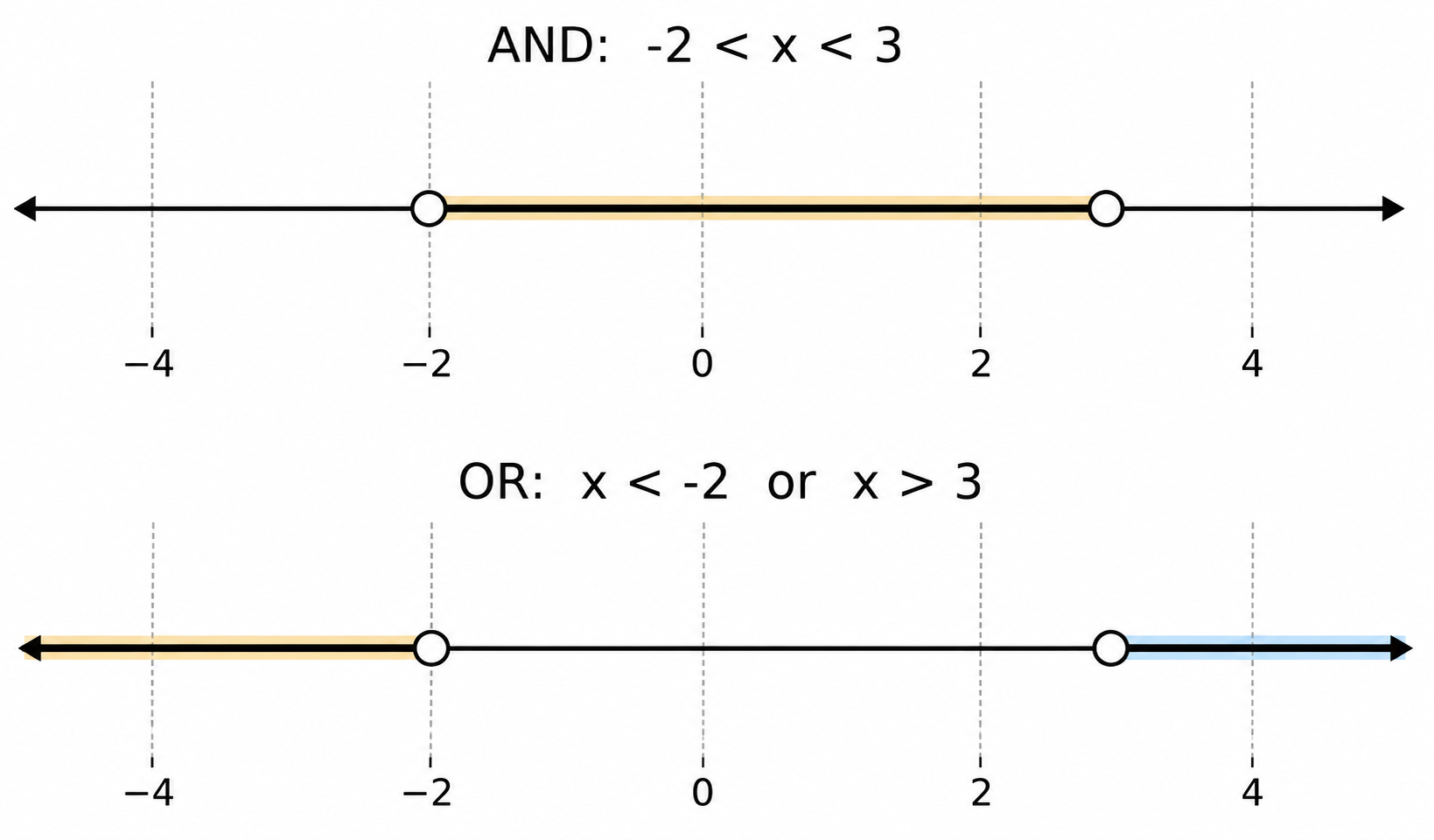
AND (both conditions must be true)
\[
a < x < b
\]
Means \(x\) is between \(a\) and \(b\).
OR (either condition may be true)
\[
x < -2 \quad \text{or} \quad x > 5
\]
Means two separate intervals.
Common Problem Types
1. AND Inequalities
Chained style: \(a < bx + c < d\)
2. OR Inequalities
Separate inequalities joined by “or.”
3. Solving in Steps
Solve each inequality individually, then combine the results.
4. Interpreting Graphs
Recognize when intervals overlap (AND) or split (OR).
Strategies
- Decide whether the connector is and or or before solving.
- For chained inequalities, perform the same operation on all three parts.
- For or problems, solve each inequality separately.
- Sketch a quick number line to see whether intervals overlap or split.
- Check endpoint symbols carefully: open circle for \(<\) or \(>\), closed circle for \(\le\) or \(\ge\).
Worked Examples
Example 1 — AND
\[ -1 < 2x + 3 < 7 \]
Subtract 3 → \(-4 < 2x < 4\)
Divide → \(-2 < x < 2\)
Example 2 — OR
Solve: \[ 3x - 1 \ge 5 \quad \text{or} \quad 2x + 4 < 0 \]
Left: \(x \ge 2\)
Right: \(x < -2\)
Final: \(x < -2\) or \(x \ge 2\)
- Mixing up AND and OR shapes.
- Forgetting to flip the inequality when dividing by a negative.
- Combining the solutions incorrectly.
Practice Problems
- \(1 < 2x + 5 < 9\)
- \(x - 4 \le -3\) or \(2x + 1 \ge 7\)
- \(-6 \le 3x + 6 \le 9\)
- \(2x - 3 > 5\) or \(x + 1 < 0\)
1. \(1 < 2x + 5 < 9\)
Subtract \(5\) from all three parts:
\[ -4 < 2x < 4 \]
Divide all three parts by \(2\):
\[ -2 < x < 2 \]
Answer: \(-2 < x < 2\)
2. \(x - 4 \le -3\) or \(2x + 1 \ge 7\)
Solve the first inequality:
\[ x - 4 \le -3 \]
Add \(4\):
\[ x \le 1 \]
Solve the second inequality:
\[ 2x + 1 \ge 7 \]
Subtract \(1\):
\[ 2x \ge 6 \]
Divide by \(2\):
\[ x \ge 3 \]
Combine with or:
\[ x \le 1 \quad \text{or} \quad x \ge 3 \]
Answer: \(x \le 1\) or \(x \ge 3\)
3. \(-6 \le 3x + 6 \le 9\)
Subtract \(6\) from all three parts:
\[ -12 \le 3x \le 3 \]
Divide all three parts by \(3\):
\[ -4 \le x \le 1 \]
Answer: \(-4 \le x \le 1\)
4. \(2x - 3 > 5\) or \(x + 1 < 0\)
Solve the first inequality:
\[ 2x - 3 > 5 \]
Add \(3\):
\[ 2x > 8 \]
Divide by \(2\):
\[ x > 4 \]
Solve the second inequality:
\[ x + 1 < 0 \]
Subtract \(1\):
\[ x < -1 \]
Combine with or:
\[ x > 4 \quad \text{or} \quad x < -1 \]
Answer: \(x > 4\) or \(x < -1\)
Summary
- AND → overlap region; OR → two separate intervals.
- Solve each inequality separately, then combine logically.
- Flip sign only when dividing by a negative.
- “AND” = intersection. “OR” = union.
- Use number lines to visualize split vs overlap.
- Check each solution interval separately.