Independent vs. Dependent Events
By the end of this lesson, you’ll be able to:
- Determine whether two events are independent or dependent.
- Explain how one event can change the probability of another.
- Calculate probabilities for independent and dependent events.
- Understand how replacement affects repeated selections.
- Use conditional probability and tree diagrams to represent dependent events.
Key Ideas
Two events can be independent or dependent depending on whether the occurrence of one changes the probability of the other.
The key question is:
Does knowing that the first event occurred change the probability of the second event?
If no → independent
If yes → dependent
Independent Events
Events \(A\) and \(B\) are independent when the occurrence of one does not change the probability of the other.
For independent events:
\[ P(B\mid A)=P(B) \]
Therefore:
\[ \boxed{ P(A\text{ and }B)=P(A)P(B) } \]
For example, consider flipping a fair coin twice.
The probability of heads on the first flip is:
\[ \frac12 \]
After getting heads, the probability of heads on the second flip is still:
\[ \frac12 \]
The first flip does not affect the second.
Therefore, the events are:
\[ \boxed{\text{independent}} \]
and:
\[ P(HH) = \frac12\cdot\frac12 = \boxed{\frac14} \]
Dependent Events
Events \(A\) and \(B\) are dependent when the occurrence of one changes the probability of the other.
For dependent events:
\[ \boxed{ P(A\text{ and }B) = P(A)\cdot P(B\mid A) } \]
The notation:
\[ P(B\mid A) \]
means:
the probability of \(B\) given that \(A\) has occurred.
For example, suppose a bag contains:
- 5 red marbles
- 3 blue marbles
If one marble is selected and not replaced, the contents of the bag change.
Originally:
\[ P(\text{blue})=\frac38 \]
If a red marble is selected first, only 7 marbles remain:
- 4 red
- 3 blue
Now:
\[ P(\text{blue}\mid\text{first red}) = \frac37 \]
Because:
\[ \frac37\ne\frac38 \]
the first selection changed the probability of the second.
Therefore, the events are:
\[ \boxed{\text{dependent}} \]
Replacement and Independence
Replacement is especially important in problems involving repeated selections.
With Replacement
Suppose a bag contains:
- 5 red marbles
- 3 blue marbles
A marble is selected, recorded, and then returned to the bag before another marble is selected.
Before each selection, the bag again contains:
\[ 8 \]
marbles.
For example:
\[ P(\text{red on first draw})=\frac58 \]
and after replacement:
\[ P(\text{red on second draw})=\frac58 \]
The probabilities are restored.
In this type of random-draw problem, the events are independent.
Without Replacement
Now suppose the first marble is not returned.
If the first marble is red, the bag changes from:
\[ 5\text{ red and }3\text{ blue} \]
to:
\[ 4\text{ red and }3\text{ blue} \]
The second probability is therefore different:
\[ P(\text{second red}\mid\text{first red}) = \frac47 \]
The events are dependent.
For standard random-selection problems:
- with replacement → usually independent
- without replacement → usually dependent
The deeper question is always whether the first outcome changes the probability of the next outcome.
Probability Trees
A tree diagram organizes the possible outcomes of a multi-step probability experiment.
Each branch represents a possible outcome and its probability.
For example, suppose a bag contains:
- 2 red marbles
- 1 blue marble
Two marbles are selected without replacement.
The first selection has probabilities:
\[ P(R)=\frac23 \]
and:
\[ P(B)=\frac13 \]
If the first marble is red, the remaining bag contains:
- 1 red
- 1 blue
so:
\[ P(R\mid R)=\frac12 \]
and:
\[ P(B\mid R)=\frac12 \]
If the first marble is blue, both remaining marbles are red:
\[ P(R\mid B)=1 \]
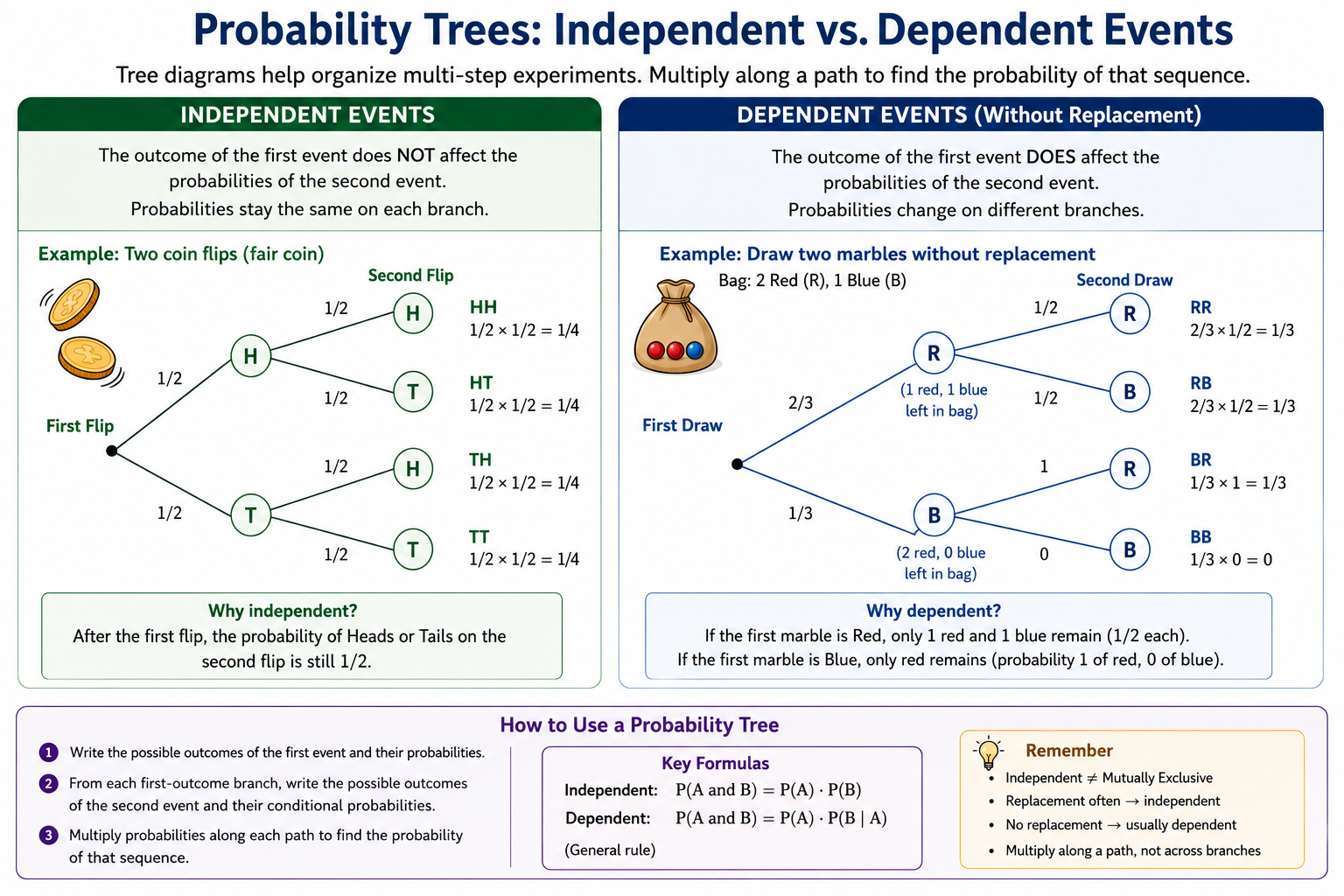
To find the probability of a particular path through the tree, multiply the probabilities along that path.
For example:
\[ P(R\text{ then }B) = \frac23\cdot\frac12 = \boxed{\frac13} \]
Common Problem Types
1. Identifying Independence
Ask whether the first outcome changes the probability of the second.
Example:
A fair coin is flipped twice.
The probability of heads on the second flip is always:
\[ \frac12 \]
regardless of what happened on the first flip.
Therefore:
\[ \boxed{\text{independent}} \]
2. Card Draws With Replacement
A card is drawn from a standard deck, replaced, and then another card is drawn.
Suppose we want two queens.
There are 4 queens among 52 cards.
Because the first card is replaced:
\[ P(\text{queen on second draw}) = \frac{4}{52} \]
just as on the first draw.
Therefore:
\[ P(\text{two queens}) = \frac{4}{52}\cdot\frac{4}{52} = \boxed{\frac{1}{169}} \]
3. Card Draws Without Replacement
Suppose two cards are drawn without replacement.
What is the probability that both are black?
Initially there are:
\[ 26 \]
black cards among 52 cards.
So:
\[ P(\text{first black}) = \frac{26}{52} \]
If the first card is black, there are now:
\[ 25 \]
black cards among:
\[ 51 \]
remaining cards.
Therefore:
\[ P(\text{both black}) = \frac{26}{52}\cdot\frac{25}{51} = \boxed{\frac{25}{102}} \]
4. Selecting Objects Without Replacement
Choosing objects from a group without putting them back typically creates dependence.
Example:
A bag contains 6 green and 4 yellow marbles.
Two marbles are selected without replacement.
If the first marble is green, the probability of green changes from:
\[ \frac{6}{10} \]
to:
\[ \frac59 \]
Because the probability changed, the events are dependent.
5. Conditional Probability
Sometimes the problem directly tells you that one event has already occurred.
For example:
\[ P(B\mid A) \]
means:
What is the probability of \(B\) given that \(A\) has occurred?
If:
\[ P(B\mid A)\ne P(B) \]
then knowing \(A\) occurred changes the probability of \(B\).
The events are dependent.
If:
\[ P(B\mid A)=P(B) \]
then the events are independent.
6. Reading a Probability Tree
Tree diagrams are especially useful when probabilities change from one step to the next.
Remember:
- branches show possible outcomes
- branch labels show probabilities
- multiply along a path to find the probability of that sequence
For dependent events, later branches may have different probabilities depending on what happened earlier.
Independent Is NOT the Same as Mutually Exclusive
These ideas are easy to confuse.
Independent events can occur together, and one does not change the probability of the other.
Mutually exclusive events cannot occur together.
For example, on one roll of a die:
- rolling an even number
- rolling an odd number
are mutually exclusive because one roll cannot be both even and odd.
But they are not independent.
If you know the roll is even, then:
\[ P(\text{odd}\mid\text{even})=0 \]
even though normally:
\[ P(\text{odd})=\frac12 \]
Knowing one event occurred completely changed the probability of the other.
Do not confuse:
Independent → one event does not affect the probability of the other.
Mutually exclusive → the events cannot happen at the same time.
Strategies
Ask the Key Question
Ask:
Does knowing the first event occurred change the probability of the second?
If no:
\[ \boxed{\text{independent}} \]
If yes:
\[ \boxed{\text{dependent}} \]
Check for Replacement
For repeated random selections:
- with replacement → probabilities are usually restored
- without replacement → probabilities usually change
Update Both the Favorable Count and the Total
For sampling without replacement, remember that the total number of objects decreases.
For example:
\[ \frac{5}{8} \]
might become:
\[ \frac{4}{7} \]
after one favorable object is removed.
Do not keep the original denominator.
Use Conditional Probability
For dependent events, write:
\[ P(B\mid A) \]
to remind yourself that the probability of \(B\) depends on what happened in event \(A\).
Use a Tree for Multiple Steps
A tree diagram can make changing probabilities easier to track.
Multiply probabilities along the branches of the path you want.
Worked Examples
Example 1 — Marbles Without Replacement
A bag contains:
- 5 red marbles
- 3 blue marbles
Two marbles are selected without replacement.
What is the probability of selecting red and then blue?
For the first selection:
\[ P(\text{red}) = \frac58 \]
After selecting a red marble, there are:
- 4 red marbles
- 3 blue marbles
- 7 total marbles
Therefore:
\[ P(\text{blue}\mid\text{first red}) = \frac37 \]
Multiply:
\[ P(\text{red then blue}) = \frac58\cdot\frac37 = \boxed{\frac{15}{56}} \]
Example 2 — Two Coin Flips
A fair coin is flipped twice.
What is the probability of heads followed by tails?
The first flip does not affect the second.
Therefore, the events are independent.
\[ P(H\text{ then }T) = \frac12\cdot\frac12 = \boxed{\frac14} \]
Example 3 — With vs. Without Replacement
A bag contains 3 red and 2 blue marbles.
What is the probability of drawing two red marbles?
With Replacement
The probability of red is:
\[ \frac35 \]
on both draws.
Therefore:
\[ P(\text{two red}) = \frac35\cdot\frac35 = \boxed{\frac{9}{25}} \]
Without Replacement
After one red marble is selected, only:
\[ 2 \]
red marbles remain among:
\[ 4 \]
total marbles.
Therefore:
\[ P(\text{two red}) = \frac35\cdot\frac24 = \boxed{\frac{3}{10}} \]
The two answers differ because replacement changes whether the second probability stays the same.
Example 4 — Test Independence From Probabilities
Suppose:
\[ P(A)=0.40 \]
and:
\[ P(A\mid B)=0.40 \]
Knowing that \(B\) occurred did not change the probability of \(A\).
Therefore:
\[ \boxed{A\text{ and }B\text{ are independent}} \]
Now suppose instead:
\[ P(A\mid B)=0.65 \]
Since:
\[ 0.65\ne0.40 \]
knowing that \(B\) occurred changes the probability of \(A\).
Therefore:
\[ \boxed{A\text{ and }B\text{ are dependent}} \]
- Treating dependent events as though their probabilities stay unchanged.
- Forgetting to reduce the total after selecting without replacement.
- Updating the numerator but forgetting to update the denominator.
- Assuming every two-step experiment is independent.
- Assuming replacement is the definition of independence rather than checking whether probabilities change.
- Confusing independent events with mutually exclusive events.
- Ignoring information given by conditional probabilities.
- Adding probabilities along a tree path instead of multiplying them.
Practice Problems
A fair coin is flipped twice. Are the two flips independent or dependent?
Two cards are drawn from a standard deck with replacement. What is the probability that both cards are queens?
Two cards are drawn from a standard deck without replacement. What is the probability that both cards are black?
Two students are randomly selected from a class of 30 without replacement. Are the selections independent or dependent?
A bag contains 4 red and 6 blue marbles. Two marbles are drawn without replacement. What is the probability of drawing two red marbles?
Suppose \(P(A)=0.30\) and \(P(A\mid B)=0.30\). Are \(A\) and \(B\) independent or dependent?
Suppose \(P(A)=0.30\) and \(P(A\mid B)=0.50\). Are \(A\) and \(B\) independent or dependent?
1. The outcome of the first coin flip does not affect the probability of the second.
The probability of heads or tails remains:
\[ \frac12 \]
on the second flip.
Therefore:
\[ \boxed{\text{independent}} \]
2. There are 4 queens among 52 cards.
Because the first card is replaced, the deck returns to its original composition.
Therefore:
\[ P(\text{two queens}) = \frac{4}{52}\cdot\frac{4}{52} \]
Simplify:
\[ P(\text{two queens}) = \frac{1}{13}\cdot\frac{1}{13} = \boxed{\frac{1}{169}} \]
3. Initially there are 26 black cards among 52 cards.
After drawing one black card without replacement, there are:
\[ 25 \]
black cards among:
\[ 51 \]
remaining cards.
Therefore:
\[ P(\text{both black}) = \frac{26}{52}\cdot\frac{25}{51} \]
Simplify:
\[ P(\text{both black}) = \frac12\cdot\frac{25}{51} = \boxed{\frac{25}{102}} \]
4. After the first student is selected, only:
\[ 29 \]
students remain available for the second selection.
The first selection changes the possible outcomes for the second.
Therefore:
\[ \boxed{\text{dependent}} \]
5. There are:
\[ 4+6=10 \]
total marbles.
The probability of drawing red first is:
\[ \frac{4}{10} \]
After one red marble is removed, there are:
- 3 red marbles
- 9 total marbles
remaining.
Therefore:
\[ P(\text{two red}) = \frac{4}{10}\cdot\frac39 \]
Simplify:
\[ P(\text{two red}) = \boxed{\frac{2}{15}} \]
6. Compare:
\[ P(A)=0.30 \]
and:
\[ P(A\mid B)=0.30 \]
The probability of \(A\) did not change when we learned that \(B\) occurred.
Therefore:
\[ \boxed{\text{independent}} \]
7. Compare:
\[ P(A)=0.30 \]
and:
\[ P(A\mid B)=0.50 \]
The probability changed.
Therefore:
\[ \boxed{\text{dependent}} \]
Summary
Two events are independent when one does not change the probability of the other.
For independent events:
\[ \boxed{ P(A\text{ and }B)=P(A)P(B) } \]
Two events are dependent when one changes the probability of the other.
For dependent events:
\[ \boxed{ P(A\text{ and }B) = P(A)P(B\mid A) } \]
In standard repeated-selection problems:
- with replacement → usually independent
- without replacement → usually dependent
The most important question is:
Does knowing one event occurred change the probability of the other?
- Ask: Does the first event change the next probability?
- No change → independent.
- Probability changes → dependent.
- With replacement → usually independent.
- Without replacement → usually dependent.
- Without replacement → update the numerator and denominator.
- \(P(B\mid A)\) means the probability of \(B\) given \(A\).
- Independent is not the same as mutually exclusive.
- On a probability tree, multiply along a path.