Function Concepts & Notation
By the end of this lesson, you’ll be able to:
- Understand what a function is and how it behaves.
- Interpret and use function notation such as \(f(x)\).
- Distinguish functions from non-functions using graphs and tables.
Key Ideas
A function is a rule that assigns exactly one output to each valid input.
Key points:
- Written as \(f(x)\) and read “\(f\) of \(x\).”
- The input is the independent variable; the output depends on it.
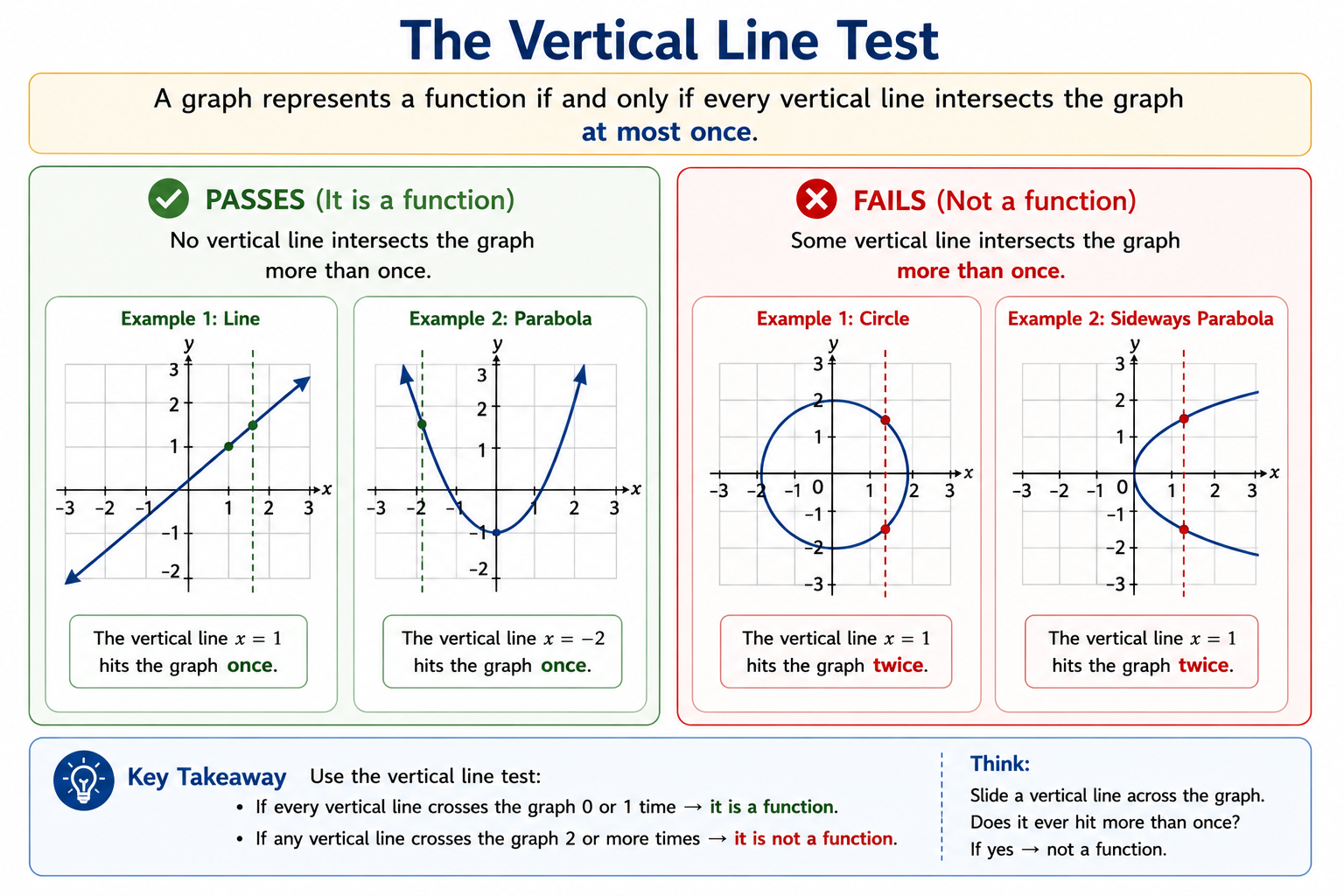
- A graph represents a function if and only if it passes the vertical line test.
Common Problem Types
1. Evaluating Functions
Plug a value into the expression to find the output.
2. Determining Whether a Relation Is a Function
Check whether each input produces only one output.
3. Using Tables, Graphs, or Mappings
Use the vertical line test for graphs; check for repeated inputs in tables.
4. Reading Function Notation
Expressions like \(f(a+2)\) or \(g(3)\) simply mean “evaluate at that input.”
Strategies
- Treat \(f(x)\) as a label, not multiplication—it’s just the name of the function.
- Replace \(x\) with the given input everywhere inside the expression.
- When checking a graph, imagine sliding a vertical line across it.
- For mapping diagrams, look for repeated inputs with different outputs.
- For equations, solve for \(y\) and check if any \(x\) produces multiple \(y\) values.
Worked Examples
Example 1 — Evaluate a Function
Given: \[ f(x) = 3x - 7 \] Find \(f(2)\).
Solution:
\[
\begin{split}
f(2) &= 3(2) - 7 \\
&= -1
\end{split}
\]
Example 2 — Is It a Function?
Relation shown:
Input → Output
1 → 4
1 → 5
Explanation:
Input 1 has two different outputs, so the relation is not a function.
- Interpreting \(f(x)\) as multiplication instead of a function label.
- Mixing up inputs and outputs when evaluating.
- Believing a relation is a function even when a single input maps to multiple outputs.
Practice Problems
- If \(g(x) = x^2 + 1\), find \(g(3)\).
- Does \(x^2 = y\) represent a function?
- Is a circle a function?
- If \(f(t) = 5 - 2t\), find \(f(-3)\).
- Is the mapping \(a \to 3\) and \(a \to 4\) a function?
1.
\[
g(3) = 3^2 + 1 = 10
\]
2.
Yes—each \(x\) produces exactly one \(y\).
3.
No—vertical lines hit the circle twice, so it fails the vertical line test.
4.
\[
f(-3) = 5 - 2(-3) = 11
\]
5.
No—a single input (\(a\)) maps to two outputs.
Summary
- A function assigns exactly one output to each input.
- Use \(f(x)\) to denote the value of the function at input \(x\).
- Check functions using the vertical line test for graphs.
- A relation is not a function if an input maps to multiple outputs.
- Function notation represents evaluation, not multiplication.
- \(f(x)\) is a name, not a product—treat it like “the value of the function.”
- Use vertical line test for graphs; check repeated inputs for tables.
- Plug in inputs carefully when evaluating expressions.
- If one input has two outputs, it’s automatically not a function.