Domain & Range
By the end of this lesson, you’ll be able to:
- Determine the domain and range of a function from formulas, graphs, and tables.
- Identify restrictions caused by denominators, square roots, and logarithms.
- Interpret domain and range in real-world contexts.
Key Ideas
The domain is the set of allowed inputs.
The range is the set of resulting outputs.
Certain expressions impose natural restrictions:
- Denominators cannot be zero.
- Square roots require a nonnegative radicand.
- Logarithms require positive inputs.
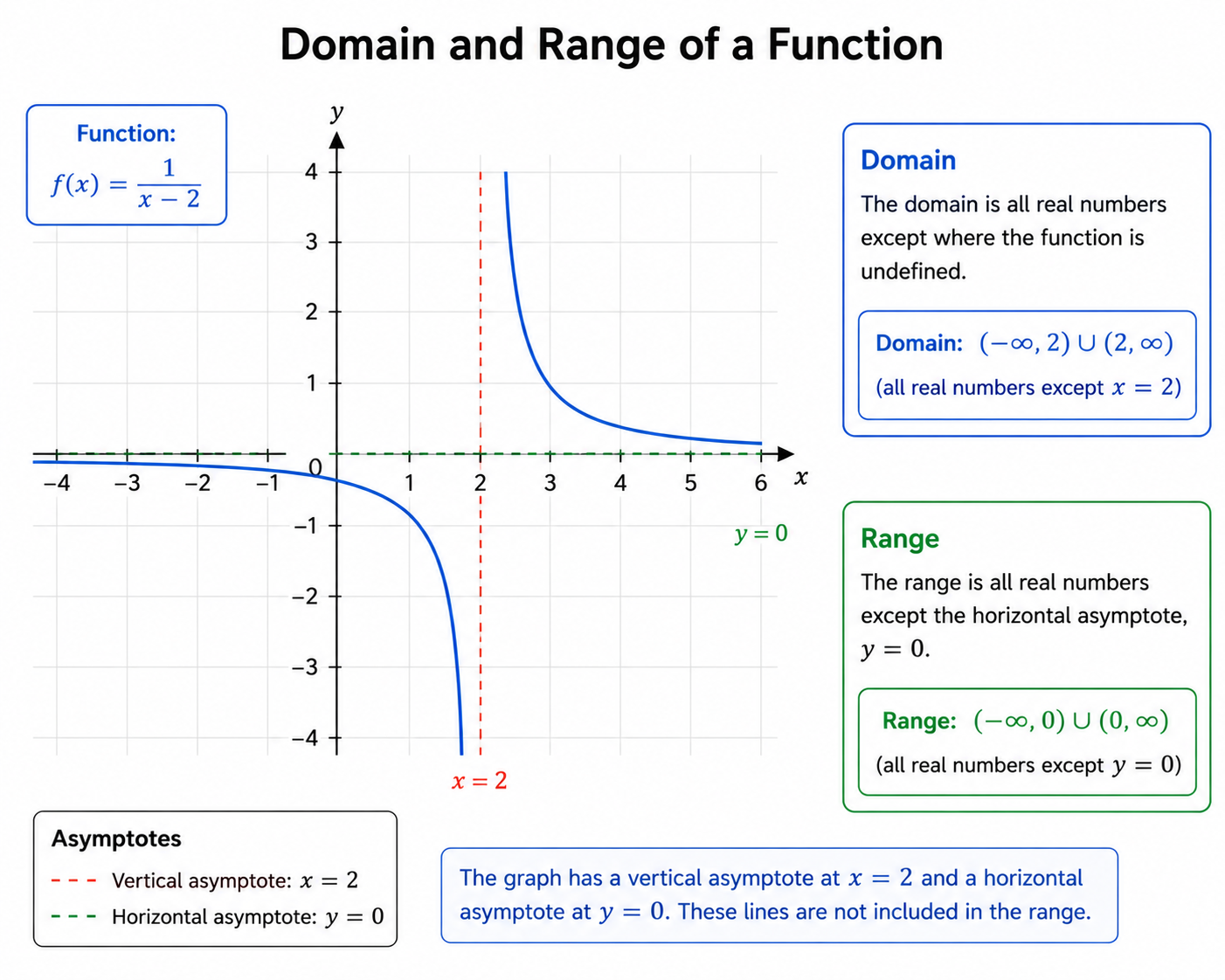
Graphs also show domain and range visually:
- Domain → all \(x\)-values where the graph exists.
- Range → all \(y\)-values that appear on the graph.
Common Problem Types
1. Formula-Based Domain
Determine which \(x\)-values make the expression valid.
2. Graph-Based Domain & Range
Read the leftmost/rightmost points (domain) and lowest/highest points (range).
3. Square Root Expressions
Solve inequalities of the form radicand \(\ge 0\).
4. Rational Expressions
Exclude values that make the denominator zero.
5. Logarithmic Functions
Solve inequalities of the form inside \(> 0\).
Strategies
- Start with the expression and check for restrictions.
- If the expression has no denominators, square roots, or logs, the domain is typically all real numbers.
- Use the graph to confirm domain edges and output behavior.
- For range questions, plug in key domain points or use the graph to locate minimums/maximums.
- In real-world contexts, interpret what values make sense physically.
Worked Examples
Example 1 — Denominator Restriction
Find the domain of: \[ g(x) = \frac{1}{x - 4} \]
Denominator cannot be zero: \[ x - 4 \ne 0 \quad \Rightarrow \quad x \ne 4. \]
Domain: all real numbers except \(4\).
Example 2 — Square Root Restriction
Find domain and range of: \[ h(x) = \sqrt{x - 5} \]
Radicand must be nonnegative: \[ x - 5 \ge 0 \quad \Rightarrow \quad x \ge 5. \]
Since square roots produce nonnegative outputs: \[ \text{Range: } y \ge 0. \]
- Mixing up domain and range—domain is inputs, range is outputs.
- Allowing negative values inside a square root.
- Ignoring denominator restrictions.
- Forgetting that logarithms require positive inputs.
Practice Problems
- Domain of \(f(x) = \sqrt{9 - x}\).
- Domain of \(t(x) = \dfrac{4}{x + 7}\).
- Range of \(y = x^2\).
- Domain of \(g(x) = \ln(x - 1)\).
- Range of \(f(x) = \sqrt{x}\).
1.
\(9 - x \ge 0 \Rightarrow x \le 9\)
2.
Denominator \(\ne 0\) → \(x \ne -7\)
3.
\(x^2 \ge 0\) for all real \(x\) → \(y \ge 0\)
4.
Inside of log must be \(> 0\):
\[
x - 1 > 0 \Rightarrow x > 1
\]
5.
Square root outputs are nonnegative → \(y \ge 0\)
Summary
- Domain describes allowable inputs; range describes the possible outputs.
- Square roots, denominators, and logarithms create common domain restrictions.
- Use inequality reasoning to determine allowable values.
- Graphs provide visual cues for domain and range.
- Range often depends on both algebraic reasoning and graphical behavior.
- Check for denominators, square roots, and logs—these create most restrictions.
- For graphs, scan horizontally for domain and vertically for range.
- Range often begins at a minimum or maximum value—look for turning points.
- In applied problems, consider what inputs make sense in context.