Graphing Lines in Slope-Intercept Form
By the end of this lesson, you’ll be able to:
- Identify slope \(m\) and y-intercept \(b\) in \(y = mx + b\).
- Graph lines by starting at the intercept and using slope.
- Explain how slope and intercept affect the shape and position of a line.
Key Ideas
Slope-intercept form is the most graph-friendly way to write a linear equation:
\[ y = mx + b \]
- \(m\) = slope (the “tilt” — rise over run)
- \(b\) = y-intercept (where the line crosses the y-axis)
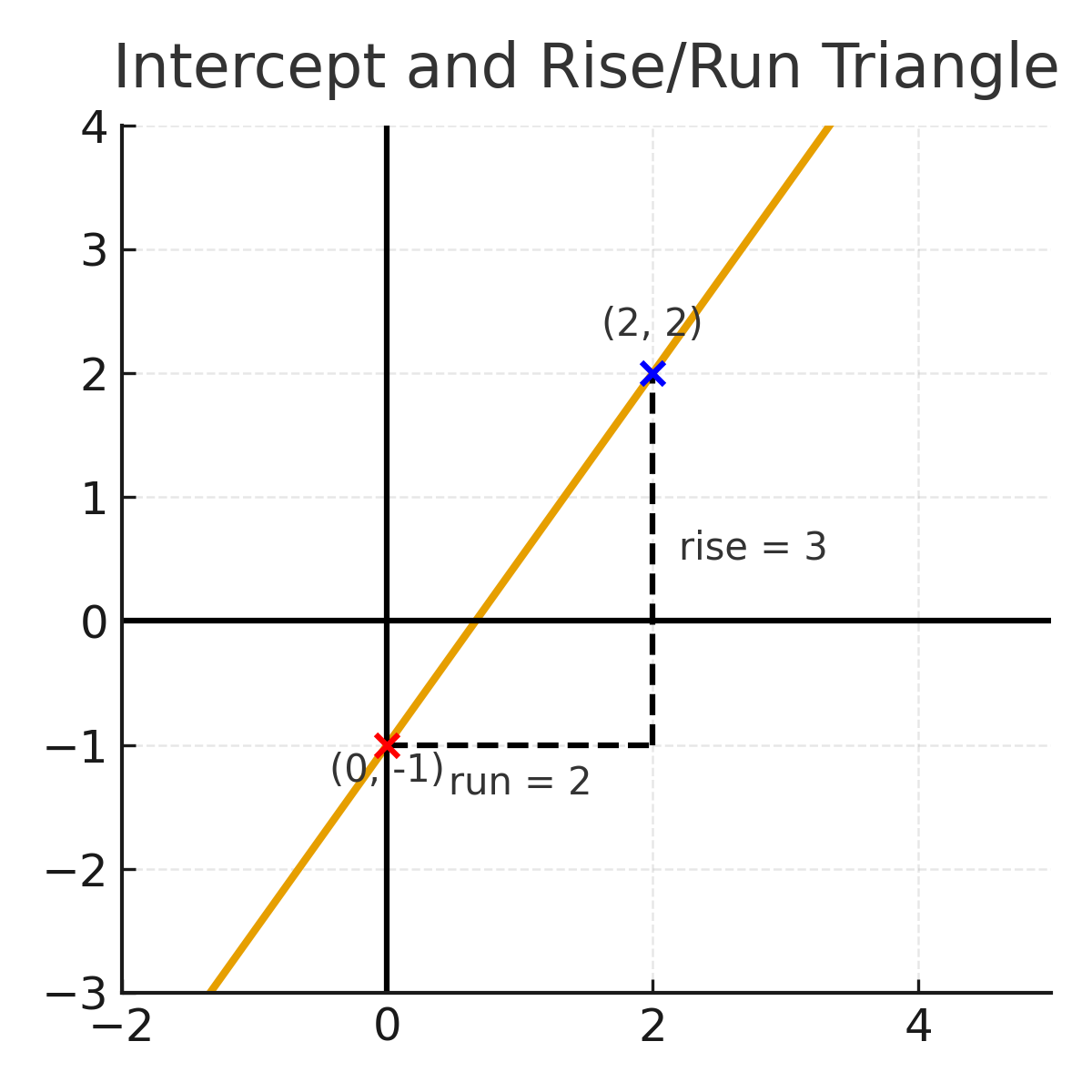
To graph a line:
- Plot the point \((0, b)\) on the y-axis.
- Use slope \(m = \frac{\text{rise}}{\text{run}}\) to move to a second point.
- Draw a straight line through both points.
Common Problem Types
1. Graphing using slope and intercept
Graph \(y = 2x - 3\):
- \(m = 2 = \frac{2}{1}\)
- \(b = -3\)
Plot \((0, -3)\), then go up 2, right 1.
2. Identify slope/intercept from a graph
- Intercept = the point where the line touches the y-axis
- Slope = compute rise/run using any two clear lattice points
3. Writing an equation from a description
Example: “Slope 4, passes through \((0, -1)\).”
Because \((0, -1)\) is the intercept:
\[ y = 4x - 1 \]
Strategies
- Write slope as a fraction (even whole numbers like \(3\) → \(\frac{3}{1}\)).
- Always start by plotting the y-intercept, not x-intercept.
- Use a rise/run triangle to avoid sign mistakes.
- If slope is negative, think “up and left” or “down and right.”
- Use two points to draw a more accurate line (not just one).
Worked Examples
Example 1
Graph \(y = -\frac{1}{2}x + 4\).
- \(b = 4\) → start at \((0, 4)\)
- \(m = -\frac{1}{2}\) → down 1, right 2
Plot \((0, 4)\) and then \((2, 3)\), then draw the line.
Example 2
Find the slope-intercept equation from two points: \((1, 3)\) and \((5, 11)\).
Find slope:
\[ m = \frac{11 - 3}{5 - 1} = \frac{8}{4} = 2 \]
Plug into \(y = mx + b\) using point \((1, 3)\):
\[ 3 = 2(1) + b \Rightarrow b = 1 \]
Final equation:
\[ y = 2x + 1 \]
- Using run/rise instead of rise/run.
- Plotting the intercept on the x-axis by accident.
- Forgetting that slope is directional and can be negative.
- Dropping the sign on the y-intercept.
Practice Problems
- Graph \(y = 3x - 2\).
- Graph \(y = -x + 5\).
- Identify slope/intercept: \(y = \frac{1}{3}x - 4\).
- Write equation through \((0, -2)\) and \((3, 4)\).
- Write equation with slope \(-2\) and y-intercept \(7\).
1. Graph \(y = 3x - 2\).
Identify the slope and y-intercept.
\[ m=3=\frac{3}{1} \]
\[ b=-2 \]
Plot the y-intercept \((0,-2)\).
Use the slope \(\frac{3}{1}\):
- up 3
- right 1
This gives a second point at \((1,1)\).
Plot both points and draw a straight line through them.
2. Graph \(y = -x + 5\).
Identify the slope and y-intercept.
\[ m=-1=-\frac{1}{1} \]
\[ b=5 \]
Plot the y-intercept \((0,5)\).
Use the slope \(-\frac{1}{1}\):
- down 1
- right 1
This gives a second point at \((1,4)\).
Plot both points and draw a straight line through them.
3. Identify slope and intercept: \(y = \frac{1}{3}x - 4\).
Compare with
\[ y=mx+b \]
Therefore:
\[ m=\frac13 \]
\[ b=-4 \]
Slope = \(\frac13\), y-intercept = \(-4\).
4. Write the equation through \((0,-2)\) and \((3,4)\).
Find the slope:
\[ m=\frac{4-(-2)}{3-0} =\frac{6}{3} =2 \]
Since one point is \((0,-2)\), the y-intercept is
\[ b=-2 \]
Substitute into
\[ y=mx+b \]
\[ y=2x-2 \]
5. Write the equation with slope \(-2\) and y-intercept \(7\).
Use
\[ y=mx+b \]
Substitute the given values:
\[ y=-2x+7 \]
Summary
- In \(y = mx + b\), slope tells how steep the line is, and \(b\) tells where it crosses the y-axis.
- Graph by plotting the intercept and applying rise/run.
- A line is fully determined by its slope and y-intercept.
- Rewrite slope as a fraction to graph it more easily.
- Start at the y-intercept every time.
- Negative slope means the line goes down as you move right.
- Use at least two points for accuracy.