Graphing Parabolas
By the end of this lesson, you’ll be able to:
- Identify a parabola’s vertex, axis of symmetry, and direction of opening.
- Graph parabolas from vertex form and standard form.
- Relate the algebraic features of a quadratic to geometric features on its graph.
Key Ideas
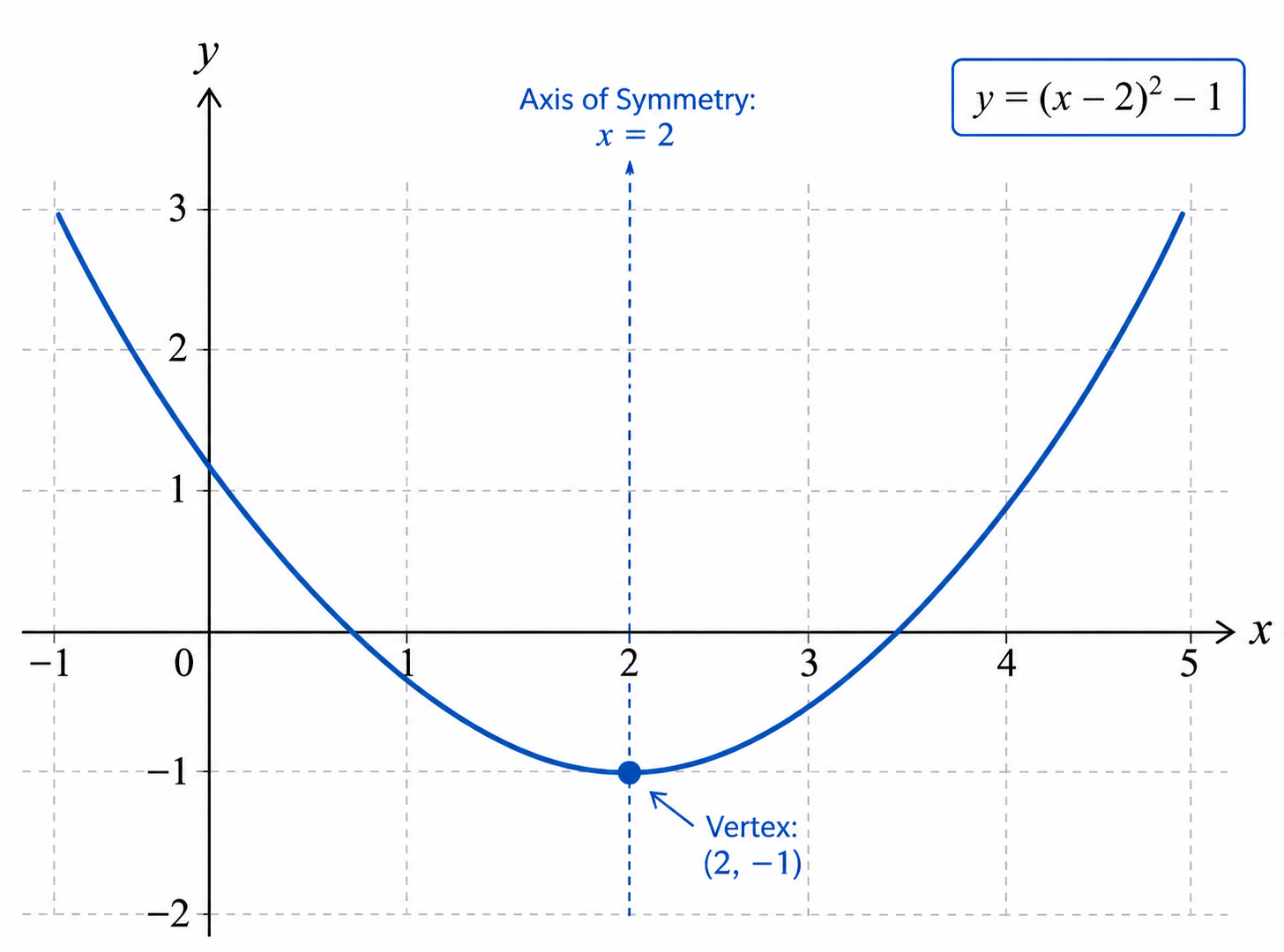
A parabola is the U-shaped graph of any quadratic function. Every parabola has:
- a vertex — its lowest or highest point
- an axis of symmetry — a vertical line that splits it into mirror halves
- a direction of opening — either upward or downward
For a quadratic in vertex form:
\[ y = a(x - h)^2 + k \]
- Vertex: \((h, k)\)
- Axis of symmetry: \(x = h\)
- Opens up if \(a > 0\), down if \(a < 0\)
- Larger \(|a|\) → narrower graph; smaller \(|a|\) → wider graph
For a quadratic in standard form:
\[ y = ax^2 + bx + c \]
The vertex occurs at:
\[ \begin{split} x_v &= -\frac{b}{2a} \end{split} \]
Then compute \(y_v = f(x_v)\) to get the full vertex.
Geometrically, a parabola is the set of points equidistant from a point (the focus) and a line (the directrix).
You don’t need these for basic graphing, but they explain why the graph is perfectly symmetrical.
Common Problem Types
1. Identify key features from vertex form
Read off \((h, k)\) and determine the opening direction from the sign of \(a\).
2. Find the vertex from standard form
Use \(x_v = -\frac{b}{2a}\), then compute \(y_v\).
3. Sketch graphs
Plot the vertex, reflect points across the axis, determine width from \(a\).
4. Use symmetry and a table of values
Always choose points on both sides of the axis.
Strategies
Start with the vertex — it anchors the entire graph.
Use the axis of symmetry to get matching points quickly.
Check the sign of \(a\) early to avoid graphing in the wrong direction.
When in standard form, use:
\[ \begin{split} x_v &= -\frac{b}{2a} \end{split} \]
Build a small, efficient table with symmetric \(x\)-values (e.g., \(h - 1\), \(h\), \(h + 1\)).
Worked Examples
Example 1 — Vertex Form
Graph: \[ y = 2(x - 1)^2 + 3 \]
Solution:
Identify key values: \(a = 2\), \(h = 1\), \(k = 3\).
Vertex: \((1, 3)\)
Axis: \(x = 1\)
Opening: \(a > 0\) → opens upward (and is narrower than \(y = x^2\))
Build a quick table:
- \(x = 1\): \(y = 3\) (vertex)
- \(x = 2\): \(y = 5\)
- \(x = 0\): \(y = 5\) (symmetry)
- \(x = 1\): \(y = 3\) (vertex)
Sketch the points and draw a smooth U-shape.
Example 2 — Standard Form
Graph: \[ y = -x^2 + 4x + 1 \]
Solution:
Identify \(a = -1\), \(b = 4\), \(c = 1\).
Find the vertex \(x\)-coordinate:
\[ \begin{split} x_v &= -\frac{b}{2a} \\ &= -\frac{4}{2(-1)} \\ &= 2 \end{split} \]
Evaluate \(y_v\):
\[ \begin{split} y_v &= f(2) \\ &= -(2)^2 + 4(2) + 1 \\ &= -4 + 8 + 1 \\ &= 5 \end{split} \]
Vertex: \((2, 5)\)
Axis: \(x = 2\)
Opening: \(a < 0\) → opens downward
Helpful points:
- \(y\)-intercept: \((0, 1)\)
- Additional symmetric points around \(x = 2\)
- \(y\)-intercept: \((0, 1)\)
- Mixing up \(h\) and \(k\) when reading vertex form.
- Forgetting the negative in the formula \(x_v = -\frac{b}{2a}\).
- Graphing the parabola in the wrong direction.
- Ignoring symmetry when plotting points.
Practice Problems
- For \(y = (x - 3)^2 - 4\), identify the vertex, axis, and direction.
- For \(y = -2(x + 1)^2 + 5\), find the vertex and its features.
- For \(y = x^2 - 4x + 1\), find the vertex and axis.
- For \(y = -\frac12 x^2 + 2x\), compute the vertex.
- For \(y = 3x^2 + 6x + 2\), find the vertex.
- For \(y=(x-3)^2-4\), identify the vertex, axis, and direction.
This equation is already in vertex form:
\[ y=a(x-h)^2+k \]
Comparing:
\[ y=(x-3)^2-4 \]
gives:
\[ a=1,\quad h=3,\quad k=-4 \]
Therefore:
- Vertex: \((3,-4)\)
- Axis of symmetry: \(x=3\)
- Since \(a=1>0\), the parabola opens upward.
Answer: Vertex \((3,-4)\), axis \(x=3\), opens up.
- For \(y=-2(x+1)^2+5\), find the vertex and its features.
Rewrite mentally as:
\[ y=-2(x-(-1))^2+5 \]
So:
\[ a=-2,\quad h=-1,\quad k=5 \]
Therefore:
- Vertex: \((-1,5)\)
- Axis of symmetry: \(x=-1\)
- Since \(a<0\), the parabola opens downward.
- Because \(|a|=2>1\), the parabola is narrower than \(y=x^2\).
Answer: Vertex \((-1,5)\), axis \(x=-1\), opens down.
- For \(y=x^2-4x+1\), find the vertex and axis.
This equation is in standard form:
\[ y=ax^2+bx+c \]
with
\[ a=1,\quad b=-4,\quad c=1. \]
Find the \(x\)-coordinate of the vertex:
\[ \begin{split} x_v &= -\frac{b}{2a} \\ &= -\frac{-4}{2(1)} \\ &= \frac{4}{2} \\ &= 2 \end{split} \]
Substitute \(x=2\) into the equation:
\[ \begin{split} y_v &= (2)^2-4(2)+1 \\ &= 4-8+1 \\ &= -3 \end{split} \]
Therefore:
- Vertex: \((2,-3)\)
- Axis of symmetry: \(x=2\)
Answer: \((2,-3)\) with axis \(x=2\).
- For \(y=-\frac12x^2+2x\), compute the vertex.
Identify:
\[ a=-\frac12,\qquad b=2 \]
Use the vertex formula:
\[ \begin{split} x_v &= -\frac{b}{2a} \\ &= -\frac{2}{2(-\frac12)} \\ &= -\frac{2}{-1} \\ &= 2 \end{split} \]
Now evaluate the function at \(x=2\):
\[ \begin{split} y_v &= -\frac12(2)^2+2(2) \\ &= -\frac12(4)+4 \\ &= -2+4 \\ &= 2 \end{split} \]
Therefore:
- Vertex: \((2,2)\)
- Axis of symmetry: \(x=2\)
- Since \(a<0\), the parabola opens downward.
Answer: \((2,2)\).
- For \(y=3x^2+6x+2\), find the vertex.
Identify:
\[ a=3,\quad b=6,\quad c=2 \]
Find the \(x\)-coordinate of the vertex:
\[ \begin{split} x_v &= -\frac{b}{2a} \\ &= -\frac{6}{2(3)} \\ &= -\frac{6}{6} \\ &= -1 \end{split} \]
Substitute \(x=-1\) into the equation:
\[ \begin{split} y_v &= 3(-1)^2+6(-1)+2 \\ &= 3-6+2 \\ &= -1 \end{split} \]
Therefore:
- Vertex: \((-1,-1)\)
- Axis of symmetry: \(x=-1\)
- Since \(a>0\), the parabola opens upward.
Answer: \((-1,-1)\).
Summary
- Vertex form gives the vertex instantly: \((h, k)\).
- Standard form uses \(x_v = -\frac{b}{2a}\) to locate the vertex.
- The sign of \(a\) determines if the parabola opens up or down.
- Use symmetry to graph efficiently and accurately.
- Vertex first—everything else builds from it.
- Use symmetry to double your points with half the work.
- A large \(|a|\) means a narrow parabola.
- Always remember \(-\frac{b}{2a}\), not \(\frac{b}{2a}\).