Completing the Square
By the end of this lesson, you’ll be able to:
- Rewrite a quadratic in vertex form using completing the square.
- Solve quadratic equations by completing the square.
- Identify the vertex directly from completed-square form.
Key Ideas
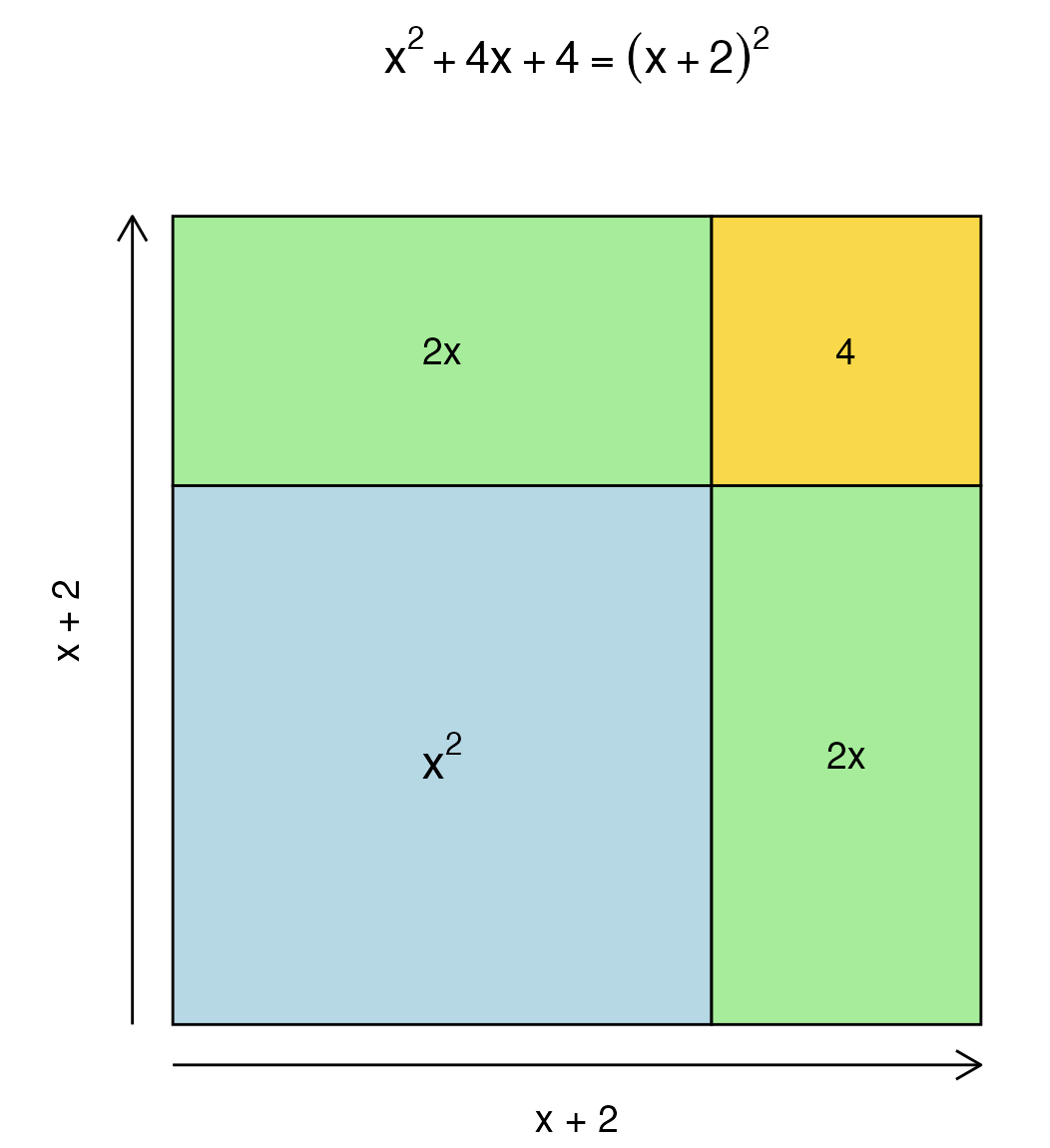
Completing the square rewrites a quadratic so that the \(x\)-portion becomes a perfect square.
For an expression of the form: \[ x^2 + bx, \] you create a perfect square trinomial by adding: \[ \left(\frac{b}{2}\right)^2. \]
General steps for: \[ ax^2 + bx + c \]
- Factor out \(a\) from \(x^2\) and \(x\) terms (if \(a \ne 1\)).
- Take half of the coefficient of \(x\), square it, and add/subtract inside the parentheses.
- Rewrite the trinomial as a perfect square \((x - h)^2\) (or \((x + h)^2\)).
- Adjust the constants outside the parentheses to keep the expression equivalent.
Common Problem Types
1. Rewriting to Vertex Form
Turn a standard-form quadratic into \((x - h)^2 + k\).
2. Solving Equations
Complete the square and then take square roots.
3. Recognizing Perfect Squares
Sometimes the left side is already a perfect square—just identify it.
4. Handling \(a \ne 1\)
Factor out the leading coefficient before completing the square.
Strategies
- Always group \(x^2\) and \(x\) terms first.
- Compute \(\left(\frac{b}{2}\right)^2\) carefully—sign errors are common.
- If solving, add the square term to both sides to keep the equation balanced.
- Once in the form \((x - h)^2 = k\), take the square root and solve for \(x\).
- Use vertex form to read the vertex quickly: \((h, k)\).
Worked Examples
Example 1 — Rewrite in Vertex Form (a = 1)
Rewrite: \[ f(x) = x^2 - 4x + 1 \]
Solution:
Group \(x\)-terms: \[ f(x) = x^2 - 4x + 1 \]
Half of \(-4\) is \(-2\); square it: \((-2)^2 = 4\)
Add and subtract 4: \[ f(x) = (x^2 - 4x + 4) - 4 + 1 \]
Perfect square: \[ x^2 - 4x + 4 = (x - 2)^2 \]
Simplify constants: \(-4 + 1 = -3\)
Final: \[ f(x) = (x - 2)^2 - 3 \]
Vertex: \((2, -3)\)
Example 2 — Solve by Completing the Square
Solve: \[ x^2 + 6x + 1 = 0 \]
Solution:
Move constant: \[ x^2 + 6x = -1 \]
Half of 6 is 3; square it: \(9\)
Add 9 to both sides: \[ x^2 + 6x + 9 = 8 \]
Square form: \[ (x + 3)^2 = 8 \]
Square root: \[ x + 3 = \pm \sqrt{8} = \pm 2\sqrt{2} \]
Solve: \[ x = -3 \pm 2\sqrt{2} \]
- Forgetting to add the square term to both sides when solving.
- Using the wrong value for \(\left(\frac{b}{2}\right)^2\).
- Not factoring out the leading coefficient when \(a \ne 1\).
Practice Problems
- Rewrite \(f(x) = x^2 + 8x + 3\) in vertex form.
- Rewrite \(f(x) = x^2 - 10x + 1\) in vertex form.
- Solve by completing the square: \(x^2 + 4x - 5 = 0\).
- Solve: \(x^2 - 2x + 1 = 9\).
- Find the vertex of \(f(x) = x^2 + 6x + 2\).
1.
Half of 8 → 4; \(4^2 = 16\)
\(x^2 + 8x + 16 - 16 + 3\)
\((x + 4)^2 - 13\)
Vertex: \((-4, -13)\)
2.
Half of \(-10\) → \(-5\); \((-5)^2 = 25\)
\(x^2 - 10x + 25 - 25 + 1\)
\((x - 5)^2 - 24\)
Vertex: \((5, -24)\)
3.
\(x^2 + 4x = 5\)
Half of 4 → 2; \(2^2 = 4\)
\(x^2 + 4x + 4 = 9\)
\((x + 2)^2 = 9\)
\(x + 2 = \pm 3\)
\(x = 1\) or \(x = -5\)
4.
\((x - 1)^2 = 9\)
\(x - 1 = \pm 3\)
\(x = 4\) or \(x = -2\)
5.
Half of 6 → 3; \(3^2 = 9\)
\(x^2 + 6x + 9 - 7\)
Vertex form: \((x + 3)^2 - 7\)
Vertex: \((-3, -7)\)
Summary
- Completing the square rewrites a quadratic into a perfect square form.
- For \(x^2 + bx\), add \(\left(\frac{b}{2}\right)^2\) to form a square.
- Use the method to rewrite into vertex form or solve equations.
- Vertex form \((x - h)^2 + k\) gives the vertex immediately.
- Always group \(x^2\) and \(x\) first.
- Compute \(\left(\frac{b}{2}\right)^2\) carefully—signs matter.
- If solving, remember to add the square term to both sides.
- Vertex form makes transformations and graphing much easier.