Factoring Quadratics
By the end of this lesson, you’ll be able to:
- Factor quadratic trinomials of the form \(x^2 + bx + c\).
- Factor general quadratics \(ax^2 + bx + c\) where \(a \ne 1\).
- Recognize and factor special patterns like perfect square trinomials and differences of squares.
Key Ideas
Factoring rewrites a quadratic into a product of two binomials:
\[ ax^2 + bx + c = (px + q)(rx + s). \]
For quadratics with leading coefficient 1:
- Find two numbers that multiply to \(c\) and add to \(b\).
Before factoring, always check for a GCF (greatest common factor).
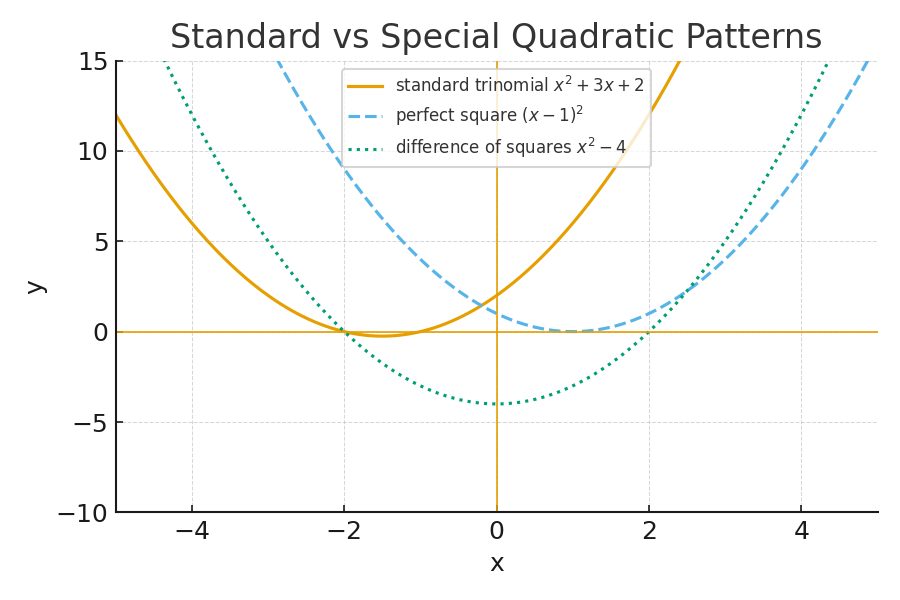
Special patterns to recognize:
Perfect square trinomial
\[ x^2 + 2ax + a^2 = (x + a)^2 \]Difference of squares
\[ A^2 - B^2 = (A - B)(A + B) \]
Common Problem Types
1. Trinomials with \(a = 1\)
Find two numbers whose product is \(c\) and sum is \(b\).
2. Trinomials with \(a \ne 1\)
Use the AC method or structured factoring to break apart the middle term.
3. Special Patterns
Recognize perfect square trinomials and differences of squares instantly.
4. Factoring Out GCF
Always simplify before applying any other method.
Strategies
- Start by factoring out the GCF; it simplifies everything.
- For \(a = 1\), build factor pairs of \(c\) and test sums.
- For \(a \ne 1\), use the AC method to avoid guesswork.
- After factoring, you can expand quickly to check your work.
- Look for special patterns—they save major time.
Worked Examples
Example 1 — Simple Trinomial
Factor: \[ x^2 + 7x + 12 \]
Solution:
We need numbers that multiply to \(12\) and add to \(7\):
- \(3 \cdot 4 = 12\) and \(3 + 4 = 7\).
So:
\[ x^2 + 7x + 12 = (x + 3)(x + 4) \]
Example 2 — Leading Coefficient Not 1
Factor: \[ 2x^2 + 7x + 3 \]
Solution (AC method):
- Compute \(ac = 2 \cdot 3 = 6\).
- Find numbers multiplying to \(6\) and adding to \(7\): \(1\) and \(6\).
- Rewrite the middle term: \[ 2x^2 + x + 6x + 3 \]
- Group: \[ (2x^2 + x) + (6x + 3) \]
- Factor each group:
- \(x(2x + 1)\)
- \(3(2x + 1)\)
- \(x(2x + 1)\)
- Factor out \((2x + 1)\):
\[ (2x + 1)(x + 3) \]
Example 3 — Difference of Squares
Factor: \[ 9x^2 - 16 \]
Recognize:
- \(9x^2 = (3x)^2\)
- \(16 = 4^2\)
Use the pattern:
\[ A^2 - B^2 = (A - B)(A + B) \]
So:
\[ (3x - 4)(3x + 4) \]
- Forgetting to factor out a GCF before attempting other methods.
- Mixing up signs—always check by expanding your result.
- Trying to factor expressions like \(a^2 + b^2\) (not factorable over the reals).
Practice Problems
- Factor: \(x^2 + 5x + 6\)
- Factor: \(x^2 - 9x + 14\)
- Factor: \(3x^2 + 11x + 6\)
- Factor: \(4x^2 - 25\)
- Factor completely: \(2x^2 - 8x\)
1.
Numbers multiplying to \(6\) and adding to \(5\): \(2\) and \(3\).
So: \((x + 2)(x + 3)\)
2.
Two numbers multiply to \(14\) and add to \(-9\): \(-7\) and \(-2\).
So: \((x - 7)(x - 2)\)
3.
AC = \(18\). Numbers: \(2\) and \(9\).
Rewrite: \(3x^2 + 2x + 9x + 6\)
Group: \((3x^2 + 2x) + (9x + 6)\)
Factor: \(x(3x + 2) + 3(3x + 2)\)
Final: \((3x + 2)(x + 3)\)
4.
Difference of squares: \((2x)^2 - 5^2\)
So: \((2x - 5)(2x + 5)\)
5.
Factor GCF first: \(2x(x - 4)\)
Linear inside—done.
Summary
- To factor \(x^2 + bx + c\), find two numbers that multiply to \(c\) and add to \(b\).
- For \(ax^2 + bx + c\) with \(a \ne 1\), break apart the middle term using the AC method.
- Special patterns like perfect squares and differences of squares factor instantly.
- Check by expanding—if you get the original expression, you’re correct.
- Always factor out the GCF first—it simplifies everything.
- For trinomials with leading coefficient 1, build factor pairs of \(c\) quickly.
- Memorize the perfect square and difference-of-squares patterns.
- If stuck, expand your factors to check—they should match the original.