Zero Product Property & Roots
By the end of this lesson, you’ll be able to:
- Use the zero product property to solve factored quadratic equations.
- Connect solutions (roots) to \(x\)-intercepts on the graph.
- Recognize repeated factors and understand multiplicity.
Key Ideas
The Zero Product Property says:
If \(AB = 0\), then \(A = 0\) or \(B = 0\) (or both).
For a factored quadratic: \[ a(x - r_1)(x - r_2) = 0, \] the solutions are: \[ x = r_1, \quad x = r_2. \]
These solutions correspond to:
- roots
- zeros
- solutions
- \(x\)-intercepts of the graph
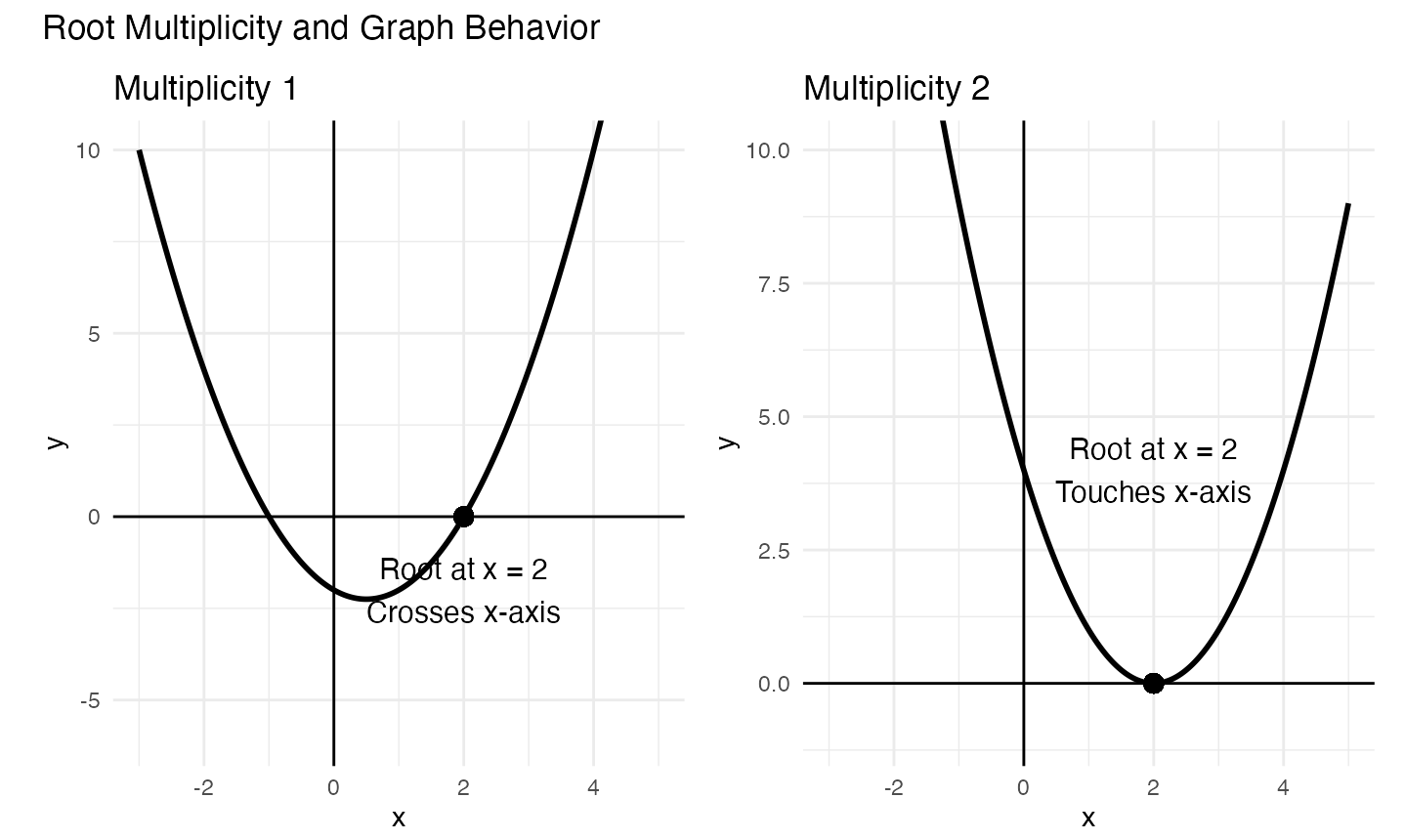
If a factor repeats, like \((x - r)^2\), the root has multiplicity 2, and the graph touches the \(x\)-axis instead of crossing.
Common Problem Types
1. Solve Already-Factored Quadratics
Set each factor equal to zero.
2. Factor First, Then Solve
Useful when the quadratic is expanded.
3. Repeated Roots
When a factor appears more than once, the solution repeats (multiplicity).
4. Difference of Squares
Use \(A^2 - B^2 = (A - B)(A + B)\) before solving.
Strategies
- Always check if the equation is already factored—if not, factor first.
- Set each factor equal to zero and solve.
- Look for special factoring patterns (GCF, difference of squares).
- After solving, connect results to the graph: do the \(x\)-intercepts match?
- Expand your factors mentally if unsure—quick check for correctness.
Worked Examples
Example 1 — Solve a Factored Equation
Solve: \[ (x - 3)(x + 5) = 0 \]
Solution:
Set each factor equal to zero:
- \(x - 3 = 0 \Rightarrow x = 3\)
- \(x + 5 = 0 \Rightarrow x = -5\)
Solutions: \(x = 3,\,-5\)
Example 2 — Factor Then Solve
Solve: \[ x^2 - x - 6 = 0 \]
Solution:
- Factor: numbers that multiply to \(-6\) and add to \(-1\) → \(-3\) and \(2\).
\[ (x - 3)(x + 2) = 0 \] - Set each equal to 0:
- \(x = 3\)
- \(x = -2\)
- \(x = 3\)
Solutions: \(x = 3,\,-2\)
Example 3 — Repeated Root (Multiplicity)
Solve: \[ (x + 4)^2 = 0 \]
Solution:
\((x + 4)^2 = (x + 4)(x + 4)\)
Set one factor equal to zero: \[ x + 4 = 0 \Rightarrow x = -4 \]
This root has multiplicity 2.
Graphically: the parabola touches the \(x\)-axis at \(x = -4\).
- Dividing by a factor instead of setting it equal to zero.
- Forgetting one factor, leading to missing a solution.
- Not factoring completely before applying the zero product property.
Practice Problems
- Solve: \((x + 1)(x - 4) = 0\)
- Solve: \(x^2 + 5x + 6 = 0\)
- Solve: \(2x^2 - 8x = 0\)
- Solve: \((3x - 2)^2 = 0\)
- Solve: \(x^2 - 9 = 0\)
1.
\(x + 1 = 0 \Rightarrow x = -1\)
\(x - 4 = 0 \Rightarrow x = 4\)
Solutions: \(x = -1,\,4\)
2.
Factor: \((x + 2)(x + 3)\)
Solutions: \(x = -2,\,-3\)
3.
Factor GCF: \(2x(x - 4) = 0\)
Solutions: \(x = 0,\,4\)
4.
\((3x - 2)^2 = 0 \Rightarrow 3x - 2 = 0\)
\(x = \frac{2}{3}\) (multiplicity 2)
5.
Difference of squares: \((x - 3)(x + 3) = 0\)
Solutions: \(x = 3,\,-3\)
Summary
- Use the zero product property by setting each factor equal to zero.
- Factoring is the essential first step unless the equation is already factored.
- Each factor gives a solution; repeated factors create repeated roots.
- Roots correspond directly to the graph’s \(x\)-intercepts.
- If it’s factored, set each factor equal to zero—done.
- If it’s not factored, factor completely before solving.
- Look for patterns: GCF, trinomials, difference of squares.
- Repeated factors mean the graph touches (not crosses) the axis.