SAT Math Cheat Sheet
Essential Geometry, Algebra, and Data Formulas
This page summarizes the must-know formulas for the SAT Math test.
The SAT provides a few formulas at the beginning of each math module, but many others are not provided and must be memorized.
Use this as a quick reference throughout your prep.
Geometry & Trigonometry
SAT Reference Sheet (Provided on Test Day)
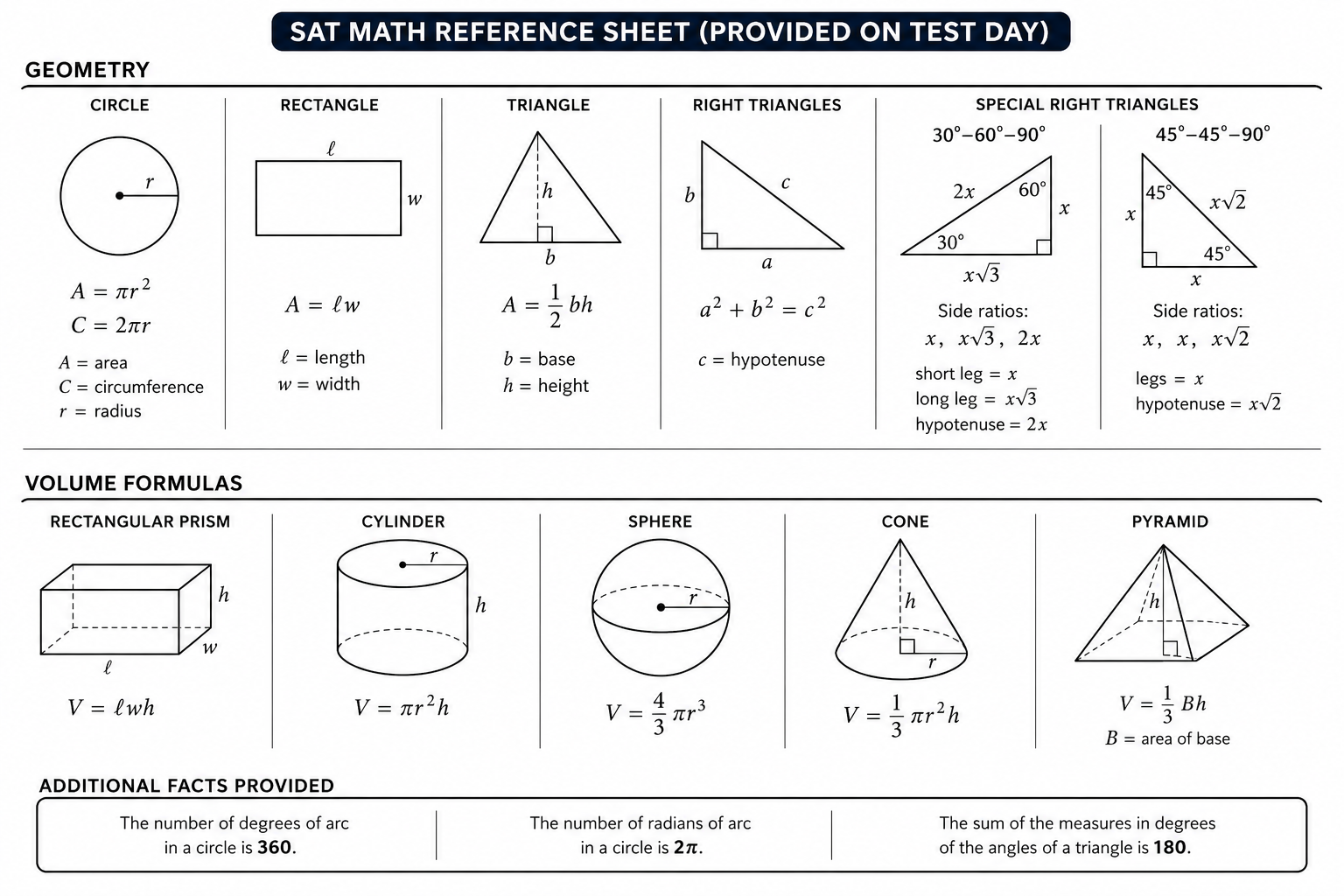
The formulas above are provided by the SAT at the beginning of each math module.
Special Right Triangles
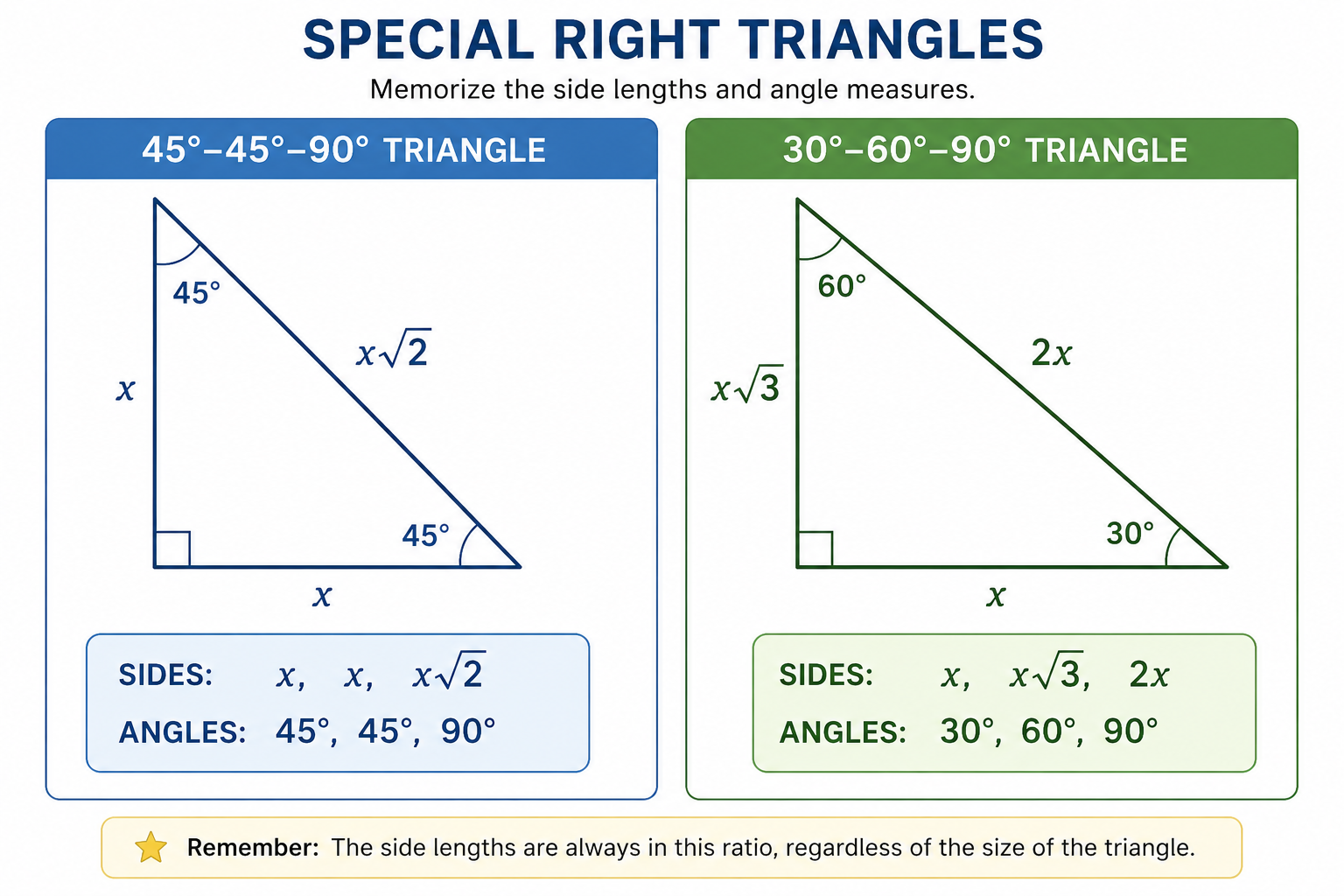
The SAT reference sheet includes formulas related to these triangles, but it is still helpful to memorize their side ratios.
45°-45°-90°
Sides are:
\[ x,\ x,\ x\sqrt{2} \]
30°-60°-90°
Sides are:
\[ x,\ x\sqrt{3},\ 2x \]
Circles — Arcs & Sectors
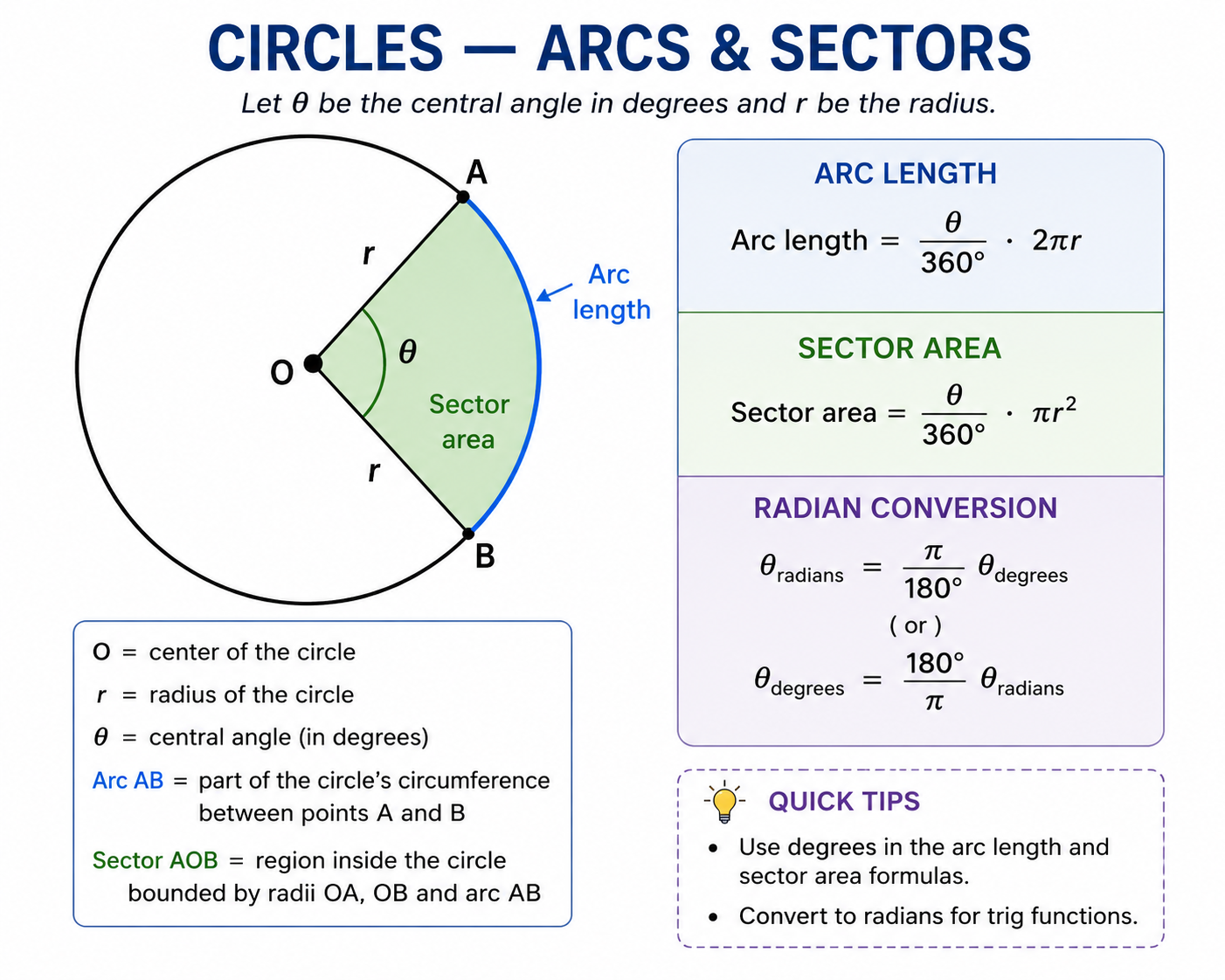
Arc Length
\[ \text{Arc Length} = \frac{\theta}{360^\circ} \cdot 2\pi r \]
Sector Area
\[ \text{Sector Area} = \frac{\theta}{360^\circ} \cdot \pi r^2 \]
Radian Conversion
\[ \theta_{\text{radians}} = \frac{\pi}{180^\circ} \theta_{\text{degrees}} \]
\[ \theta_{\text{degrees}} = \frac{180^\circ}{\pi} \theta_{\text{radians}} \]
Polygon Angle Sums
Interior Angle Sum
\[ (n-2)180^\circ \]
where \(n\) is the number of sides.
Interior Angle of a Regular Polygon
\[ \frac{(n-2)180^\circ}{n} \]
Surface Area Formulas
The SAT reference sheet provides volume formulas but not surface area formulas.
Cube
\[ SA = 6s^2 \]
Rectangular Prism
\[ SA = 2lw + 2lh + 2wh \]
Cylinder
\[ SA = 2\pi r^2 + 2\pi rh \]
Sphere
\[ SA = 4\pi r^2 \]
Coordinate Geometry
Distance Formula
\[ d = \sqrt{ (x_2-x_1)^2 + (y_2-y_1)^2 } \]
Midpoint Formula
\[ \left( \frac{x_1+x_2}{2}, \frac{y_1+y_2}{2} \right) \]
Circle Equation
\[ (x-h)^2+(y-k)^2=r^2 \]
where:
- \((h,k)\) is the center
- \(r\) is the radius
Trigonometry
SOH-CAH-TOA
\[ \sin(\theta) = \frac{\text{opposite}} {\text{hypotenuse}} \]
\[ \cos(\theta) = \frac{\text{adjacent}} {\text{hypotenuse}} \]
\[ \tan(\theta) = \frac{\text{opposite}} {\text{adjacent}} \]
Unit Circle
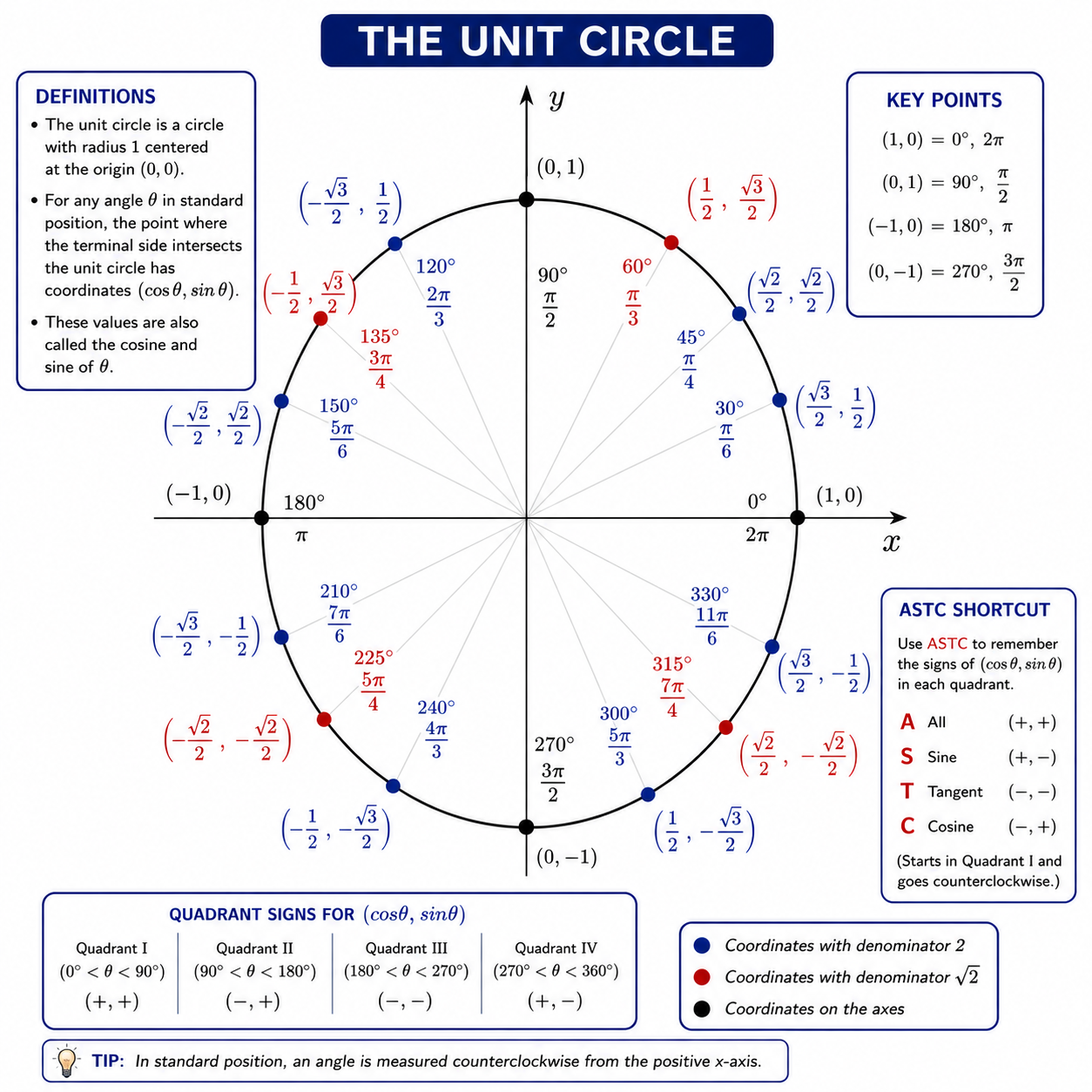
The coordinates on the unit circle are:
\[ (\cos\theta,\sin\theta) \]
Use the ASTC shortcut to remember which trig function is positive in each quadrant:
- Quadrant I: All positive
- Quadrant II: Sine positive
- Quadrant III: Tangent positive
- Quadrant IV: Cosine positive
Helpful Geometry Facts
- Sum of angles in a triangle: \(180^\circ\)
- Sum of angles in a quadrilateral: \(360^\circ\)
- Parallel lines have equal slopes.
- Perpendicular lines have slopes that are negative reciprocals.
Algebra & Functions
Slope & Lines
Slope Formula
\[ m=\frac{y_2-y_1}{x_2-x_1} \]
Slope-Intercept Form
\[ y=mx+b \]
Point-Slope Form
\[ y-y_1=m(x-x_1) \]
Standard Form
\[ Ax+By=C \]
Slope Relationships
- Parallel lines have the same slope.
- Perpendicular lines have slopes that are negative reciprocals.
Functions
Function Notation
\[ y=f(x) \]
A function assigns exactly one output to each input.
Example:
\[ f(x)=2x+3 \]
Then:
\[ f(4)=11 \]
Function Transformations
| Transformation | Effect on Graph |
|---|---|
| \(f(x)+k\) | Shift up \(k\) units |
| \(f(x)-k\) | Shift down \(k\) units |
| \(f(x-h)\) | Shift right \(h\) units |
| \(f(x+h)\) | Shift left \(h\) units |
| \(-f(x)\) | Reflect across the \(x\)-axis |
| \(f(-x)\) | Reflect across the \(y\)-axis |
| \(af(x)\) | Vertical stretch by factor \(a\) if \(a>1\) |
| \(af(x)\) | Vertical compression if \(0<a<1\) |
| \(f(bx)\) | Horizontal compression if \(b>1\) |
| \(f(bx)\) | Horizontal stretch by factor \(\frac{1}{b}\) if \(0<b<1\) |
Common SAT Traps
- \(f(x-h)\) shifts right, not left.
- \(f(x+h)\) shifts left, not right.
- \(f(bx)\) affects the graph horizontally.
- \(af(x)\) affects the graph vertically.
General Transformation Form
\[ g(x)=a\,f(b(x-h))+k \]
Function Composition
\[ (f\circ g)(x)=f(g(x)) \]
To compose functions:
- Evaluate the inside function first.
- Substitute the result into the outside function.
Example:
\[ f(x)=2x+1 \]
\[ g(x)=x^2 \]
Then:
\[ (f\circ g)(x) = f(x^2) = 2x^2+1 \]
Inverse Functions
An inverse function reverses the effect of a function.
Notation:
\[ f^{-1}(x) \]
Finding an Inverse
- Replace \(f(x)\) with \(y\).
- Swap \(x\) and \(y\).
- Solve for \(y\).
Example:
\[ y=2x+3 \]
Swap:
\[ x=2y+3 \]
Solve:
\[ y=\frac{x-3}{2} \]
Therefore:
\[ f^{-1}(x)=\frac{x-3}{2} \]
Exponents & Radicals
| Rule | Formula |
|---|---|
| Product Rule | \(a^m \cdot a^n = a^{m+n}\) |
| Quotient Rule | \(\frac{a^m}{a^n}=a^{m-n}\) |
| Power Rule | \((a^m)^n=a^{mn}\) |
| Negative Exponent | \(a^{-n}=\frac{1}{a^n}\) |
| Zero Exponent | \(a^0=1\) |
| Rational Exponent | \(a^{m/n}=\sqrt[n]{a^m}\) |
Scientific Notation
\[ a\times10^n \]
where
\[ 1\le a<10 \]
Exponential Growth & Decay
General Form
\[ y=a(b)^t \]
Percent Growth
\[ b=1+r \]
Percent Decay
\[ b=1-r \]
Compound Interest
\[ A=P\left(1+\frac{r}{n}\right)^{nt} \]
where:
- \(P\) = principal
- \(r\) = annual interest rate
- \(n\) = number of compounding periods per year
- \(t\) = time in years
Quadratics
Standard Form
\[ y=ax^2+bx+c \]
Vertex Form
\[ y=a(x-h)^2+k \]
Vertex Formula
\[ h=-\frac{b}{2a} \]
Vertex Coordinates
\[ \left( -\frac{b}{2a}, f\!\left(-\frac{b}{2a}\right) \right) \]
Quadratic Formula
\[ x= \frac{-b\pm\sqrt{b^2-4ac}} {2a} \]
Discriminant
\[ b^2-4ac \]
- Positive → two real roots
- Zero → one real root
- Negative → no real roots
Data Analysis & Statistics
Mean (Average)
\[ \text{mean} = \frac{\text{sum of terms}}{\text{number of terms}} \]
Weighted Mean
\[ \text{weighted mean} = \frac{\sum (w_i \cdot x_i)}{\sum w_i} \]
Percent Change
\[ \frac{\text{new} - \text{old}}{\text{old}} \times 100\% \]
Probability
\[ P = \frac{\text{favorable}}{\text{total}} \]
Conditional Probability
\[ P(A \mid B) = \frac{P(A \text{ and } B)}{P(B)} \]
Union Rule
\[ P(A \text{ or } B) = P(A)+P(B)-P(A \text{ and } B) \]
Independent Events
\[ P(A \text{ and } B) = P(A)P(B) \]
when events are independent.
Quick Reminder
- and → multiply (for independent events)
- or → add (then subtract overlap)
Counting Principles
Counting questions are less common on the SAT, but these formulas can be useful when outcomes must be arranged or selected.
Fundamental Counting Principle
If one choice can happen in \(m\) ways and another independent choice can happen in \(n\) ways, then the two choices together can happen in:
\[ m \cdot n \]
ways.
Permutations
Use permutations when order matters.
\[ {}_nP_r = \frac{n!}{(n-r)!} \]
where:
- \(n\) = total number of items
- \(r\) = number of items chosen
- order matters
Combinations
Use combinations when order does not matter.
\[ {}_nC_r = \frac{n!}{r!(n-r)!} \]
where:
- \(n\) = total number of items
- \(r\) = number of items chosen
- order does not matter
Quick Rule
- Order matters → permutation
- Order does not matter → combination
Two-Way Tables
Use two-way tables to organize counts by category.
For conditional probability:
\[ P(A \mid B) = \frac{P(A \text{ and } B)}{P(B)} \]
Ratios, Rates, and Conversions
Ratios
A ratio compares two quantities.
\[ a:b \]
or
\[ \frac{a}{b} \]
Proportions
\[ \frac{a}{b} = \frac{c}{d} \]
Rate (Distance–Time)
\[ d = rt \]
Unit Rate
\[ \frac{a}{b} \rightarrow \text{per 1 unit} \]
Density
\[ \text{density} = \frac{\text{mass}}{\text{volume}} \]
Unit Conversions
Use dimensional analysis:
\[ \text{quantity} \times \frac{\text{desired units}}{\text{given units}} \]
Systems of Equations
Substitution / Elimination
Solve:
\[ \begin{cases} ax + by = c \\ dx + ey = f \end{cases} \]
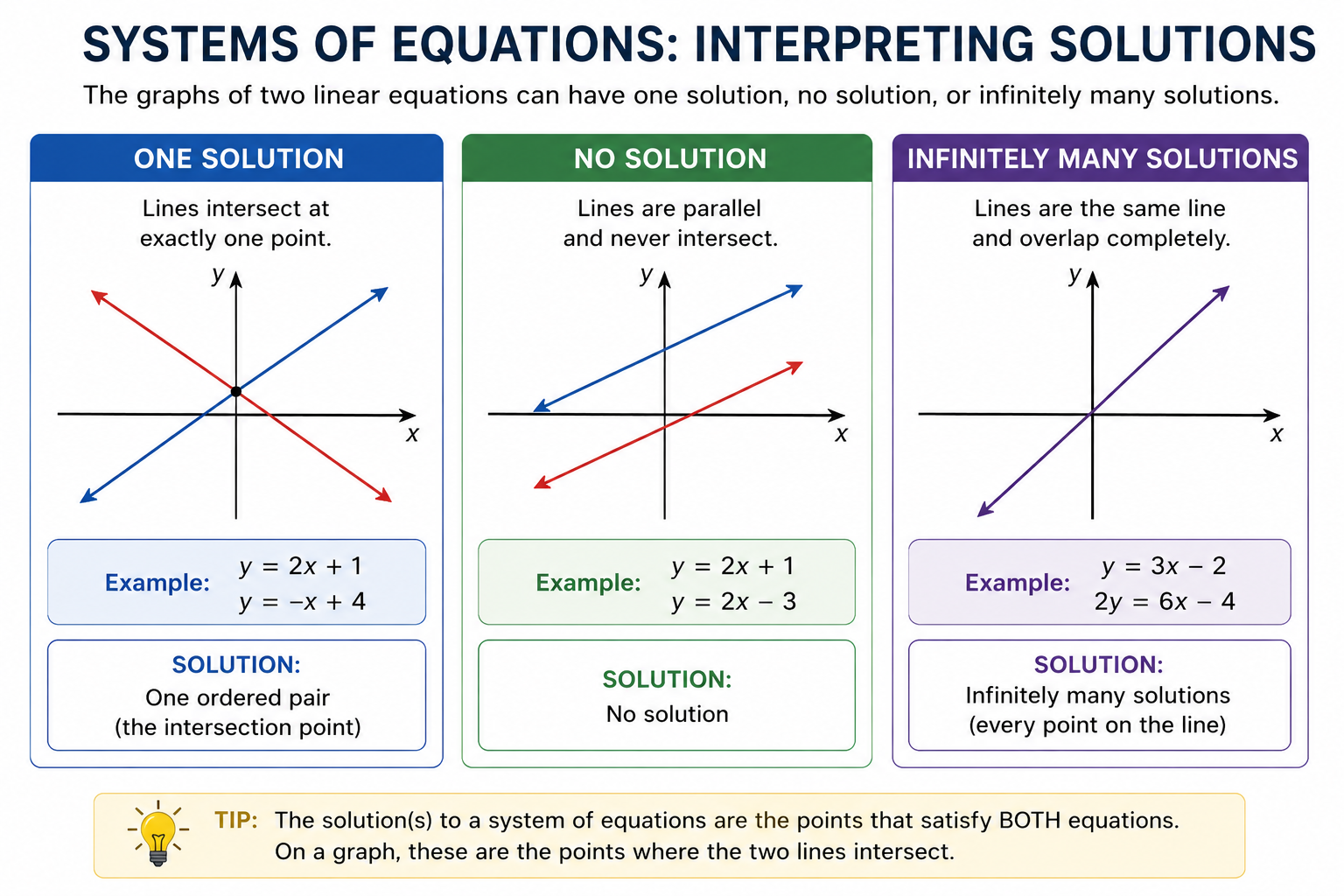
Interpreting Systems
- One solution: lines intersect
- No solution: parallel lines
- Infinite solutions: same line
Inequalities & Systems
Compound Inequalities
“Between”:
\[ a \le x \le b \]
Linear Inequality Graphing
- \(>\) or \(<\) → dashed line
- \(\ge\) or \(\le\) → solid line
- Shade above or below depending on \(y\) compared to \(mx+b\)
Systems of Inequalities
Solution = overlapping shaded region.
Final Tips
- Vertex formula \(h = -\frac{b}{2a}\)
- Quadratic formula
- Slope formula
- Distance & midpoint formulas
- Circle equation
- Exponential growth/decay
- Radian conversions
- Arc length and sector area
- Function transformation rules
- Probability rules
SAT Desmos Quick Wins
| Task | Desmos Strategy |
|---|---|
| Solve an equation | Graph both sides and find the intersection |
| Solve a system | Graph both equations |
| Find a quadratic vertex | Graph the parabola |
| Line of best fit | Use regression |
| Evaluate values quickly | Use a table |
| Check answer choices | Enter and compare expressions |
Common Factoring Patterns
Difference of Squares
\[ a^2-b^2=(a-b)(a+b) \]
Perfect Square Trinomials
\[ (a+b)^2=a^2+2ab+b^2 \]
\[ (a-b)^2=a^2-2ab+b^2 \]