Arcs & Sectors
By the end of this lesson, you’ll be able to:
- Compute arc length from a central angle.
- Compute sector area from a central angle.
- Use proportional reasoning with parts of a circle.
- Solve backward for a central angle from an arc length or sector area.
- Interpret arcs and sectors in geometric and applied contexts.
Key Ideas
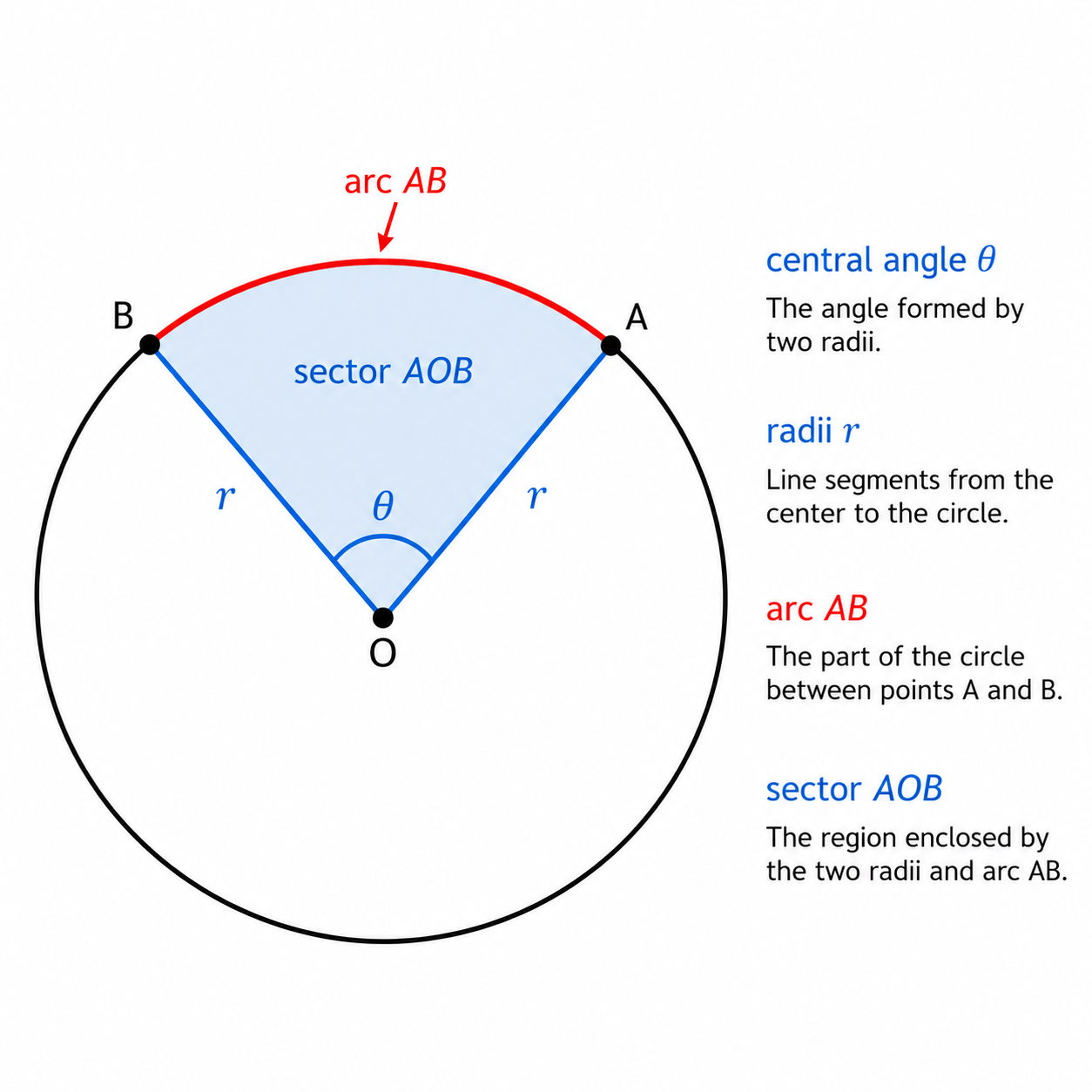
An arc is part of the circumference of a circle.
A sector is the region enclosed by two radii and the arc between them.
The size of both depends on the central angle, \(\theta\).
A full circle measures:
\[ 360^\circ \]
So an angle of \(\theta\) represents the fraction:
\[ \frac{\theta}{360^\circ} \]
of the entire circle.
Arc Length
Arc length is the same fraction of the circumference as the central angle is of \(360^\circ\).
Since:
\[ C=2\pi r \]
the arc-length formula is:
\[ \boxed{ L=\frac{\theta}{360^\circ}\cdot2\pi r } \]
where:
- \(L\) = arc length
- \(\theta\) = central angle
- \(r\) = radius
Sector Area
Sector area is the same fraction of the circle’s total area as the central angle is of \(360^\circ\).
Since:
\[ A=\pi r^2 \]
the sector-area formula is:
\[ \boxed{ A_{\text{sector}} = \frac{\theta}{360^\circ}\cdot\pi r^2 } \]
Both formulas use the same fraction:
\[ \frac{\theta}{360^\circ} \]
The difference is the whole being used:
- Arc length → fraction of the circumference
- Sector area → fraction of the circle’s area
Common Problem Types
1. Finding Arc Length From a Central Angle
Use:
\[ L=\frac{\theta}{360^\circ}\cdot2\pi r \]
For example, suppose:
\[ r=8 \]
and:
\[ \theta=90^\circ \]
A \(90^\circ\) angle is:
\[ \frac{90}{360}=\frac14 \]
of a circle.
The full circumference is:
\[ 2\pi(8)=16\pi \]
So the arc length is:
\[ \frac14(16\pi)=4\pi \]
2. Finding Sector Area From a Central Angle
Use:
\[ A_{\text{sector}} = \frac{\theta}{360^\circ}\cdot\pi r^2 \]
For example, suppose:
\[ r=6 \]
and:
\[ \theta=120^\circ \]
The sector represents:
\[ \frac{120}{360}=\frac13 \]
of the circle.
The total area is:
\[ \pi(6^2)=36\pi \]
So the sector area is:
\[ \frac13(36\pi)=12\pi \]
3. Finding a Central Angle From Arc Length
Sometimes the arc length is known and the angle is missing.
Start with:
\[ L=\frac{\theta}{360^\circ}\cdot2\pi r \]
Then solve for \(\theta\).
For example, if:
\[ L=5\pi \]
and:
\[ r=10 \]
then:
\[ 5\pi = \frac{\theta}{360^\circ}(20\pi) \]
Divide both sides by \(20\pi\):
\[ \frac14 = \frac{\theta}{360^\circ} \]
Multiply by \(360^\circ\):
\[ \theta=90^\circ \]
4. Finding a Central Angle From Sector Area
The same idea works with sector area.
Suppose a circle has radius 6 and a sector has area \(9\pi\).
The total circle area is:
\[ \pi(6^2)=36\pi \]
So the sector is:
\[ \frac{9\pi}{36\pi}=\frac14 \]
of the circle.
Therefore, its central angle is:
\[ \frac14(360^\circ)=90^\circ \]
5. Real-World Applications
Arcs and sectors appear in problems involving:
- pizza slices
- circular tracks
- wheels
- fan blades
- radar sweeps
- rotating objects
- circular gardens
Ask whether the problem is describing:
- a distance along the edge → arc length
- a region inside the circle → sector area
Strategies
- Start by identifying the radius and central angle.
- Think of the angle as a fraction of the full \(360^\circ\) circle.
- For arc length, multiply that fraction by:
\[ 2\pi r \]
- For sector area, multiply that fraction by:
\[ \pi r^2 \]
- Simplify the fraction \(\frac{\theta}{360}\) before multiplying when possible.
- Keep \(\pi\) exact unless a decimal approximation is requested.
- If the arc length or sector area is given, work backward using a proportion.
- Check units: arc length uses ordinary units; sector area uses square units.
Worked Examples
Example 1 — Arc Length
In a circle with radius 12, find the arc length for a central angle of \(45^\circ\).
Use:
\[ L=\frac{\theta}{360^\circ}\cdot2\pi r \]
Substitute:
\[ L = \frac{45}{360}\cdot2\pi(12) \]
Simplify:
\[ \frac{45}{360}=\frac18 \]
and:
\[ 2\pi(12)=24\pi \]
So:
\[ L=\frac18(24\pi) \]
\[ L=3\pi \]
Therefore:
\[ \boxed{3\pi} \]
Example 2 — Sector Area
Find the area of a sector with radius 10 and central angle \(90^\circ\).
Use:
\[ A_{\text{sector}} = \frac{\theta}{360^\circ}\cdot\pi r^2 \]
Substitute:
\[ A_{\text{sector}} = \frac{90}{360}\cdot\pi(10^2) \]
Simplify:
\[ \frac{90}{360}=\frac14 \]
and:
\[ \pi(10^2)=100\pi \]
Therefore:
\[ A_{\text{sector}} = \frac14(100\pi) \]
\[ A_{\text{sector}}=25\pi \]
So:
\[ \boxed{25\pi\text{ square units}} \]
Example 3 — Find the Central Angle From Arc Length
A circle has radius 10 and an arc length of \(5\pi\).
Find the central angle.
Use:
\[ L=\frac{\theta}{360^\circ}\cdot2\pi r \]
Substitute:
\[ 5\pi = \frac{\theta}{360^\circ}\cdot20\pi \]
Divide by \(20\pi\):
\[ \frac14 = \frac{\theta}{360^\circ} \]
Multiply by \(360^\circ\):
\[ \theta=90^\circ \]
Therefore:
\[ \boxed{90^\circ} \]
Example 4 — Find the Central Angle From Sector Area
A circle has radius 8 and a sector area of \(16\pi\).
Find the central angle.
First find the total area of the circle:
\[ A=\pi r^2 \]
\[ A=\pi(8^2)=64\pi \]
The sector occupies:
\[ \frac{16\pi}{64\pi}=\frac14 \]
of the circle.
Therefore, its central angle is:
\[ \frac14(360^\circ)=90^\circ \]
So:
\[ \boxed{90^\circ} \]
- Using circle area when the problem asks for arc length.
- Using circumference when the problem asks for sector area.
- Dividing the central angle by \(180^\circ\) instead of \(360^\circ\).
- Forgetting to square the radius when finding sector area.
- Confusing the radius with the diameter.
- Forgetting that arc length uses ordinary units while sector area uses square units.
- Converting to decimals too early instead of keeping \(\pi\) exact.
Practice Problems
A circle has radius 6 and central angle \(60^\circ\). Find the arc length.
A circle has radius 4 and central angle \(30^\circ\). Find the sector area.
A circle has radius 10 and an arc length of \(5\pi\). Find the central angle.
A circle has radius 6 and a sector area of \(12\pi\). Find the central angle.
1. Use the arc-length formula:
\[ L=\frac{\theta}{360^\circ}\cdot2\pi r \]
Substitute:
\[ L = \frac{60}{360}\cdot2\pi(6) \]
Simplify:
\[ \frac{60}{360}=\frac16 \]
and:
\[ 2\pi(6)=12\pi \]
Therefore:
\[ L=\frac16(12\pi) \]
\[ \boxed{L=2\pi} \]
2. Use the sector-area formula:
\[ A_{\text{sector}} = \frac{\theta}{360^\circ}\cdot\pi r^2 \]
Substitute:
\[ A_{\text{sector}} = \frac{30}{360}\cdot\pi(4^2) \]
Simplify:
\[ \frac{30}{360}=\frac1{12} \]
and:
\[ \pi(4^2)=16\pi \]
So:
\[ A_{\text{sector}} = \frac1{12}(16\pi) \]
\[ A_{\text{sector}} = \frac{4\pi}{3} \]
Therefore:
\[ \boxed{\frac{4\pi}{3}\text{ square units}} \]
3. Use:
\[ L=\frac{\theta}{360^\circ}\cdot2\pi r \]
Substitute:
\[ 5\pi = \frac{\theta}{360^\circ}\cdot20\pi \]
Divide both sides by \(20\pi\):
\[ \frac14 = \frac{\theta}{360^\circ} \]
Multiply by \(360^\circ\):
\[ \boxed{\theta=90^\circ} \]
4. First find the total area of the circle:
\[ A=\pi r^2 \]
\[ A=\pi(6^2)=36\pi \]
The sector area is \(12\pi\), so the sector represents:
\[ \frac{12\pi}{36\pi} = \frac13 \]
of the full circle.
Therefore, the central angle is:
\[ \frac13(360^\circ)=120^\circ \]
So:
\[ \boxed{\theta=120^\circ} \]
Summary
- A central angle of \(\theta\) represents:
\[ \frac{\theta}{360^\circ} \]
of the full circle.
- Arc length is that fraction of the circumference:
\[ L= \frac{\theta}{360^\circ}\cdot2\pi r \]
- Sector area is that fraction of the circle’s area:
\[ A_{\text{sector}} = \frac{\theta}{360^\circ}\cdot\pi r^2 \]
- Arc length measures part of the distance around a circle.
- Sector area measures part of the space inside a circle.
- Arc → think circumference.
- Sector → think area.
- Always compare the central angle with \(360^\circ\).
- \(90^\circ\) → \(\frac14\) of a circle.
- \(180^\circ\) → \(\frac12\) of a circle.
- \(120^\circ\) → \(\frac13\) of a circle.
- \(60^\circ\) → \(\frac16\) of a circle.
- When stuck, use:
\[ \frac{\theta}{360^\circ} = \frac{\text{part}}{\text{whole}} \]