Radians & Unit Circle Basics
By the end of this lesson, you’ll be able to:
- Connect radian measure to arc length on the unit circle.
- Convert between degrees and radians.
- Locate common angles around the unit circle.
- Determine the quadrant in which an angle lies.
- Recognize coterminal angles.
- Use multiples and fractions of \(\pi\) to reason about rotations.
Key Ideas
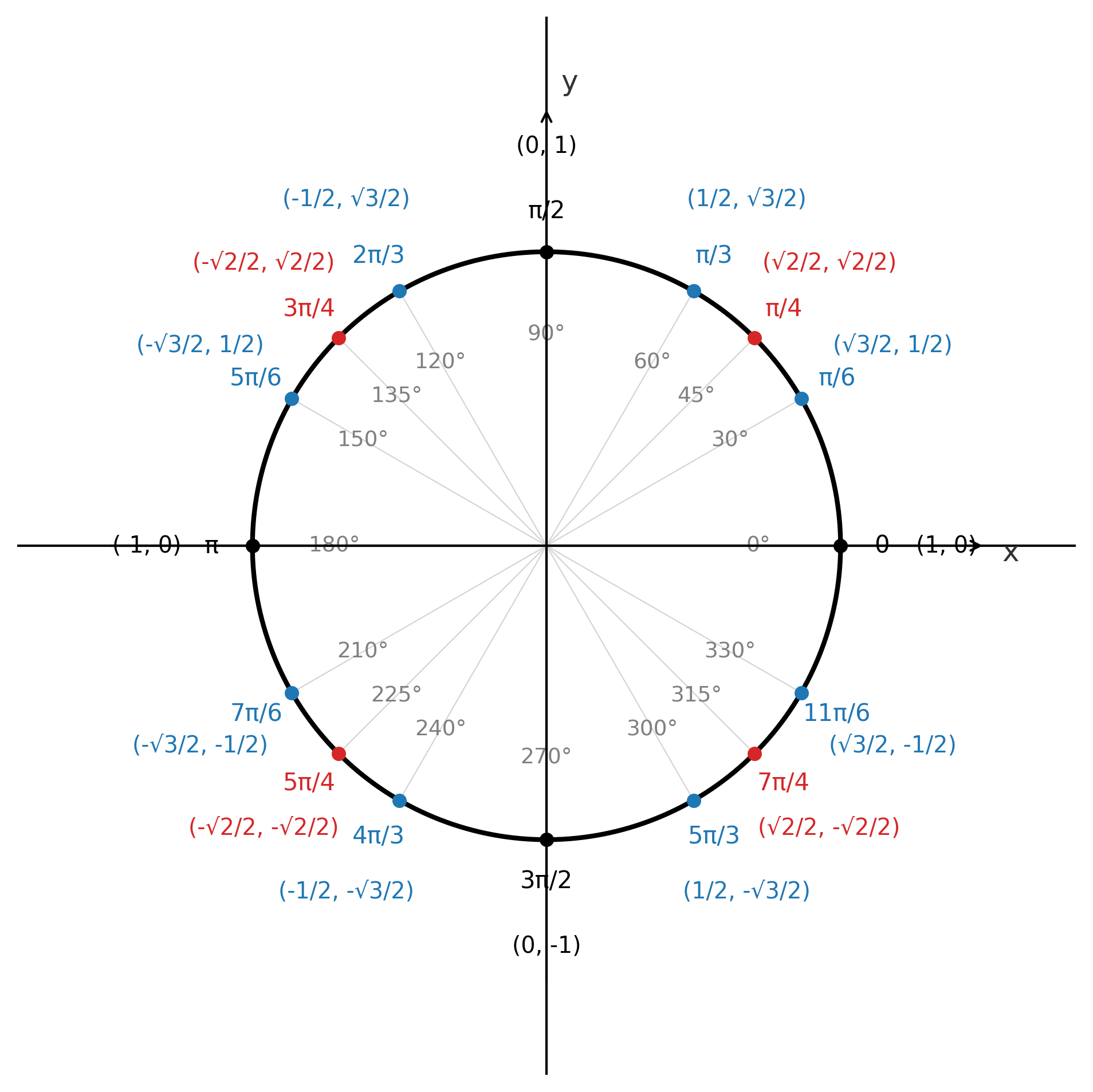
The unit circle is a circle with:
- center \((0,0)\)
- radius \(1\)
Angles on the unit circle are measured starting from the positive \(x\)-axis.
Positive angles rotate counterclockwise.
A full rotation is:
\[ 360^\circ=2\pi \]
A half rotation is:
\[ 180^\circ=\pi \]
A quarter rotation is:
\[ 90^\circ=\frac{\pi}{2} \]
What Is a Radian?
A radian measures an angle using the arc it intercepts on a circle.
In general:
\[ s=r\theta \]
where:
- \(s\) = arc length
- \(r\) = radius
- \(\theta\) = angle in radians
On the unit circle:
\[ r=1 \]
so:
\[ s=(1)\theta \]
Therefore:
\[ \boxed{s=\theta} \]
On the unit circle, the numerical value of the angle in radians equals the length of its intercepted arc.
For example, an angle of:
\[ \frac{\pi}{2} \]
radians intercepts an arc of length:
\[ \frac{\pi}{2} \]
on the unit circle.
Degrees and Radians
The key relationship is:
\[ \boxed{180^\circ=\pi\text{ radians}} \]
Therefore:
\[ 360^\circ=2\pi \]
To convert from degrees to radians, multiply by:
\[ \boxed{\frac{\pi}{180^\circ}} \]
To convert from radians to degrees, multiply by:
\[ \boxed{\frac{180^\circ}{\pi}} \]
Benchmark Angles
These common angles are useful to recognize without converting every time.
| Degrees | Radians |
|---|---|
| \(0^\circ\) | \(0\) |
| \(30^\circ\) | \(\frac{\pi}{6}\) |
| \(45^\circ\) | \(\frac{\pi}{4}\) |
| \(60^\circ\) | \(\frac{\pi}{3}\) |
| \(90^\circ\) | \(\frac{\pi}{2}\) |
| \(120^\circ\) | \(\frac{2\pi}{3}\) |
| \(135^\circ\) | \(\frac{3\pi}{4}\) |
| \(150^\circ\) | \(\frac{5\pi}{6}\) |
| \(180^\circ\) | \(\pi\) |
| \(210^\circ\) | \(\frac{7\pi}{6}\) |
| \(225^\circ\) | \(\frac{5\pi}{4}\) |
| \(240^\circ\) | \(\frac{4\pi}{3}\) |
| \(270^\circ\) | \(\frac{3\pi}{2}\) |
| \(300^\circ\) | \(\frac{5\pi}{3}\) |
| \(315^\circ\) | \(\frac{7\pi}{4}\) |
| \(330^\circ\) | \(\frac{11\pi}{6}\) |
| \(360^\circ\) | \(2\pi\) |
You do not necessarily need to memorize this table all at once.
Instead, use familiar fractions of a full rotation.
For example:
\[ \frac{\pi}{2}=90^\circ \]
so:
\[ \frac{3\pi}{2}=270^\circ \]
Similarly:
\[ \frac{\pi}{4}=45^\circ \]
so:
\[ \frac{5\pi}{4}=225^\circ \]
Quadrants
The coordinate plane divides the unit circle into four quadrants.
The quadrant boundaries occur at:
\[ 0,\quad \frac{\pi}{2},\quad \pi,\quad \frac{3\pi}{2},\quad 2\pi \]
So:
- Quadrant I:
\[ 0<\theta<\frac{\pi}{2} \]
- Quadrant II:
\[ \frac{\pi}{2}<\theta<\pi \]
- Quadrant III:
\[ \pi<\theta<\frac{3\pi}{2} \]
- Quadrant IV:
\[ \frac{3\pi}{2}<\theta<2\pi \]
Angles exactly on the \(x\)- or \(y\)-axis are not inside a quadrant.
For example:
\[ \frac{\pi}{2} \]
lies on the positive \(y\)-axis, not in Quadrant I or II.
Coterminal Angles
Angles that end at the same position on the unit circle are called coterminal angles.
One full rotation is:
\[ 360^\circ \]
or:
\[ 2\pi \]
So adding or subtracting a full rotation produces a coterminal angle.
In degrees:
\[ \theta+360^\circ \]
In radians:
\[ \theta+2\pi \]
More generally:
\[ \boxed{\theta+2\pi n} \]
where \(n\) is any integer.
For example:
\[ \frac{\pi}{3} \]
and:
\[ \frac{\pi}{3}+2\pi = \frac{7\pi}{3} \]
are coterminal.
They end at the same location on the unit circle.
Common Problem Types
1. Converting Degrees to Radians
Multiply by:
\[ \frac{\pi}{180^\circ} \]
For example:
\[ 120^\circ \]
becomes:
\[ 120^\circ \left( \frac{\pi}{180^\circ} \right) \]
Simplify:
\[ \boxed{\frac{2\pi}{3}} \]
2. Converting Radians to Degrees
Multiply by:
\[ \frac{180^\circ}{\pi} \]
For example:
\[ \frac{5\pi}{4} \]
becomes:
\[ \frac{5\pi}{4} \left( \frac{180^\circ}{\pi} \right) \]
Cancel \(\pi\):
\[ \frac{5(180^\circ)}{4} \]
\[ \boxed{225^\circ} \]
3. Identifying the Quadrant
Suppose:
\[ \theta=\frac{5\pi}{6} \]
We know:
\[ \frac{\pi}{2} < \frac{5\pi}{6} < \pi \]
Angles between \(\frac{\pi}{2}\) and \(\pi\) lie in Quadrant II.
Therefore:
\[ \boxed{\text{Quadrant II}} \]
4. Recognizing Axis Angles
Some angles lie directly on an axis.
For example:
\[ \pi=180^\circ \]
This points directly along the negative \(x\)-axis.
Similarly:
\[ \frac{3\pi}{2}=270^\circ \]
points directly along the negative \(y\)-axis.
These angles are not considered to lie within a quadrant.
5. Finding Coterminal Angles
To find a positive coterminal angle, add:
\[ 2\pi \]
For example:
\[ -\frac{\pi}{4} \]
Add one full rotation:
\[ -\frac{\pi}{4}+2\pi \]
Rewrite:
\[ -\frac{\pi}{4}+\frac{8\pi}{4} \]
\[ =\frac{7\pi}{4} \]
Therefore:
\[ \boxed{\frac{7\pi}{4}} \]
is a positive coterminal angle.
6. Using Arc Length on the Unit Circle
In general:
\[ s=r\theta \]
On the unit circle:
\[ r=1 \]
so:
\[ s=\theta \]
If:
\[ \theta=\frac{2\pi}{3} \]
then the intercepted arc length is:
\[ \boxed{\frac{2\pi}{3}} \]
Strategies
- Remember the central conversion:
\[ \boxed{\pi=180^\circ} \]
- Degrees → radians:
\[ \times\frac{\pi}{180^\circ} \]
- Radians → degrees:
\[ \times\frac{180^\circ}{\pi} \]
- Simplify fractions after converting to radians.
- Think of \(\pi\) in terms of rotations:
- \(\frac{\pi}{2}\) → quarter-turn
- \(\pi\) → half-turn
- \(\frac{3\pi}{2}\) → three-quarter-turn
- \(2\pi\) → full turn
- Use the quadrant boundaries to locate unfamiliar angles.
- Add or subtract \(2\pi\) to find coterminal angles.
- If a radian angle is difficult to visualize, temporarily convert it to degrees.
Worked Examples
Example 1 — Degrees to Radians
Convert:
\[ 120^\circ \]
to radians.
Multiply by:
\[ \frac{\pi}{180^\circ} \]
\[ 120^\circ \left( \frac{\pi}{180^\circ} \right) \]
Cancel the degree units:
\[ \frac{120\pi}{180} \]
Simplify:
\[ \boxed{\frac{2\pi}{3}} \]
Example 2 — Radians to Degrees
Convert:
\[ \frac{5\pi}{4} \]
to degrees.
Multiply by:
\[ \frac{180^\circ}{\pi} \]
\[ \frac{5\pi}{4} \left( \frac{180^\circ}{\pi} \right) \]
Cancel \(\pi\):
\[ \frac{5(180^\circ)}{4} \]
\[ =5(45^\circ) \]
\[ \boxed{225^\circ} \]
Example 3 — Identify a Quadrant
Determine the quadrant containing:
\[ \frac{3\pi}{4} \]
Compare with the quadrant boundaries:
\[ \frac{\pi}{2} < \frac{3\pi}{4} < \pi \]
Therefore, the angle lies between \(90^\circ\) and \(180^\circ\).
So:
\[ \boxed{\text{Quadrant II}} \]
Example 4 — Find a Coterminal Angle
Find a positive coterminal angle for:
\[ -\frac{\pi}{3} \]
Add one full rotation:
\[ -\frac{\pi}{3}+2\pi \]
Rewrite:
\[ -\frac{\pi}{3}+\frac{6\pi}{3} \]
\[ =\frac{5\pi}{3} \]
Therefore:
\[ \boxed{\frac{5\pi}{3}} \]
is coterminal with \(-\frac{\pi}{3}\).
Example 5 — Arc Length on the Unit Circle
An angle on the unit circle measures:
\[ \frac{3\pi}{4} \]
radians.
What arc length does it intercept?
Use:
\[ s=r\theta \]
Since the unit circle has:
\[ r=1 \]
we get:
\[ s = 1\left(\frac{3\pi}{4}\right) \]
Therefore:
\[ \boxed{s=\frac{3\pi}{4}} \]
- Forgetting to include \(\pi\) when converting degrees to radians.
- Multiplying by the wrong conversion factor.
- Writing a degree symbol on a radian measure.
- Forgetting to simplify radian fractions.
- Placing an angle in the wrong quadrant.
- Saying an angle on an axis belongs to a quadrant.
- Adding \(\pi\) instead of \(2\pi\) when finding a coterminal angle.
- Forgetting that \(s=\theta\) is true specifically on the unit circle because \(r=1\).
Practice Problems
- Convert:
\[ 210^\circ \]
to radians.
- Convert:
\[ \frac{7\pi}{6} \]
to degrees.
- What quadrant contains:
\[ \frac{3\pi}{4}? \]
- What quadrant contains:
\[ \frac{5\pi}{3}? \]
- Find a positive coterminal angle for:
\[ -\frac{\pi}{2} \]
- An angle on the unit circle measures:
\[ \frac{5\pi}{6} \]
radians. What is the corresponding arc length?
1. Convert degrees to radians by multiplying by:
\[ \frac{\pi}{180^\circ} \]
\[ 210^\circ \left( \frac{\pi}{180^\circ} \right) = \frac{210\pi}{180} \]
Simplify:
\[ \boxed{\frac{7\pi}{6}} \]
2. Convert radians to degrees by multiplying by:
\[ \frac{180^\circ}{\pi} \]
\[ \frac{7\pi}{6} \left( \frac{180^\circ}{\pi} \right) \]
Cancel \(\pi\):
\[ \frac{7(180^\circ)}{6} \]
\[ =7(30^\circ) \]
\[ \boxed{210^\circ} \]
3. Compare:
\[ \frac{\pi}{2} < \frac{3\pi}{4} < \pi \]
Therefore:
\[ \boxed{\text{Quadrant II}} \]
4. Compare:
\[ \frac{3\pi}{2} < \frac{5\pi}{3} < 2\pi \]
Therefore:
\[ \boxed{\text{Quadrant IV}} \]
5. Start with:
\[ -\frac{\pi}{2} \]
Add one full rotation:
\[ -\frac{\pi}{2}+2\pi \]
Rewrite:
\[ -\frac{\pi}{2}+\frac{4\pi}{2} \]
\[ =\frac{3\pi}{2} \]
Therefore:
\[ \boxed{\frac{3\pi}{2}} \]
is a positive coterminal angle.
6. On the unit circle:
\[ r=1 \]
Use:
\[ s=r\theta \]
\[ s = 1\left(\frac{5\pi}{6}\right) \]
Therefore:
\[ \boxed{\frac{5\pi}{6}} \]
Summary
- The unit circle has radius:
\[ 1 \]
- The key degree–radian relationship is:
\[ \boxed{180^\circ=\pi} \]
- Therefore:
\[ 360^\circ=2\pi \]
- Degrees → radians:
\[ \times\frac{\pi}{180^\circ} \]
- Radians → degrees:
\[ \times\frac{180^\circ}{\pi} \]
- On the unit circle:
\[ \boxed{s=\theta} \]
because \(r=1\).
- The quadrant boundaries are:
\[ 0,\quad \frac{\pi}{2},\quad \pi,\quad \frac{3\pi}{2},\quad 2\pi \]
- Coterminal angles differ by whole rotations:
\[ \boxed{\theta+2\pi n} \]
where \(n\) is an integer.
- \(\pi\) → \(180^\circ\)
- \(\frac{\pi}{2}\) → \(90^\circ\)
- \(\frac{\pi}{4}\) → \(45^\circ\)
- \(\frac{\pi}{3}\) → \(60^\circ\)
- \(2\pi\) → \(360^\circ\)
- Positive angles rotate counterclockwise.
- Add or subtract \(2\pi\) for coterminal angles.
- On the unit circle, radian measure = intercepted arc length.